Home > Press > New research unveils graphene 'moth eyes' to power future smart technologies: New ultra-thin, patterned graphene sheets will be essential in designing future technologies such as 'smart wallpaper' and Internet-of-things applications
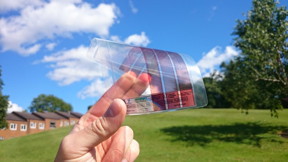 |
| Solar cells operate by absorbing light first, then converting it into electricity. The most efficient cells needs to do this absorption within a very narrow region of the solar cell material. The narrower this region, the better the cell efficiency. The ability to strongly absorb light by these structures could pave the roadmap to higher cell efficiencies. CREDIT: University of Surrey |
Abstract:
• New ultra-thin, patterned graphene sheets will be essential in designing future technologies such as 'smart wallpaper' and internet-of-things applications
• Advanced Technology Institute uses moth-inspired ultrathin graphene sheets to capture light for use in energy production and to power smart sensors
• Graphene is traditionally an excellent electronic material, but is inefficient for optical applications, absorbs only 2.3% of the light incident on it. A new technique enhances light absorption by 90%.
New research unveils graphene 'moth eyes' to power future smart technologies: New ultra-thin, patterned graphene sheets will be essential in designing future technologies such as 'smart wallpaper' and Internet-of-things applications
Surrey, UK | Posted on March 1st, 2016New research published today in Science Advances has shown how graphene can be manipulated to create the most light-absorbent material for its weight, to date. This nanometre-thin material will enable future applications such as 'smart wallpaper' that could generate electricity from waste light or heat, and power a host of applications within the growing 'internet of things'.
Using a technique known as nanotexturing, which involves growing graphene around a textured metallic surface, researchers from the University of Surrey's Advanced Technology Institute took inspiration from nature to create ultra-thin graphene sheets designed to more effectively capture light. Just one atom thick, graphene is very strong but traditionally inefficient at light absorption. To combat this, the team used the nano-patterning to localise light into the narrow spaces between the textured surface, enhancing the amount of light absorbed by the material by about 90%.
"Nature has evolved simple yet powerful adaptations, from which we have taken inspiration in order to answer challenges of future technologies," explained Professor Ravi Silva, Head of the Advanced Technology Institute.
"Moths' eyes have microscopic patterning that allows them to see in the dimmest conditions. These work by channelling light towards the middle of the eye, with the added benefit of eliminating reflections, which would otherwise alert predators of their location. We have used the same technique to make an amazingly thin, efficient, light-absorbent material by patterning graphene in a similar fashion."
Graphene has already been noted for its remarkable electrical conductivity and mechanical strength. Professor Ravi's team understood that for graphene's potential to be realised as material for future applications, it should also harness light and heat effectively.
Professor Silva commented: "Solar cells coated with this material would be able to harvest very dim light. Installed indoors, as part of future 'smart wallpaper' or 'smart windows', this material could generate electricity from waste light or heat, powering a numerous array of smart applications. New types of sensors and energy harvesters connected through the Internet of Things would also benefit from this type of coating."
Dr José Anguita of the University of Surrey and lead author of the paper commented: "As a result of its thinness, graphene is only able to absorb a small percentage of the light that falls on it. For this reason, it is not suitable for the kinds of optoelectronic technologies our 'smart' future will demand."
"Nanotexturing graphene has the effect of channelling the light into the narrow spaces between nanostructures, thereby enhancing the amount of light absorbed by the material. It is now possible to observe strong light absorption from even nanometre-thin films. Typically a graphene sheet would have 2-3% light absorption. Using this method, our ultrathin coating of nanotextured few-layer graphene absorbs 95% of incident light across a broad spectrum, from the UV to the infrared."
Professor Ravi Silva noted: "The next step is to incorporate this material in a variety of existing and emerging technologies. We are very excited about the potential to exploit this material in existing optical devices for performance enhancement, whilst looking towards new applications. Through Surrey's EPSRC funded Graphene Centre, we are looking for industry partners to exploit this technology and are keen to hear from innovative companies who we can explore the future applications of this technology with us."
The Surrey team developed this technology in cooperation with BAE Systems for infrared imaging in opto-MEMs devices.
####
For more information, please click here
Contacts:
Amy Sutton
44-014-836-86141
Copyright © University of Surrey
If you have a comment, please Contact us.Issuers of news releases, not 7th Wave, Inc. or Nanotechnology Now, are solely responsible for the accuracy of the content.
Bookmark:


| Related News Press |
News and information
 Quantum computer improves AI predictions April 17th, 2026
Flexible sensor gains sensitivity under pressure April 17th, 2026
A reusable chip for particulate matter sensing April 17th, 2026
Detecting vibrational quantum beating in the predissociation dynamics of SF6 using time-resolved photoelectron spectroscopy April 17th, 2026
Graphene/ Graphite
Electrifying results shed light on graphene foam as a potential material for lab grown cartilage June 6th, 2025
Breakthrough in proton barrier films using pore-free graphene oxide: Kumamoto University researchers achieve new milestone in advanced coating technologies September 13th, 2024
NRL discovers two-dimensional waveguides February 16th, 2024
Internet-of-Things
Nanofibrous metal oxide semiconductor for sensory face November 8th, 2024
Govt.-Legislation/Regulation/Funding/Policy
Quantum computer improves AI predictions April 17th, 2026
Metasurfaces smooth light to boost magnetic sensing precision January 30th, 2026
New imaging approach transforms study of bacterial biofilms August 8th, 2025
Possible Futures
A fundamentally new therapeutic approach to cystic fibrosis: Nanobody repairs cellular defect April 17th, 2026
UC Irvine physicists discover method to reverse ‘quantum scrambling’ : The work addresses the problem of information loss in quantum computing system April 17th, 2026
MEMS
Sensors
Flexible sensor gains sensitivity under pressure April 17th, 2026
Tiny nanosheets, big leap: A new sensor detects ethanol at ultra-low levels January 30th, 2026
From sensors to smart systems: the rise of AI-driven photonic noses January 30th, 2026
Sensors innovations for smart lithium-based batteries: advancements, opportunities, and potential challenges August 8th, 2025
Discoveries
Quantum computer improves AI predictions April 17th, 2026
Flexible sensor gains sensitivity under pressure April 17th, 2026
A reusable chip for particulate matter sensing April 17th, 2026
Detecting vibrational quantum beating in the predissociation dynamics of SF6 using time-resolved photoelectron spectroscopy April 17th, 2026
Materials/Metamaterials/Magnetoresistance
First real-time observation of two-dimensional melting process: Researchers at Mainz University unveil new insights into magnetic vortex structures August 8th, 2025
Researchers unveil a groundbreaking clay-based solution to capture carbon dioxide and combat climate change June 6th, 2025
A 1960s idea inspires NBI researchers to study hitherto inaccessible quantum states June 6th, 2025
Institute for Nanoscience hosts annual proposal planning meeting May 16th, 2025
Announcements
A fundamentally new therapeutic approach to cystic fibrosis: Nanobody repairs cellular defect April 17th, 2026
UC Irvine physicists discover method to reverse ‘quantum scrambling’ : The work addresses the problem of information loss in quantum computing system April 17th, 2026
Interviews/Book Reviews/Essays/Reports/Podcasts/Journals/White papers/Posters
A fundamentally new therapeutic approach to cystic fibrosis: Nanobody repairs cellular defect April 17th, 2026
UC Irvine physicists discover method to reverse ‘quantum scrambling’ : The work addresses the problem of information loss in quantum computing system April 17th, 2026
Energy
Sensors innovations for smart lithium-based batteries: advancements, opportunities, and potential challenges August 8th, 2025
Simple algorithm paired with standard imaging tool could predict failure in lithium metal batteries August 8th, 2025
Home
Nanomaterials enable dual-mode heating and cooling device: Device could cut HVAC energy use by nearly 20% in the US December 2nd, 2020
Bosch Sensortec launches ideation community to foster and accelerate innovative IoT applications : Creativity hub for customers, partners, developers and makers February 18th, 2019
Iran Develops Water-Repellent Nano-Paint December 5th, 2018
Industrial
Tiny nanosheets, big leap: A new sensor detects ethanol at ultra-low levels January 30th, 2026
Quantum interference in molecule-surface collisions February 28th, 2025
Boron nitride nanotube fibers get real: Rice lab creates first heat-tolerant, stable fibers from wet-spinning process June 24th, 2022
Solar/Photovoltaic
Spinel-type sulfide semiconductors to operate the next-generation LEDs and solar cells For solar-cell absorbers and green-LED source October 3rd, 2025
KAIST researchers introduce new and improved, next-generation perovskite solar cell November 8th, 2024
Groundbreaking precision in single-molecule optoelectronics August 16th, 2024
Development of zinc oxide nanopagoda array photoelectrode: photoelectrochemical water-splitting hydrogen production January 12th, 2024
 |
||
 |
||
| The latest news from around the world, FREE | ||
 |
||
|
|
||
| Premium Products | ||
 |
||
|
Only the news you want to read!
Learn More |
||
 |
||
|
Full-service, expert consulting
Learn More |
||
|
|
||