Home > Press > Breathing new life into nanotubes for a cooler planet:Researchers at Skoltech discover a simple, single-step heat treatment that nearly doubles the CO2-trapping power of carbon nanotubes
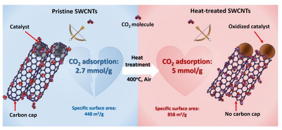 |
| Single-step thermal treatment of single-walled carbon nanotubes for enhanced CO2 adsorption capacity Credit Amit Kumar Pal, Dmitry V. Krasnikov, Liubov A. Varlamova, Konstantin K. Zamansky, Kseniya A. Litvintseva, Sergei V. Porokhin, Nikita E. Gordeev, Anastasia E. Goldt, Eugene E. Nazarov, Stanislav S. Fedotov, Pavel B. Sorokin & Albert G. Nasibulin |
Abstract:
The fight against climate change relies heavily on finding better ways to capture carbon dioxide before it escapes into our atmosphere. While carbon nanotubes have long been seen as a "wonder material" for this task, their internal structures are often locked away like a closed pipe. Now, a research team from the Skolkovo Institute of Science and Technology (Skoltech) has pioneered a deceptively simple way to pop those caps open and supercharge their adsorption capacity.
Breathing new life into nanotubes for a cooler planet:Researchers at Skoltech discover a simple, single-step heat treatment that nearly doubles the CO2-trapping power of carbon nanotubes
Shenyang, P.R.C. | Posted on January 30th, 2026In a study published in Carbon Research, the team reveals that a straightforward thermal treatment, essentially "baking" single-walled carbon nanotubes (SWCNTs) in ambient air, can dramatically expand their available surface area. By heating the tubes at 400 °C for four hours, the researchers nearly doubled the specific surface area from 448 to 858 m²/g. This breakthrough is led by corresponding authors Dmitry V. Krasnikov and Albert G. Nasibulin, both prominent researchers at Skoltech in Moscow. Their work focuses on making high-performance nanomaterials more practical and scalable for global environmental applications.
"The secret lies in the accessibility of the nanotubes," explains the team. The heat treatment does two critical things: it oxidizes leftover catalyst particles and burns away the carbon "caps" at the ends of the tubes. This exposes the inner channels of the nanotubes, providing extensive surface area for CO2 molecules to settle.
Why This Matters for Carbon Capture:
Efficiency Boost: In dynamic breakthrough tests, the thermally treated nanotubes reached a CO2 uptake of 5.0 mmol/g, an 85% improvement over untreated samples.
Simplicity is Key: Unlike complex chemical purification processes that can cause nanotubes to clump together (bundling), this single-step thermal method keeps the surface accessible and active.
Precision Science: By comparing experimental data with Monte-Carlo and geometric simulations, the researchers were able to pinpoint exactly how CO2 molecules interact with these nano-surfaces, confirming that the "opened" tubes are far more effective at trapping gas.
The Skolkovo Institute of Science and Technology has become a hub for such advanced material science. The work of Krasnikov and Nasibulin underscores the institute's commitment to developing scalable, evidence-based solutions for the ongoing climate crisis. By showing that a simple heating process can transform raw nanocarbon into a high-capacity sponge for greenhouse gases, they have provided a vital tool for the next generation of carbon capture technology. As industries look for cost-effective ways to lower their emissions, this Skoltech-led innovation offers a clear path forward: sometimes, the most effective solution is as simple as turning up the heat.
Corresponding Authors:
Dmitry V. Krasnikov Skolkovo Institute of Science and Technology, Moscow, Russia
Albert G. Nasibulin Skolkovo Institute of Science and Technology, Moscow, Russia
####
For more information, please click here
Contacts:
Biochar Editorial Office
Shenyang Agricultural University
Copyright © Shenyang Agricultural University
If you have a comment, please Contact us.Issuers of news releases, not 7th Wave, Inc. or Nanotechnology Now, are solely responsible for the accuracy of the content.
Bookmark:


| Related Links |
| Related News Press |
News and information
 Quantum computer improves AI predictions April 17th, 2026
Flexible sensor gains sensitivity under pressure April 17th, 2026
A reusable chip for particulate matter sensing April 17th, 2026
Detecting vibrational quantum beating in the predissociation dynamics of SF6 using time-resolved photoelectron spectroscopy April 17th, 2026
Possible Futures
A fundamentally new therapeutic approach to cystic fibrosis: Nanobody repairs cellular defect April 17th, 2026
UC Irvine physicists discover method to reverse ‘quantum scrambling’ : The work addresses the problem of information loss in quantum computing system April 17th, 2026
Discoveries
Quantum computer improves AI predictions April 17th, 2026
Flexible sensor gains sensitivity under pressure April 17th, 2026
A reusable chip for particulate matter sensing April 17th, 2026
Detecting vibrational quantum beating in the predissociation dynamics of SF6 using time-resolved photoelectron spectroscopy April 17th, 2026
Announcements
A fundamentally new therapeutic approach to cystic fibrosis: Nanobody repairs cellular defect April 17th, 2026
UC Irvine physicists discover method to reverse ‘quantum scrambling’ : The work addresses the problem of information loss in quantum computing system April 17th, 2026
Interviews/Book Reviews/Essays/Reports/Podcasts/Journals/White papers/Posters
A fundamentally new therapeutic approach to cystic fibrosis: Nanobody repairs cellular defect April 17th, 2026
UC Irvine physicists discover method to reverse ‘quantum scrambling’ : The work addresses the problem of information loss in quantum computing system April 17th, 2026
Environment
A reusable chip for particulate matter sensing April 17th, 2026
Researchers unveil a groundbreaking clay-based solution to capture carbon dioxide and combat climate change June 6th, 2025
Onion-like nanoparticles found in aircraft exhaust May 14th, 2025
 |
||
 |
||
| The latest news from around the world, FREE | ||
 |
||
|
|
||
| Premium Products | ||
 |
||
|
Only the news you want to read!
Learn More |
||
 |
||
|
Full-service, expert consulting
Learn More |
||
|
|
||