Home > Press > Sensors innovations for smart lithium-based batteries: advancements, opportunities, and potential challenges
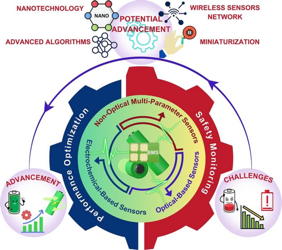 |
| •Sensors for smart Lithium-based batteries (LiBs) are classified based on their application into safety monitoring (i.e., temperature, pressure, and strain) to detect hazardous conditions and performance optimization (i.e., optical and electrochemical sensors) for monitoring factors such as state of charge and state of health. •The potential for innovation in LiB sensor technology is driven by advancements in nanotechnology, miniaturization, machine learning algorithms, and wireless sensor networks, all of which contribute to enhanced sensor performance. •Key challenges faced in developing LiB sensors include miniaturization, power consumption, cost efficiency and scalability, and compatibility with existing battery management systems. Credit amile Mohammadi Moradian, Amjad Ali, Xuehua Yan, Gang Pei, Shu Zhang, Ahmad Naveed, Khurram Shehzad, Zohreh Shahnavaz, Farooq Ahmad, Balal Yousaf. |
Abstract:
Lithium-ion batteries (LiBs) are the beating heart of the electric vehicle (EV) revolution, renewable energy storage, and portable electronics. Yet, their safety risks—thermal runaway, gas venting, catastrophic failure—remain a critical bottleneck. Now, a comprehensive review led by Shu Zhang (Nanjing Forestry University) , published in Nano-Micro Letters, unveils how advanced sensor technologies are transforming LiBs into smart, self-aware energy systems.
Sensors innovations for smart lithium-based batteries: advancements, opportunities, and potential challenges
Shanghai, China | Posted on August 8th, 2025Why Smart Sensors Matter
Real-time Safety Monitoring: From temperature spikes to gas leaks, sensors act as an early warning system, preventing thermal runaway before it starts.
Performance Optimization: By tracking state-of-charge (SoC) and state-of-health (SoH), sensors enable precise battery management, extending lifespan and efficiency.
In-situ Diagnostics: Embedded sensors reveal hidden degradation mechanisms—like lithium plating or electrolyte breakdown—without dismantling the battery.
Cutting-edge Sensor Strategies
Fiber Bragg Grating (FBG) Sensors: These hair-thin optical fibers detect micro-strain and temperature changes inside cells, offering sub-millimeter precision without electromagnetic interference.
Gas Sensors for Thermal Runaway: Chemiresistive and amperometric sensors detect H2, CO2, and volatile organic compounds (VOCs) at ppm levels, providing ~600 seconds of early warning before fire/explosion events.
MEMS-Integrated Microsensors: Miniaturized temperature-pressure sensors embedded in 18650 cells monitor jelly-roll expansion, correlating mechanical stress with capacity fade.
Detection & AI Integration
Ultrasonic & Acoustic Emission: Detect electrode cracking and gas formation via sound waves, achieving <5% error in SoH prediction.
Machine Learning Fusion: Random forest and LSTM models analyze multi-sensor data (voltage, strain, gas) to predict remaining useful life (RUL) with <2% MAPE.
Blockchain-Enabled IoT: Wireless sensor networks (WSNs) paired with blockchain secure real-time battery data for EV fleets and grid storage.
Future Outlook
Self-healing Sensors: Dynamic polymer nanocomposites recover from mechanical damage, ensuring 90% conductivity after thermal cycling.
Sustainability: Recyclable nanocellulose-based sensors reduce environmental impact, aligning with EU battery regulations (2027).
AI-BMS Synergy: Physics-informed neural networks (PINNs) will couple sensor data with electrochemical models for zero-latency fault detection.
Smart sensors are redefining lithium-ion batteries from passive energy stores to intelligent, self-protecting systems. Stay tuned for breakthroughs from the Jiangsu-Nankai sensor consortium!
####
For more information, please click here
Contacts:
Bowen Li
Shanghai Jiao Tong University Journal Center
Office: 021-62800059
Copyright © Shanghai Jiao Tong University Journal Center
If you have a comment, please Contact us.Issuers of news releases, not 7th Wave, Inc. or Nanotechnology Now, are solely responsible for the accuracy of the content.
Bookmark:


| Related Links |
| Related News Press |
News and information
 Quantum computer improves AI predictions April 17th, 2026
Flexible sensor gains sensitivity under pressure April 17th, 2026
A reusable chip for particulate matter sensing April 17th, 2026
Detecting vibrational quantum beating in the predissociation dynamics of SF6 using time-resolved photoelectron spectroscopy April 17th, 2026
Possible Futures
A fundamentally new therapeutic approach to cystic fibrosis: Nanobody repairs cellular defect April 17th, 2026
UC Irvine physicists discover method to reverse ‘quantum scrambling’ : The work addresses the problem of information loss in quantum computing system April 17th, 2026
Sensors
Flexible sensor gains sensitivity under pressure April 17th, 2026
Tiny nanosheets, big leap: A new sensor detects ethanol at ultra-low levels January 30th, 2026
From sensors to smart systems: the rise of AI-driven photonic noses January 30th, 2026
Announcements
A fundamentally new therapeutic approach to cystic fibrosis: Nanobody repairs cellular defect April 17th, 2026
UC Irvine physicists discover method to reverse ‘quantum scrambling’ : The work addresses the problem of information loss in quantum computing system April 17th, 2026
Interviews/Book Reviews/Essays/Reports/Podcasts/Journals/White papers/Posters
A fundamentally new therapeutic approach to cystic fibrosis: Nanobody repairs cellular defect April 17th, 2026
UC Irvine physicists discover method to reverse ‘quantum scrambling’ : The work addresses the problem of information loss in quantum computing system April 17th, 2026
Energy
Simple algorithm paired with standard imaging tool could predict failure in lithium metal batteries August 8th, 2025
KAIST researchers introduce new and improved, next-generation perovskite solar cell November 8th, 2024
Automotive/Transportation
Decoding hydrogen‑bond network of electrolyte for cryogenic durable aqueous zinc‑ion batteries January 30th, 2026
Simple algorithm paired with standard imaging tool could predict failure in lithium metal batteries August 8th, 2025
Battery Technology/Capacitors/Generators/Piezoelectrics/Thermoelectrics/Energy storage
Decoding hydrogen‑bond network of electrolyte for cryogenic durable aqueous zinc‑ion batteries January 30th, 2026
COF scaffold membrane with gate‑lane nanostructure for efficient Li+/Mg2+ separation January 30th, 2026
MXene nanomaterials enter a new dimension Multilayer nanomaterial: MXene flakes created at Drexel University show new promise as 1D scrolls January 30th, 2026
 |
||
 |
||
| The latest news from around the world, FREE | ||
 |
||
|
|
||
| Premium Products | ||
 |
||
|
Only the news you want to read!
Learn More |
||
 |
||
|
Full-service, expert consulting
Learn More |
||
|
|
||