Home > Press > Decoding hydrogen‑bond network of electrolyte for cryogenic durable aqueous zinc‑ion batteries
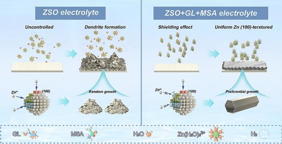 |
| •The hydrogen-bond network structure and solvation structure of the electrolyte are reconstructed by glycerol (GL) and methylsulfonamide (MSA) to achieve low-temperature durability in aqueous zinc-ion batteries (AZIBs). •GL and MSA collaboratively construct (100)-oriented high-activity dendrite-free zinc anode to improve the rate performance of AZIBs. •The Zn||Zn symmetrical cell achieved stable operation for 4,000 h at 1 mA cm−2 and 1 mAh cm−2 (30 °C) and 5,400 h at 0.5 mA cm−2 and 0.5 mAh cm−2 (−20 °C). Credit Xiyan Wei, Jinpeng Guan, Yongbiao Mu*, Yuhan Zou, Xianbin Wei, Lin Yang, Quanyan Man, Chao Yang, Limin Zang*, Jingyu Sun*, Lin Zeng*. |
Abstract:
As renewable energy storage expands into polar and high-altitude regions, conventional aqueous zinc-ion batteries (AZIBs) face a triple threat: dendrite growth, hydrogen-evolution corrosion, and electrolyte freezing below –20 °C. Now researchers from Southern University of Science and Technology, Soochow University and Guilin University of Technology—led by Prof. Lin Zeng, Prof. Yongbiao Mu and Prof. Jingyu Sun—report a dual-additive electrolyte that re-wires the hydrogen-bond network, guides (100)-oriented zinc deposition, and delivers record lifespan from room temperature down to –40 °C. The work provides a universal recipe for cryogenic-tolerant, high-rate AZIBs deployable in extreme climates.
Decoding hydrogen‑bond network of electrolyte for cryogenic durable aqueous zinc‑ion batteries
Shanghai, China | Posted on January 30th, 2026Why Hydrogen-Bond Reconstruction Matters
Anti-Freeze & Anti-Dendrite: Glycerol (GL) and methylsulfonamide (MSA) raise configurational entropy, suppress ice nucleation and lower freezing point to –45 °C while blocking water access to the Zn surface.
(100)-Textured Anode: Cooperative adsorption of GL on Zn(101) and MSA on Zn(002) channels growth along the highly active Zn(100) plane, cutting activation energy for stripping by 50 %.
Entropy-Driven Kinetics: Elevated disorder offsets viscosity penalty, enabling 40 mA cm-2 reversible plating and 5 A g-1 cathode rates without concentration polarization.
Innovative Design & Features
Dual-Additive Synergy: 50 vol % GL disrupts the H-bond lattice; 1 M MSA tunes solvation shell from 5.7 to 4.2 coordinated H₂O per Zn2+, suppressing HER and forming a 7–10 nm SEI rich in ZnCO3 and ZnS.
In-Situ Spectroscopy & MD: ATR-FTIR, Raman and NMR capture blue-shifted O–H modes; MD simulations reveal Cl⁻ enrichment near GL and Li⁺ clustering along PEI chains, validating lane-separated ion transport.
Cryo-Electrochemistry: Symmetric cells run 5 400 h at –20 °C (0.5 mA cm-2, 0.5 mAh cm-2) and 600 h at 40 mA cm-2 (30 °C), while full cells retain 85 % capacity after 2 000 cycles at –20 °C.
Applications & Future Outlook
Grid Storage in Cold Climates: pouch cells (300 μL electrolyte) deliver 78 % capacity retention after 600 cycles at 1 A g-1, proving scalability for alpine micro-grids and polar base stations.
Fast-Charging Devices: critical current density rises to 60 mA cm-2 at 30 °C and 25 mA cm-2 at –20 °C, unlocking 10-min charge capability for portable electronics and e-bikes.
Electrolyte Platform: the entropy-boosted, H-bond-engineered concept is compatible with existing ZnSO4 supply chains; next steps include antifouling polymers for natural brine and fire-retardant variants for aerospace.
This comprehensive study demonstrates that entropy-mediated hydrogen-bond reconstruction can simultaneously defeat dendrites, hydrogen evolution and electrolyte freezing, pushing aqueous zinc batteries into the cryogenic frontier. Stay tuned for more sub-zero breakthroughs from Prof. Lin Zeng, Prof. Yongbiao Mu and Prof. Jingyu Sun and their teams!
####
For more information, please click here
Contacts:
Bowen Li
Shanghai Jiao Tong University Journal Center
Office: 021-62800059
Copyright © Shanghai Jiao Tong University Journal Center
If you have a comment, please Contact us.Issuers of news releases, not 7th Wave, Inc. or Nanotechnology Now, are solely responsible for the accuracy of the content.
Bookmark:


| Related Links |
| Related News Press |
News and information
 Quantum computer improves AI predictions April 17th, 2026
Flexible sensor gains sensitivity under pressure April 17th, 2026
A reusable chip for particulate matter sensing April 17th, 2026
Detecting vibrational quantum beating in the predissociation dynamics of SF6 using time-resolved photoelectron spectroscopy April 17th, 2026
Possible Futures
A fundamentally new therapeutic approach to cystic fibrosis: Nanobody repairs cellular defect April 17th, 2026
UC Irvine physicists discover method to reverse ‘quantum scrambling’ : The work addresses the problem of information loss in quantum computing system April 17th, 2026
Discoveries
Quantum computer improves AI predictions April 17th, 2026
Flexible sensor gains sensitivity under pressure April 17th, 2026
A reusable chip for particulate matter sensing April 17th, 2026
Detecting vibrational quantum beating in the predissociation dynamics of SF6 using time-resolved photoelectron spectroscopy April 17th, 2026
Announcements
A fundamentally new therapeutic approach to cystic fibrosis: Nanobody repairs cellular defect April 17th, 2026
UC Irvine physicists discover method to reverse ‘quantum scrambling’ : The work addresses the problem of information loss in quantum computing system April 17th, 2026
Interviews/Book Reviews/Essays/Reports/Podcasts/Journals/White papers/Posters
A fundamentally new therapeutic approach to cystic fibrosis: Nanobody repairs cellular defect April 17th, 2026
UC Irvine physicists discover method to reverse ‘quantum scrambling’ : The work addresses the problem of information loss in quantum computing system April 17th, 2026
Automotive/Transportation
Sensors innovations for smart lithium-based batteries: advancements, opportunities, and potential challenges August 8th, 2025
Simple algorithm paired with standard imaging tool could predict failure in lithium metal batteries August 8th, 2025
Aerospace/Space
ICFO researchers overcome long-standing bottleneck in single photon detection with twisted 2D materials August 8th, 2025
Onion-like nanoparticles found in aircraft exhaust May 14th, 2025
Battery Technology/Capacitors/Generators/Piezoelectrics/Thermoelectrics/Energy storage
COF scaffold membrane with gate‑lane nanostructure for efficient Li+/Mg2+ separation January 30th, 2026
MXene nanomaterials enter a new dimension Multilayer nanomaterial: MXene flakes created at Drexel University show new promise as 1D scrolls January 30th, 2026
Rice membrane extracts lithium from brines with greater speed, less waste October 3rd, 2025
 |
||
 |
||
| The latest news from around the world, FREE | ||
 |
||
|
|
||
| Premium Products | ||
 |
||
|
Only the news you want to read!
Learn More |
||
 |
||
|
Full-service, expert consulting
Learn More |
||
|
|
||