Home > Press > UCF researcher discovers new technique for infrared “color” detection and imaging: The new specialized tunable detection and imaging technique for infrared photons surpasses present technology and may be a cost-effective method of capturing thermal imaging or night vision, medica
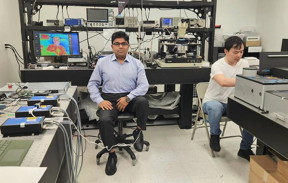 |
| UCF NanoScience Technology Center Professor Debashis Chanda sits near an infrared camera image of himself in his lab. Chanda and his research group of UCF students developed a new long wave infrared detection technique. (Photo courtesy of Debashis Chanda) Credit Photo courtesy of Debashis Chanda |
Abstract:
University of Central Florida (UCF) researcher Debashis Chanda, a professor at UCF’s NanoScience Technology Center, has developed a new technique to detect long wave infrared (LWIR) photons of different wavelengths or “colors.”
UCF researcher discovers new technique for infrared “color” detection and imaging: The new specialized tunable detection and imaging technique for infrared photons surpasses present technology and may be a cost-effective method of capturing thermal imaging or night vision, medica
Orlando, FL | Posted on December 13th, 2024The research was recently published in Nano Letters, an esteemed scholarly journal published by the American Chemical Society.
The findings are the result of a $1.5 million project funded through the Extreme Photon Imaging Capabilities program of the Defense Advanced Research Projects Agency that was awarded nearly two years ago.
The new detection and imaging technique will have applications in analyzing materials by their spectral properties, or spectroscopic imaging, as well as thermal imaging applications.
Humans perceive primary and secondary colors but not infrared light. Scientists hypothesize that animals like snakes or nocturnal species can detect various wavelengths in the infrared almost like how humans perceive colors.
Infrared, specifically LWIR, detection at room temperature has been a long-standing challenge due to the weak photon energy, Chanda says.
LWIR detectors can be broadly classified into either cooled or uncooled detectors, the researcher says.
Cooled detectors excel in high detectivity and fast response times but their reliance on cryogenic cooling significantly escalates their cost and restricts their practical applications.
In contrast, uncooled detectors, like microbolometers, can function at room temperature and come at a relatively lower cost but exhibit lower sensitivity and slower response times, Chanda says.
Both kinds of LWIR detectors lack the dynamic spectral tunability, and so they can’t distinguish photon wavelengths of different “colors.”
Chanda and his team of postdoctoral scholars sought to expand beyond the limitations of existing LWIR detectors, so they worked to demonstrate a highly sensitive, efficient and dynamically tunable method based on a nanopatterned graphene.
Tianyi Guo ’23PhD is the lead author of the research. Guo completed his doctoral degree at UCF in 2023 under Chanda’s mentorship. He is the recipient of an international thesis award from Springer Nature and his thesis exploring potential LWIR detection methods was published in the high-impact Springer Theses book series.
This newly discovered method is the culmination of the research that Guo, Chanda and others in Chanda’s lab have performed, Chanda says.
“No present cooled or uncooled detectors offer such dynamic spectral tunability and ultrafast response,” Chanda says. “This demonstration underscores the potential of engineered monolayer graphene LWIR detectors operating at room temperature, offering high sensitivity as well as dynamic spectral tunability for spectroscopic imaging.”
The detector relies on a temperature difference in materials (known as the Seebeck effect) within an asymmetrically patterned graphene film. Upon light illumination and interaction, the patterned half generates hot carriers with greatly enhanced absorption while the unpatterned half remains cool. The diffusion of the hot carriers creates a photo-thermoelectric voltage and is measured between the source and drain electrodes.
By patterning the graphene into a specialized array, the researchers achieved an enhanced absorption and can further electrostatically tune within the LWIR spectra range and provide better infrared detection. The detector significantly surpasses the capabilities of the conventional uncooled infrared detectors — also known as microbolometers.
“The proposed detection platform paves the path for a new generation of uncooled graphene-based LWIR photodetectors for wide ranging applications such as consumer electronics, molecular sensing and space to name a few,” Chanda says.
Researchers from Chanda’s group include postdoctoral scholars Aritra Biswas ’21MS ’24PhD, Sayan Chandra, Arindam Dasgupta, and Muhammad Waqas Shabbir ’16MS ’21PhD.
Licensing Opportunity
The technology is patented. For more information about licensing this technology, please visit the Office of Technology Transfer.
Researchers’ Credentials:
Chanda has joint appointments in UCF’s NanoScience Technology Center, Department of Physics and CREOL, The College of Optics and Photonics. He received his doctorate in photonics from the University of Toronto and worked as a postdoctoral fellow at the University of Illinois at Urbana-Champaign. He joined UCF in Fall 2012.
Guo joined UCF’s physics doctoral program in the fall of 2017 and graduated in fall 2023. He received his bachelor’s of science in 2015 from the University of Science and Technology of China. Guo currently is a postdoctoral researcher in Chanda’s group at UCF.
####
For more information, please click here
Contacts:
Robert Wells
University of Central Florida
Office: 352-213-5481
Copyright © University of Central Florida
If you have a comment, please Contact us.Issuers of news releases, not 7th Wave, Inc. or Nanotechnology Now, are solely responsible for the accuracy of the content.
Bookmark:


| Related News Press |
News and information
 Quantum computer improves AI predictions April 17th, 2026
Flexible sensor gains sensitivity under pressure April 17th, 2026
A reusable chip for particulate matter sensing April 17th, 2026
Detecting vibrational quantum beating in the predissociation dynamics of SF6 using time-resolved photoelectron spectroscopy April 17th, 2026
2 Dimensional Materials
Flexible sensor gains sensitivity under pressure April 17th, 2026
Graphene/ Graphite
Electrifying results shed light on graphene foam as a potential material for lab grown cartilage June 6th, 2025
Breakthrough in proton barrier films using pore-free graphene oxide: Kumamoto University researchers achieve new milestone in advanced coating technologies September 13th, 2024
NRL discovers two-dimensional waveguides February 16th, 2024
Possible Futures
A fundamentally new therapeutic approach to cystic fibrosis: Nanobody repairs cellular defect April 17th, 2026
UC Irvine physicists discover method to reverse ‘quantum scrambling’ : The work addresses the problem of information loss in quantum computing system April 17th, 2026
Optical computing/Photonic computing
ICFO researchers overcome long-standing bottleneck in single photon detection with twisted 2D materials August 8th, 2025
Programmable electron-induced color router array May 14th, 2025
Sensors
Flexible sensor gains sensitivity under pressure April 17th, 2026
Tiny nanosheets, big leap: A new sensor detects ethanol at ultra-low levels January 30th, 2026
From sensors to smart systems: the rise of AI-driven photonic noses January 30th, 2026
Sensors innovations for smart lithium-based batteries: advancements, opportunities, and potential challenges August 8th, 2025
Discoveries
Quantum computer improves AI predictions April 17th, 2026
Flexible sensor gains sensitivity under pressure April 17th, 2026
A reusable chip for particulate matter sensing April 17th, 2026
Detecting vibrational quantum beating in the predissociation dynamics of SF6 using time-resolved photoelectron spectroscopy April 17th, 2026
Announcements
A fundamentally new therapeutic approach to cystic fibrosis: Nanobody repairs cellular defect April 17th, 2026
UC Irvine physicists discover method to reverse ‘quantum scrambling’ : The work addresses the problem of information loss in quantum computing system April 17th, 2026
Photonics/Optics/Lasers
Metasurfaces smooth light to boost magnetic sensing precision January 30th, 2026
From sensors to smart systems: the rise of AI-driven photonic noses January 30th, 2026
 |
||
 |
||
| The latest news from around the world, FREE | ||
 |
||
|
|
||
| Premium Products | ||
 |
||
|
Only the news you want to read!
Learn More |
||
 |
||
|
Full-service, expert consulting
Learn More |
||
|
|
||