Home > Press > Flexible sensor gains sensitivity under pressure
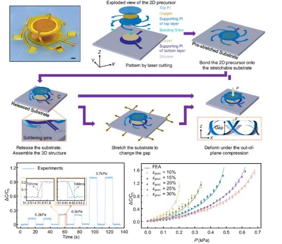 |
| Tunable 3D pressure sensor design and performance. This figure shows the design concept, working mechanism, and sensing performance of the tunable flexible capacitive pressure sensor. A laser-patterned two-dimensional precursor is transformed into a cage-like three-dimensional structure through buckling-guided assembly on a pre-stretched substrate. Under out-of-plane compression, the electrode gap decreases and capacitance rises; lateral stretching can further tune the gap and adjust the sensing range and sensitivity. The lower panels highlight the sensor’s rapid response and recovery, as well as its strain-dependent pressure–capacitance behavior, demonstrating stable and adaptable performance for dynamic pressure monitoring. Credit Microsystems & Nanoengineering |
Abstract:
Pressure sensors are expected to stay accurate across everything from gentle touch to strong, shifting loads. Yet many flexible designs are most sensitive only at low pressure, losing resolution as the force rises. Now, researchers have developed a tunable flexible capacitive pressure sensor that does the opposite: it becomes more sensitive as pressure increases. Built from a flat precursor that transforms into a three-dimensional cage-like structure, the device combines mechanical adaptability with stable electrical performance. The result is a sensor designed not just to bend and conform, but to keep delivering useful signals when conditions become heavier, harsher, and harder to predict.
Flexible sensor gains sensitivity under pressure
Beijing, China | Posted on April 17th, 2026Flexible capacitive pressure sensors have drawn wide interest for wearable health tracking, robotics, and structural monitoring because they are lightweight, low-power, and generally stable over time. But conventional structures often offer strong sensitivity only in low-pressure ranges, while many tunable designs remain difficult to scale or vulnerable to environmental disturbance. That creates a problem for real-world uses such as gait analysis, robotic grasping, wind-pressure monitoring, and infrastructure diagnostics, where loads may vary widely and performance must remain reliable over time. Based on these challenges, there is a need to carry out in-depth research on flexible pressure sensors with tunable and dependable performance across broader pressure ranges.
Researchers from the Institute of Hypergravity Science and Technology and the Department of Civil Engineering at Zhejiang University, China, reported (DOI: 10.1038/s41378-026-01252-x) the study in Microsystems & Nanoengineering in 2026. Using buckling-guided assembly and laser cutting, the team converted a two-dimensional precursor into a cage-like three-dimensional sensor architecture. The study showed that the device could be tuned after fabrication, maintained durability over 6,000 loading and unloading cycles, detected pressures as low as about 2 Pa, and performed reliably in wind tunnel experiments designed to test practical use under demanding conditions.
The sensor’s key advantage comes from how its internal geometry changes under compression. As pressure rises, the electrode gap shrinks in a nonlinear way, producing modest sensitivity at low loads but much stronger sensitivity at higher ones. Experiments and finite element analysis showed capacitance increasing from 113.8 fF to 558.9 fF as compressive strain reached 80%. Initial sensitivity was about 0.549 kPa⁻¹ and increased to 3.079 kPa⁻¹ at 0.7 kPa. The device also showed about 4% hysteresis, response and recovery times of 131 and 140 ms, and stable operation during sustained loading. The researchers further tuned performance by applying lateral strain after fabrication and by redesigning electrode shapes so that compression-induced rotation increased overlap and boosted signal response.
“Instead of losing precision as pressure builds, this sensor appears to become more informative at the point where many conventional flexible devices begin to struggle. That shift could make it especially valuable for monitoring tasks involving strong, variable, or uncertain loads, where a sensor needs to remain adaptable rather than be optimized for only one narrow operating window.” This is the broader message emerging from the study: sensitivity does not have to fade under stress if structure itself is used as part of the sensing strategy.
The work points to applications well beyond a laboratory prototype. The sensor can conform to curved surfaces, can be protected through liquid encapsulation, and showed clear wind-speed sensing performance in wind tunnel tests. It responded strongly when airflow struck in the most relevant direction and maintained stable signals even when mounted on surfaces with different curvatures. These features suggest promise for intelligent wind monitoring, structural wind-load evaluation, smart infrastructure, environmental sensing, and other flexible electronic systems that must operate reliably in changing or harsh conditions.
####
About Aerospace Information Research Institute, Chinese Academy of Sciences
About Microsystems & Nanoengineering
Microsystems & Nanoengineering is an online-only, open access international journal devoted to publishing original research results and reviews on all aspects of Micro and Nano Electro Mechanical Systems from fundamental to applied research. The journal is published by Springer Nature in partnership with the Aerospace Information Research Institute, Chinese Academy of Sciences, supported by the State Key Laboratory of Transducer Technology.
For more information, please click here
Contacts:
Na Li
Microsystems & Nanoengineering
Copyright © Aerospace Information Research Institute, Chinese Academy of Sciences
If you have a comment, please Contact us.Issuers of news releases, not 7th Wave, Inc. or Nanotechnology Now, are solely responsible for the accuracy of the content.
Bookmark:


| Related Links |
| Related News Press |
News and information
 Quantum computer improves AI predictions April 17th, 2026
A reusable chip for particulate matter sensing April 17th, 2026
Detecting vibrational quantum beating in the predissociation dynamics of SF6 using time-resolved photoelectron spectroscopy April 17th, 2026
Flexible Electronics
MXene nanomaterials enter a new dimension Multilayer nanomaterial: MXene flakes created at Drexel University show new promise as 1D scrolls January 30th, 2026
2 Dimensional Materials
MXene nanomaterials enter a new dimension Multilayer nanomaterial: MXene flakes created at Drexel University show new promise as 1D scrolls January 30th, 2026
ICFO researchers overcome long-standing bottleneck in single photon detection with twisted 2D materials August 8th, 2025
First real-time observation of two-dimensional melting process: Researchers at Mainz University unveil new insights into magnetic vortex structures August 8th, 2025
Lab to industry: InSe wafer-scale breakthrough for future electronics August 8th, 2025
Possible Futures
A fundamentally new therapeutic approach to cystic fibrosis: Nanobody repairs cellular defect April 17th, 2026
UC Irvine physicists discover method to reverse ‘quantum scrambling’ : The work addresses the problem of information loss in quantum computing system April 17th, 2026
Sensors
Tiny nanosheets, big leap: A new sensor detects ethanol at ultra-low levels January 30th, 2026
From sensors to smart systems: the rise of AI-driven photonic noses January 30th, 2026
Sensors innovations for smart lithium-based batteries: advancements, opportunities, and potential challenges August 8th, 2025
Discoveries
Quantum computer improves AI predictions April 17th, 2026
A reusable chip for particulate matter sensing April 17th, 2026
Detecting vibrational quantum beating in the predissociation dynamics of SF6 using time-resolved photoelectron spectroscopy April 17th, 2026
Announcements
A fundamentally new therapeutic approach to cystic fibrosis: Nanobody repairs cellular defect April 17th, 2026
UC Irvine physicists discover method to reverse ‘quantum scrambling’ : The work addresses the problem of information loss in quantum computing system April 17th, 2026
Interviews/Book Reviews/Essays/Reports/Podcasts/Journals/White papers/Posters
A fundamentally new therapeutic approach to cystic fibrosis: Nanobody repairs cellular defect April 17th, 2026
UC Irvine physicists discover method to reverse ‘quantum scrambling’ : The work addresses the problem of information loss in quantum computing system April 17th, 2026
 |
||
 |
||
| The latest news from around the world, FREE | ||
 |
||
|
|
||
| Premium Products | ||
 |
||
|
Only the news you want to read!
Learn More |
||
 |
||
|
Full-service, expert consulting
Learn More |
||
|
|
||