Home > Press > When light gets trapped at nanoscale: New ways to power the future of optoelectronics From bound states in the continuum to machine-learning design, photonic metasurfaces are opening scalable routes to efficient light control
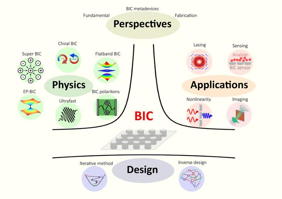 |
| An overview showing how bound states in the continuum (BICs) have advanced from new design methods and fundamental physics to practical applications in lasing, sensing, and next-generation photonic metadevices, as well as the road ahead for scalable manufacturing and quantum integration. Credit Dr. Son Tung Ha from A*STAR, Singapore Image source link: https://doi.org/10.29026/oea.2026.250224 |
Abstract:
Modern life is increasingly shaped by light. Optical devices exist in smartphone cameras, medical sensors, and emerging quantum technologies. As these technologies become more powerful, they are also expected to become smaller, lighter, and more energy efficient. One promising solution comes from metasurfaces—ultrathin layers patterned with nanoscale structures (“meta-atoms”) that offer unprecedented control over light within a flat, chip-compatible platform. When integrated with optoelectronic platforms, these metasurfaces give rise to so-called metadevices, offering new ways to control light on a chip. For many applications, trapping light so that it interacts more with active media is a key requirement, and this is where a photonic bound states in the continuum (BIC) enters the picture.
When light gets trapped at nanoscale: New ways to power the future of optoelectronics From bound states in the continuum to machine-learning design, photonic metasurfaces are opening scalable routes to efficient light control
Chengdu, China | Posted on April 17th, 2026Despite this promise, designing BICs for practical use remains challenging. Unlike traditional optical cavities that rely on light bouncing back and forth between two mirrors, BICs trap light through destructive interference between light waves. This mechanism allows light to remain confined in open systems like BIC metasurfaces. In theory, BICs are bound, non-radiative states that can trap light indefinitely, although practical limitations inevitably cause some leakage. Even so, these “quasi-BICs” retain exceptionally strong light confinement, making them among the most promising optical resonators available today. As the demand for more sophisticated functionalities grows, highly symmetric nanostructures are no longer sufficient, making the design more challenging and increasing the need for more flexible design strategies.
In a review article, that was made available online on March 15, 2026, and later published in Volume 9, Issue 3 of the journal Opto-Electronic Advances on March 24, 2026, first author Thi Thu Ha Do and corresponding author Son Tung Ha, from the Advanced Optical Technologies department at the Agency for Science, Technology and Research (A*STAR), Singapore, discuss how far photonic BICs have come and where they are headed next. The review provides a comprehensive overview of the field, beginning with the foundations of BIC physics and moving through recent advances in design strategies, material platforms, and device concepts.
The authors guide readers through the foundations of BIC physics and provide a library of materials to design BICs across a broad range of the electromagnetic spectrum, from deep ultraviolet, visible, and infrared to terahertz and microwave wavelengths. This diversity in materials is matched by a significant evolution in how these structures are conceived.
Another striking feature of BICs is their intrinsic topological nature, which allows these states to split or merge in a controlled manner. This tunability gives rise to a range of extraordinary photonic states, such as super-BICs, chiral BICs, and flatband BICs, as well as emergent physical phenomena, such as BIC polariton condensation, ultrafast optical switching, and exceptional points. The review also provides a clear discussion of the deeper physical principles that give BICs their unusual and robust behaviour, helping to connect these advances to broader themes in modern photonics and condensed matter physics.
One especially valuable aspect of the review is its comprehensive survey of low-loss all-dielectric materials that can support BICs across a wide range of wavelengths, from the ultraviolet to the microwave regime. By gathering this information into a single, curated resource, the authors make it easier for researchers to identify suitable material platforms for specific applications. This practical focus is further strengthened by discussions of emerging design strategies, including machine-learning and inverse-design approaches, which are becoming essential as the demands on metasurfaces grow more complex.
These advances translate directly into practical opportunities, with immediate implications for applications in lasing, sensing, nonlinear optics, wavefront shaping, and imaging. Beyond summarizing past achievements, the review looks firmly toward the future of the field, outlining key challenges such as scaling fabrication to wafer-level production and integrating BIC metasurfaces with active electronic systems.
####
About Compuscript Ltd
About Opto-Electronic Advances
Opto-Electronic Advances (OEA) is a premier, open-access journal dedicated to rapid, high-impact research in optics and photonics. Led by Editor-in-Chief Professor Xiangang Luo, it serves as a global platform for innovative research, boasting an Impact Factor of 22.4 and a CiteScore of 26.8. The journal's extensive scope covers fundamental and applied research in nanophotonics, plasmonics, metamaterials, and advanced optical materials. It also focuses on cutting-edge developments in light sources, sensors, optical imaging, and intelligent digital optics. Furthermore, OEA publishes significant work in biophotonics, nonlinear optics, ultrafast photonics, and photovoltaics. By publishing high-quality empirical and theoretical papers, OEA facilitates global knowledge sharing among researchers and professionals.
About Son Tung Ha from the Agency for Science, Technology and Research (A*STAR)
Dr. Son Tung Ha is a leading researcher at the Department of Advanced Optical Technologies at A*STAR, Singapore. His work focuses on shaping the future of optoelectronics through advanced light–matter interaction and the development of resonant metasurfaces. Dr. Ha specializes in engineering flat-optics solutions for high-resolution microLED displays in AR/VR, compact imaging systems, and exciton–polariton architectures for optical computing. As part of the Singapore’s National Semiconductor Translation and Innovation Centre, he bridges fundamental physics with industrial application, leveraging 12-inch DUV fabrication to translate metasurface innovations into manufacturable, real-world semiconductor technologies.
For more information, please click here
Contacts:
Conor Lovett
Compuscript Ltd
Office: 353-614-75205
Copyright © Compuscript Ltd
If you have a comment, please Contact us.Issuers of news releases, not 7th Wave, Inc. or Nanotechnology Now, are solely responsible for the accuracy of the content.
Bookmark:


| Related Links |
| Related News Press |
News and information
 Quantum computer improves AI predictions April 17th, 2026
Flexible sensor gains sensitivity under pressure April 17th, 2026
A reusable chip for particulate matter sensing April 17th, 2026
Detecting vibrational quantum beating in the predissociation dynamics of SF6 using time-resolved photoelectron spectroscopy April 17th, 2026
Possible Futures
A fundamentally new therapeutic approach to cystic fibrosis: Nanobody repairs cellular defect April 17th, 2026
UC Irvine physicists discover method to reverse ‘quantum scrambling’ : The work addresses the problem of information loss in quantum computing system April 17th, 2026
Chip Technology
A reusable chip for particulate matter sensing April 17th, 2026
Metasurfaces smooth light to boost magnetic sensing precision January 30th, 2026
Beyond silicon: Electronics at the scale of a single molecule January 30th, 2026
Optical computing/Photonic computing
ICFO researchers overcome long-standing bottleneck in single photon detection with twisted 2D materials August 8th, 2025
Programmable electron-induced color router array May 14th, 2025
Nanophotonic platform boosts efficiency of nonlinear-optical quantum teleportation April 25th, 2025
Discoveries
Quantum computer improves AI predictions April 17th, 2026
Flexible sensor gains sensitivity under pressure April 17th, 2026
A reusable chip for particulate matter sensing April 17th, 2026
Detecting vibrational quantum beating in the predissociation dynamics of SF6 using time-resolved photoelectron spectroscopy April 17th, 2026
Announcements
A fundamentally new therapeutic approach to cystic fibrosis: Nanobody repairs cellular defect April 17th, 2026
UC Irvine physicists discover method to reverse ‘quantum scrambling’ : The work addresses the problem of information loss in quantum computing system April 17th, 2026
Photonics/Optics/Lasers
Metasurfaces smooth light to boost magnetic sensing precision January 30th, 2026
From sensors to smart systems: the rise of AI-driven photonic noses January 30th, 2026
 |
||
 |
||
| The latest news from around the world, FREE | ||
 |
||
|
|
||
| Premium Products | ||
 |
||
|
Only the news you want to read!
Learn More |
||
 |
||
|
Full-service, expert consulting
Learn More |
||
|
|
||