Home > Press > Insight into inner magnetic layers: Measurements at BESSY II have shown how spin filters forming within magnetic sandwiches influence tunnel magnetoresistance -- results that can help in designing spintronic component-
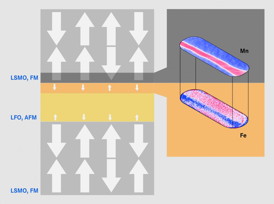 |
| The insulating LFO-layer in its normal state is antiferromagnetically ordered (AFM) and has no ferromagnetic domains. Due to the proximity to the ferromagnetic LSMO, ferromagnetic domains develop (white arrows) at the interface, pointing into the opposite direction of the LSMO-layer. CREDIT: HZB |
Abstract:
In doing so, the teams enhanced our understanding of processes that are important for future TMR data storage devices and other spintronic components. Their results have now been published in Nature Communications (DOI: 10.1038/ncomms7306).
Insight into inner magnetic layers: Measurements at BESSY II have shown how spin filters forming within magnetic sandwiches influence tunnel magnetoresistance -- results that can help in designing spintronic component-
Berlin, Germany | Posted on February 17th, 2015Layers of magnetic materials are found in every hard drive and in every read/write head today. These are sandwiches made of complex heterostructures in which the different layers have typical thicknesses of only a few nanometres. An effect of quantum physics called tunnel magnetoresistance (TMR) is critical for their operation. It occurs when two ferromagnetic layers are separated from one another by an insulating layer several plies of atoms thick, like cheese between two slices of bread. As long as the magnetisation in both "slices" is parallel, the electrons can tunnel through the "cheese", i.e. the device resistance is low. However, if the magnetisation changes in one of the layers, the electrons can no longer tunnel through the middle layer, i.e. the resistance is high. In this way, the electrical resistance can be precisely controlled through the influence of a magnetic field on one of the two outer layers, and be associated with the binary values of zero and one used for calculations.
New effect observed
The teams from France, Spain and HZB have now discovered that in such sandwiches combining different transition metal oxides, new interfacial effects can strongly influence the amplitude of the TMR This is what the French team under Manuel Bibes and Agnès Barthelemy of the Unité de Physique, CNRS/Thales, Palaiseau (working in collaboration with the team of Jacobo Santamaria in Madrid) had initially observed in measuring the electron transport characteristics. They were researching a system of two LSMO (La0.7Sr0.3MnO3) layers that were separated by a very thin layer of LFO (LaFeO3). The LSMO layers were ferromagnetic while the LFO insulating layer was anti-ferromagnetic.
New magnetic order at the interface
Measurements using the ALICE chamber and from the XPEEM instrument in beamline UE49 at BESSY II have clearly shown what is happening in the interface between the ferromagnetic layers and the anti-ferromagnetic inner layer. The teams were able to decode how each of the magnetic elements manganese and iron were oriented at the interfaces using the XPEEM instrument. "We saw how new magnetic phases arise at the boundaries that function like spin filters", explained Sergio Valencia, who heads the HZB team. "Put simply: the iron atoms near the interface are influenced by the manganese magnetic moments; they then orient their magnetic moments antiparallel to those of the manganese atoms and thus form ferromagnetic domains. We have thus demonstrated experimentally for the first time that ferromagnetic domains can be induced in non-ferromagnetic barrier layers." The French team carried out subsequent calculations of how these kinds of spin filters effect the tunnel magnetoresistance and could reproduce the experimental data.
"These kinds of complex oxide heterostructures as we investigated here could play an important role in future spintronics", says Valencia. The results that have now been published in Nature Communications explain an important process that has not been taken into account so far, and they therefore help in designing tunnel barriers with the desired properties.
###
To the publication in Nature Communications: "Insight into spin transport in oxide heterostructures from interface-resolved magnetic mapping" DOI: 10.1038/ncomms7306
####
For more information, please click here
Contacts:
Dr. Sergio Valencia Molina
49-308-062-15619
Copyright © Helmholtz-Zentrum Berlin für Materialien und Energie
If you have a comment, please Contact us.Issuers of news releases, not 7th Wave, Inc. or Nanotechnology Now, are solely responsible for the accuracy of the content.
Bookmark:


| Related News Press |
News and information
 Quantum computer improves AI predictions April 17th, 2026
Flexible sensor gains sensitivity under pressure April 17th, 2026
A reusable chip for particulate matter sensing April 17th, 2026
Detecting vibrational quantum beating in the predissociation dynamics of SF6 using time-resolved photoelectron spectroscopy April 17th, 2026
Spintronics
Quantum materials: Electron spin measured for the first time June 9th, 2023
Memory Technology
Researchers tackle the memory bottleneck stalling quantum computing October 3rd, 2025
First real-time observation of two-dimensional melting process: Researchers at Mainz University unveil new insights into magnetic vortex structures August 8th, 2025
Utilizing palladium for addressing contact issues of buried oxide thin film transistors April 5th, 2024
Discoveries
Quantum computer improves AI predictions April 17th, 2026
Flexible sensor gains sensitivity under pressure April 17th, 2026
A reusable chip for particulate matter sensing April 17th, 2026
Detecting vibrational quantum beating in the predissociation dynamics of SF6 using time-resolved photoelectron spectroscopy April 17th, 2026
Announcements
A fundamentally new therapeutic approach to cystic fibrosis: Nanobody repairs cellular defect April 17th, 2026
UC Irvine physicists discover method to reverse ‘quantum scrambling’ : The work addresses the problem of information loss in quantum computing system April 17th, 2026
Interviews/Book Reviews/Essays/Reports/Podcasts/Journals/White papers/Posters
A fundamentally new therapeutic approach to cystic fibrosis: Nanobody repairs cellular defect April 17th, 2026
UC Irvine physicists discover method to reverse ‘quantum scrambling’ : The work addresses the problem of information loss in quantum computing system April 17th, 2026
 |
||
 |
||
| The latest news from around the world, FREE | ||
 |
||
|
|
||
| Premium Products | ||
 |
||
|
Only the news you want to read!
Learn More |
||
 |
||
|
Full-service, expert consulting
Learn More |
||
|
|
||