Home > Press > UO-industry collaboration points to improved nanomaterials: University of Oregon microscope puts spotlight on the surface structure of quantum dots for designing new solar devices
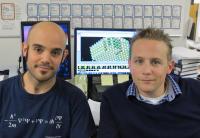 |
| University of Oregon doctoral student Christian Gervasi, left, and Thomas Allen of VoxtelNano led a university-industry collaboration to create atomic-scale maps of the density of states in individual nanocrystals with a specially designed microscope. The maps promise a route to next-generation solar cells.
Credit: University of Oregon |
Abstract:
A potential path to identify imperfections and improve the quality of nanomaterials for use in next-generation solar cells has emerged from a collaboration of University of Oregon and industry researchers.
UO-industry collaboration points to improved nanomaterials: University of Oregon microscope puts spotlight on the surface structure of quantum dots for designing new solar devices
Eugene, OR | Posted on November 20th, 2014To increase light-harvesting efficiency of solar cells beyond silicon's limit of about 29 percent, manufacturers have used layers of chemically synthesized semiconductor nanocrystals. Properties of quantum dots that are produced are manipulated by controlling the synthetic process and surface chemical structure.
This process, however, creates imperfections at the surface-forming trap states that limit device performance. Until recently, improvements in production quality have relied on feedback provided by traditional characterization techniques that probe average properties of large numbers of quantum dots.
"We want to use these materials in real devices, but they are not yet optimized," said co-author Christian F. Gervasi, a UO doctoral student.
In their study, detailed in the Journal of Physical Chemistry Letters, researchers investigated electronic states of lead sulfide nanocrystals. By using a specially designed scanning tunneling microscope, researchers created atomic-scale maps of the density of states in individual nanocrystals. This allowed them to pinpoint the energies and localization of charge traps associated with defects in the nanocrystal surface structure that are detrimental to electron propagation.
The microscope was designed in the lab of co-author George V. Nazin, a professor in the UO Department of Chemistry and Biochemistry. Its use was described in a previous paper in the same journal, in which Nazin's lab members were able to visualize the internal structures of electronic waves trapped by external electrostatic charges in carbon nanotubes.
"This technology is really cool," said Peter Palomaki, senior scientist for Voxtel Nanophotonics and co-author on the new paper. "When you really dig down into the science at a very fundamental level, this problem has always been an open-ended question. This paper is just the tip of the iceberg in terms of being able to understand what's going on."
The insight, he said, should help manufacturers tweak their synthesis of nanocrystals used in a variety of electronic devices. Co-author Thomas Allen, also a senior scientist at Voxtel, agreed. The project began after Allen heard Gervasi and Nazin discussing the microscope's capabilities.
"We wanted to see what the microscope could accomplish, and it turns out that it gives us a lot of information about the trap states and the depths of trap states in our quantum dots," said Allen, who joined Voxtel after completing the Industrial Internship Program in the UO's Materials Science Institute. "The information will help us fine-tune the ligand chemistry to make better devices for photovoltaics, detectors and sensors."
The trap states seen by the microscope in this project may explain why nanoparticle-based solar cells have not yet been commercialized, Nazin said.
"Nanoparticles are not always stable. It is a fundamental problem. When you synthesize something at this scale you don't necessarily get the same structure for all of the quantum dots. Working at the atomic scale can produce large variations in the electronic states. Our tool allows us to see these states directly and allow us to provide feedback on the materials."
###
Sony Corp. supported the research. Quantum dots were synthesized by VoxtelNanophotonics, a division of Voxtel Inc., which has research space in the UO's Lorry Lokey Laboratories. The microscope, which was described in a recent paper in the journal Review of Scientific Instruments, was built with funding from the National Science Foundation (grant DMR-0960211).
Co-authors with Gervasi, Allen, Palomaki and Nazin are Dmitry A. Kislitsyn and Jason D. Hackley, both doctoral students, and Ryuichiro Maruyama, a courtesy research associate in the Nanoscale Open Research Initiative of the UO's Department of Chemistry and Biochemistry.
####
For more information, please click here
Contacts:
Jim Barlow
541-346-3481
Sources:
George Nazin
assistant professor
physical chemistry
Department of Chemistry and Biochemistry
541-346-2017
Christian Gervasi
doctoral student
541-346-8150
Peter Palomaki
senior scientist
VoxtelNano
a division of Voxtel Inc.
541-346-8131
Thomas Allen
senior scientist
VoxtelNano
a division of Voxtel Inc.
541-346-8131
Copyright © University of Oregon
If you have a comment, please Contact us.Issuers of news releases, not 7th Wave, Inc. or Nanotechnology Now, are solely responsible for the accuracy of the content.
Bookmark:


| Related Links |
 Previous release: Special UO microscope captures defects in nanotubes:
Department of Chemistry and Biochemistry:
| Related News Press |
News and information
Quantum computer improves AI predictions April 17th, 2026
Flexible sensor gains sensitivity under pressure April 17th, 2026
A reusable chip for particulate matter sensing April 17th, 2026
Detecting vibrational quantum beating in the predissociation dynamics of SF6 using time-resolved photoelectron spectroscopy April 17th, 2026
Chemistry
Projecting light to dispense liquids: A new route to ultra-precise microdroplets January 30th, 2026
From sensors to smart systems: the rise of AI-driven photonic noses January 30th, 2026
"Nanoreactor" cage uses visible light for catalytic and ultra-selective cross-cycloadditions October 3rd, 2025
Cambridge chemists discover simple way to build bigger molecules – one carbon at a time June 6th, 2025
Sensors
Flexible sensor gains sensitivity under pressure April 17th, 2026
Tiny nanosheets, big leap: A new sensor detects ethanol at ultra-low levels January 30th, 2026
From sensors to smart systems: the rise of AI-driven photonic noses January 30th, 2026
Sensors innovations for smart lithium-based batteries: advancements, opportunities, and potential challenges August 8th, 2025
Discoveries
Quantum computer improves AI predictions April 17th, 2026
Flexible sensor gains sensitivity under pressure April 17th, 2026
A reusable chip for particulate matter sensing April 17th, 2026
Detecting vibrational quantum beating in the predissociation dynamics of SF6 using time-resolved photoelectron spectroscopy April 17th, 2026
Announcements
A fundamentally new therapeutic approach to cystic fibrosis: Nanobody repairs cellular defect April 17th, 2026
UC Irvine physicists discover method to reverse ‘quantum scrambling’ : The work addresses the problem of information loss in quantum computing system April 17th, 2026
Interviews/Book Reviews/Essays/Reports/Podcasts/Journals/White papers/Posters
A fundamentally new therapeutic approach to cystic fibrosis: Nanobody repairs cellular defect April 17th, 2026
UC Irvine physicists discover method to reverse ‘quantum scrambling’ : The work addresses the problem of information loss in quantum computing system April 17th, 2026
Energy
Sensors innovations for smart lithium-based batteries: advancements, opportunities, and potential challenges August 8th, 2025
Simple algorithm paired with standard imaging tool could predict failure in lithium metal batteries August 8th, 2025
Quantum Dots/Rods
A new kind of magnetism November 17th, 2023
IOP Publishing celebrates World Quantum Day with the announcement of a special quantum collection and the winners of two prestigious quantum awards April 14th, 2023
Qubits on strong stimulants: Researchers find ways to improve the storage time of quantum information in a spin rich material January 27th, 2023
NIST’s grid of quantum islands could reveal secrets for powerful technologies November 18th, 2022
Alliances/Trade associations/Partnerships/Distributorships
Chicago Quantum Exchange welcomes six new partners highlighting quantum technology solutions, from Chicago and beyond September 23rd, 2022
University of Illinois Chicago joins Brookhaven Lab's Quantum Center June 10th, 2022
Research partnerships
Lab to industry: InSe wafer-scale breakthrough for future electronics August 8th, 2025
HKU physicists uncover hidden order in the quantum world through deconfined quantum critical points April 25th, 2025
Solar/Photovoltaic
Spinel-type sulfide semiconductors to operate the next-generation LEDs and solar cells For solar-cell absorbers and green-LED source October 3rd, 2025
KAIST researchers introduce new and improved, next-generation perovskite solar cell November 8th, 2024
Groundbreaking precision in single-molecule optoelectronics August 16th, 2024
Development of zinc oxide nanopagoda array photoelectrode: photoelectrochemical water-splitting hydrogen production January 12th, 2024
 |
||
 |
||
| The latest news from around the world, FREE | ||
 |
||
|
|
||
| Premium Products | ||
 |
||
|
Only the news you want to read!
Learn More |
||
 |
||
|
Full-service, expert consulting
Learn More |
||
|
|
||