Home > Press > Stanislaus Wong Named AAAS Fellow for Work on Designing New Nanomaterials: Nanoscale chemistry produces materials for future energy applications
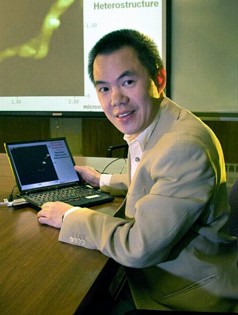 |
| Stanislaus Wong |
Abstract:
Stanislaus Wong, a chemist at the U.S. Department of Energy's Brookhaven National Laboratory, has been named a Fellow of the American Association for the Advancement of Science (AAAS) for his work on tailoring nanoscale materials-materials with dimensions measuring billionths of a meter-with possible future applications to improve solar cells, fuel cells, and batteries. Election as an AAAS Fellow is an honor bestowed upon AAAS members by their peers.
Stanislaus Wong Named AAAS Fellow for Work on Designing New Nanomaterials: Nanoscale chemistry produces materials for future energy applications
Upton, NY | Posted on December 12th, 2012The tradition of the naming of AAAS Fellows began in 1874; this year, 702 members were elected for their scientifically or socially distinguished efforts to advance science or its applications.
Wong, who also holds a joint appointment at Stony Brook University, was acknowledged for his efforts to make carbon nanotubes functional for a wide range of applications and for his work in "green" nanostructure synthesis techniques.
With respect to the latter studies, "we're trying to make multifunctional nanomaterials using techniques that are water-based and that are done at room temperature and pressure conditions. The idea is to merge the favorable properties of individual nanomaterial building blocks into an integrated whole, whose specific properties are different from and potentially better than the sum of their separate parts," Wong said. "In so doing, our goal is to design and produce truly unique nanostructures with distinctive and potentially unforeseeable properties and functionalities. And we try to do all this under sustainable conditions."
"It is a great honor to be included among the 2012 AAAS Fellows. We hope our work will make a difference to people by improving our fundamental understanding of how to reliably synthesize, modify, and engineer novel nanomaterials to address important energy issues such as catalytic enhancement and energy conversion. The fact that others in the community believe that our group's efforts have been significant and worthwhile is not only deeply satisfying but also personally humbling," he said.
Wong's team in the Brookhaven Condensed Matter Physics and Materials Sciences Department and the Stony Brook University Chemistry Department aims to create and rationally tailor novel nanostructures for specific applications.
With a focus on controlling the optoelectronic and mechanical properties of carbon nanotubes through chemistry, Wong has to keep a long-term perspective in mind when it comes to his work.
"We are gathering the necessary basic experimental understanding that should enable the reliable and pervasive incorporation of nanostructures into technological platforms and practical applications for future generations," he said.
Those experiments have led to the serendipitous discovery that nanotube and nanowire synthesis, especially of non-carbonaceous materials, can be done in an earth-friendly manner.
"We happened to stumble upon making metal oxides in a sustainable way. It turned out that lo and behold, we can actually make nanomaterials relatively rapidly and easily in high yield under ambient conditions, without the need for either catalyst seeds, surfactants, or cumbersome washing steps, that are typical of most conventional processes. This was a fortuitous discovery," Wong said.
Since that discovery, Wong has shared his techniques with colleagues through scientific talks and symposia participation in an effort to popularize sustainable nanoscience protocols. These cost-effective methods are meant to minimize waste, reagent use, and power consumption-and eliminate common practices, such as the use of high-temperature furnaces, harmful precursors, and expensive experimentation-in a way that could potentially make a wide range of materials processing procedures more eco-friendly.
"There are not enough groups making nanostructures in a sustainable way. So in recent years, I've helped to co-organize various American Chemical Society symposia on nanotechnology and the environment to highlight the benefits and promise of such strategies, moving forward."
The 2012 AAAS Fellows will receive a certificate and a rosette pin on Saturday, February 16, 2013 at the AAAS Fellows Forum during the AAAS Annual Meeting in Boston, Mass.
Wong and his team are supported by the Department of Energy Office of Science. Over the years, Wong has also received the American Chemical Society Buck-Whitney award, the National Science Foundation CAREER award, as well as an Alfred P. Sloan Foundation Faculty Fellowship.
Written by Chelsea Whyte
####
About Brookhaven National Laboratory
One of ten national laboratories overseen and primarily funded by the Office of Science of the U.S. Department of Energy (DOE), Brookhaven National Laboratory conducts research in the physical, biomedical, and environmental sciences, as well as in energy technologies and national security. Brookhaven Lab also builds and operates major scientific facilities available to university, industry and government researchers. Brookhaven is operated and managed for DOE's Office of Science by Brookhaven Science Associates, a limited-liability company founded by the Research Foundation for the State University of New York on behalf of Stony Brook University, the largest academic user of Laboratory facilities, and Battelle, a nonprofit, applied science and technology organization.
DOE's Office of Science is the single largest supporter of basic research in the physical sciences in the United States, and is working to address some of the most pressing challenges of our time. For more information, please visit science.energy.gov.
For more information, please click here
Contacts:
Karen McNulty Walsh
631 344-8350
or
Peter Genzer
631 344-3174
Copyright © Brookhaven National Laboratory
If you have a comment, please Contact us.Issuers of news releases, not 7th Wave, Inc. or Nanotechnology Now, are solely responsible for the accuracy of the content.
Bookmark:


| Related News Press |
News and information
 Quantum computer improves AI predictions April 17th, 2026
Flexible sensor gains sensitivity under pressure April 17th, 2026
A reusable chip for particulate matter sensing April 17th, 2026
Detecting vibrational quantum beating in the predissociation dynamics of SF6 using time-resolved photoelectron spectroscopy April 17th, 2026
Chemistry
Projecting light to dispense liquids: A new route to ultra-precise microdroplets January 30th, 2026
From sensors to smart systems: the rise of AI-driven photonic noses January 30th, 2026
"Nanoreactor" cage uses visible light for catalytic and ultra-selective cross-cycloadditions October 3rd, 2025
Cambridge chemists discover simple way to build bigger molecules – one carbon at a time June 6th, 2025
Single-atom catalysts change spin state when boosted by a magnetic field June 4th, 2025
Laboratories
Researchers develop molecular qubits that communicate at telecom frequencies October 3rd, 2025
Govt.-Legislation/Regulation/Funding/Policy
Quantum computer improves AI predictions April 17th, 2026
Metasurfaces smooth light to boost magnetic sensing precision January 30th, 2026
New imaging approach transforms study of bacterial biofilms August 8th, 2025
Discoveries
Quantum computer improves AI predictions April 17th, 2026
Flexible sensor gains sensitivity under pressure April 17th, 2026
A reusable chip for particulate matter sensing April 17th, 2026
Detecting vibrational quantum beating in the predissociation dynamics of SF6 using time-resolved photoelectron spectroscopy April 17th, 2026
Materials/Metamaterials/Magnetoresistance
First real-time observation of two-dimensional melting process: Researchers at Mainz University unveil new insights into magnetic vortex structures August 8th, 2025
Researchers unveil a groundbreaking clay-based solution to capture carbon dioxide and combat climate change June 6th, 2025
A 1960s idea inspires NBI researchers to study hitherto inaccessible quantum states June 6th, 2025
Institute for Nanoscience hosts annual proposal planning meeting May 16th, 2025
Announcements
A fundamentally new therapeutic approach to cystic fibrosis: Nanobody repairs cellular defect April 17th, 2026
UC Irvine physicists discover method to reverse ‘quantum scrambling’ : The work addresses the problem of information loss in quantum computing system April 17th, 2026
Energy
Sensors innovations for smart lithium-based batteries: advancements, opportunities, and potential challenges August 8th, 2025
Simple algorithm paired with standard imaging tool could predict failure in lithium metal batteries August 8th, 2025
Battery Technology/Capacitors/Generators/Piezoelectrics/Thermoelectrics/Energy storage
Decoding hydrogen‑bond network of electrolyte for cryogenic durable aqueous zinc‑ion batteries January 30th, 2026
COF scaffold membrane with gate‑lane nanostructure for efficient Li+/Mg2+ separation January 30th, 2026
MXene nanomaterials enter a new dimension Multilayer nanomaterial: MXene flakes created at Drexel University show new promise as 1D scrolls January 30th, 2026
Events/Classes
Institute for Nanoscience hosts annual proposal planning meeting May 16th, 2025
A New Blue: Mysterious origin of the ribbontail ray’s electric blue spots revealed July 5th, 2024
Researchers demonstrate co-propagation of quantum and classical signals: Study shows that quantum encryption can be implemented in existing fiber networks January 20th, 2023
Fuel Cells
Deciphering local microstrain-induced optimization of asymmetric Fe single atomic sites for efficient oxygen reduction August 8th, 2025
Current and Future Developments in Nanomaterials and Carbon Nanotubes: Applications of Nanomaterials in Energy Storage and Electronics October 28th, 2022
Grants/Sponsored Research/Awards/Scholarships/Gifts/Contests/Honors/Records
Quantum computer improves AI predictions April 17th, 2026
Detecting vibrational quantum beating in the predissociation dynamics of SF6 using time-resolved photoelectron spectroscopy April 17th, 2026
Metasurfaces smooth light to boost magnetic sensing precision January 30th, 2026
Solar/Photovoltaic
Spinel-type sulfide semiconductors to operate the next-generation LEDs and solar cells For solar-cell absorbers and green-LED source October 3rd, 2025
KAIST researchers introduce new and improved, next-generation perovskite solar cell November 8th, 2024
Groundbreaking precision in single-molecule optoelectronics August 16th, 2024
Development of zinc oxide nanopagoda array photoelectrode: photoelectrochemical water-splitting hydrogen production January 12th, 2024
 |
||
 |
||
| The latest news from around the world, FREE | ||
 |
||
|
|
||
| Premium Products | ||
 |
||
|
Only the news you want to read!
Learn More |
||
 |
||
|
Full-service, expert consulting
Learn More |
||
|
|
||