Home > Press > Stretchable conductors created using CNT fibers
 |
Abstract:
Carbon nanotube (CNT-) based continuous fiber, a CNT assembly that could potentially retain the superb properties of individual CNTs on a macroscopic scale, belongs to a fascinating new class of electronic materials with potential applications in electronics, sensing, and conducting wires.
Stretchable conductors created using CNT fibers
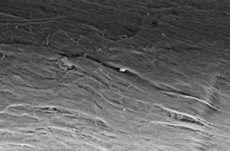
Germany | Posted on September 27th, 2012Now, researchers have reported, for the first time, the fabrication of CNT-fiber-based stretchable conductors by a simple prestraining-then-buckling approach. Upon release of the prestrain, the CNT fibers are readily kinked in-plane because of their high flexibility. This buckled shape is quite different from the sinusoidal shape observed previously in otherwise analogous systems.
Furthermore, the performance of the CNT fiber/PDMS composite film as a stretchable conductor has been tested under cyclic tensile loading. Very little variation in resistance (~1%) under multiple stretching-and-releasing cycles up to a prestrain level of 40% is observed, indicating the outstanding stability and repeatability in performance of CNT fiber/PDMS composite films as stretchable conductors. Together with their continuously improving mechanical performance, CNT fibers possessing the unique stretchability that has been demonstrated are expected to further improve their applicability as reinforcements for multifunctional composites.
####
For more information, please click here
Copyright © Wiley-VCH Materials Science Journals
If you have a comment, please Contact us.Issuers of news releases, not 7th Wave, Inc. or Nanotechnology Now, are solely responsible for the accuracy of the content.
Bookmark:


| Related Links |
 Link to the original paper on Wiley Online Library
| Related News Press |
News and information
Quantum computer improves AI predictions April 17th, 2026
Flexible sensor gains sensitivity under pressure April 17th, 2026
A reusable chip for particulate matter sensing April 17th, 2026
Detecting vibrational quantum beating in the predissociation dynamics of SF6 using time-resolved photoelectron spectroscopy April 17th, 2026
Chip Technology
A reusable chip for particulate matter sensing April 17th, 2026
Metasurfaces smooth light to boost magnetic sensing precision January 30th, 2026
Sensors
Flexible sensor gains sensitivity under pressure April 17th, 2026
Tiny nanosheets, big leap: A new sensor detects ethanol at ultra-low levels January 30th, 2026
From sensors to smart systems: the rise of AI-driven photonic noses January 30th, 2026
Sensors innovations for smart lithium-based batteries: advancements, opportunities, and potential challenges August 8th, 2025
Nanoelectronics
Lab to industry: InSe wafer-scale breakthrough for future electronics August 8th, 2025
Interdisciplinary: Rice team tackles the future of semiconductors Multiferroics could be the key to ultralow-energy computing October 6th, 2023
Key element for a scalable quantum computer: Physicists from Forschungszentrum Jülich and RWTH Aachen University demonstrate electron transport on a quantum chip September 23rd, 2022
Reduced power consumption in semiconductor devices September 23rd, 2022
Discoveries
Quantum computer improves AI predictions April 17th, 2026
Flexible sensor gains sensitivity under pressure April 17th, 2026
A reusable chip for particulate matter sensing April 17th, 2026
Detecting vibrational quantum beating in the predissociation dynamics of SF6 using time-resolved photoelectron spectroscopy April 17th, 2026
Announcements
A fundamentally new therapeutic approach to cystic fibrosis: Nanobody repairs cellular defect April 17th, 2026
UC Irvine physicists discover method to reverse ‘quantum scrambling’ : The work addresses the problem of information loss in quantum computing system April 17th, 2026
 |
||
 |
||
| The latest news from around the world, FREE | ||
 |
||
|
|
||
| Premium Products | ||
 |
||
|
Only the news you want to read!
Learn More |
||
 |
||
|
Full-service, expert consulting
Learn More |
||
|
|
||