Home > Press > UC Riverside Physicists to Study Attractive and Repulsive Forces Crucial in Designing Micro- and Nano-Machines
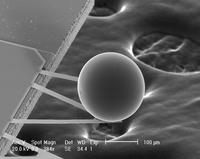 |
| Measuring only around one tenth of a millimeter, the tiny ball seen in this image is pulled toward a smooth plate (unseen but positioned above the ball in this configuration), in response to the energy fluctuations in the vacuum of empty space. The attraction between the ball and the plate is the Casimir effect. Image credit: U. Mohideen, UC Riverside. |
Abstract:
Umar Mohideen and Roya Zandi will conduct laboratory experiments and theoretical research aimed at reducing the Casimir force between objects; new book published on the force
UC Riverside Physicists to Study Attractive and Repulsive Forces Crucial in Designing Micro- and Nano-Machines
Riverside, CA | Posted on August 7th, 2009The Casimir force, also known as the Casimir effect, is typified by the small attractive force that acts between two close parallel uncharged conducting plates. Today, this force has become an interdisciplinary subject of study, playing an important role in condensed matter physics, quantum field theory, atomic and molecular physics, gravitation and cosmology, and mathematical physics. Most recently the Casimir force has been applied to nanotechnology.
Now, to study this force, UC Riverside physicists have received funding of $1.6 million for two years from the Defense Advanced Research Projects Agency (DARPA), the central research and development office for the U.S. Department of Defense, through the Department of the Navy, Space and Naval Warfare Systems Command (SPAWAR).
Grant recipients, Umar Mohideen and Roya Zandi of the Department of Physics and Astronomy, will conduct experimental and theoretical research on ways to minimize the attractive, or enhance the repulsive, Casimir force between objects—a necessary step in designing extremely small machines. Such machines could have useful applications in fields such as electronics and medicine.
In the typical geometry of two close parallel uncharged conducting plates (or a sphere and a plate), the Casimir force is attractive. But in other situations, the force can be repulsive, depending on the materials involved or their configuration.
May the force be no hindrance
Today's advances in nanofabrication include the manufacture of micro- and nano-machines with moving parts separated by distances less than a micron (a micron is a millionth of a meter; a single strand of hair is approximately 100 microns). Because the distances are extremely small, the Casimir force needs to be considered in the design and function of the micro/nano-machines for efficient operation.
"The Casimir force, which is usually attractive, is also large at short separation distances between objects," explained Mohideen, a professor of physics and the principal investigator of the grant. "It severely limits and constrains the easy and efficient functioning of nano- and micro-machines. To allow more novel designs of micro-machines, engineers will first need to decrease the Casimir force. One approach we will use in the lab is to use different material coatings to substantially reduce the Casimir force. Another approach is to use specialized coatings to bring about a repulsive Casimir force."
Joining forces for the project
Mohideen is in charge of the experimental section of the research. Zandi, the co-principal investigator of the grant, will be joined by Mehran Kardar, a professor of physics at the Massachusetts Institute of Technology (MIT), and Thorsten Emig, a physicist at the University of Cologne, Germany, in overseeing the theoretical section of the research. Giuseppe Bimonte, a physicist who will visit UCR from the Università di Napoli Federico II, Italy, also will contribute to the theoretical research. They will be joined by four postdoctoral researchers at UCR and one student at MIT. All experiments will be conducted at UCR.
In book form the force
Mohideen has coauthored a book on the Casimir force along with colleagues at North-West Technical University, St. Petersburg, Russia; the University of Leipzig, Germany; and "Scientific Instruments," Moscow, Russia.
Titled Advances in the Casimir Effect, the book is part of the "International Series of Monographs on Physics," a very selective publication list from Oxford University Press.
"The field has undergone an extraordinary phase of growth in the last decade, with many ideas initiated by the co-authors," Mohideen said. "By summarizing all the recent developments, this book will serve as a launching pad for the anticipated rapid growth of the field in the future."
He and his fellow-coauthors took two and a half years to write the book of approximately 750 pages. The book covers a wide range of diverse topics as well as many subdisciplines of physics, for example, quantum field theory, condensed matter physics, atomic and molecular physics, gravitation and cosmology, mathematical physics and nanotechnology.
"The applications of the Casimir force in nanotechnology are not covered in the existing books because these books were published before the technological relevance was appreciated," Mohideen said.
Intended for all physicists working on different manifestations of vacuum oscillations, as well as applied physicists, the book can be used, too, by advanced undergraduate and graduate students who are beginning work on van der Waals forces (which act between molecules), the Casimir force or related subjects.
"A unique feature of our book is that it presents both experiment and theory, including their mutual influence," Mohideen said.
####
About University of California, Riverside
The University of California, Riverside is a doctoral research university, a living laboratory for groundbreaking exploration of issues critical to Inland Southern California, the state and communities around the world. Reflecting California's diverse culture, UCR's enrollment of about 17,000 is expected to grow to 21,000 students by 2020. The campus is planning a medical school and has reached the heart of the Coachella Valley by way of the UCR Palm Desert Graduate Center. The campus has an annual statewide economic impact of more than $1 billion. To learn more, visit www.ucr.edu or call (951) UCR-NEWS.
For more information, please click here
Contacts:
Iqbal Pittalwala
Tel: (951) 827-6050
Media Relations
900 University Avenue
University Village 204B
Riverside, CA 92521
Tel: (951) 827-6397 (951) UCR-NEWS
Fax: (951) 827-5008
Copyright © University of California, Riverside
If you have a comment, please Contact us.Issuers of news releases, not 7th Wave, Inc. or Nanotechnology Now, are solely responsible for the accuracy of the content.
Bookmark:


| Related News Press |
News and information
 Quantum computer improves AI predictions April 17th, 2026
Flexible sensor gains sensitivity under pressure April 17th, 2026
A reusable chip for particulate matter sensing April 17th, 2026
Detecting vibrational quantum beating in the predissociation dynamics of SF6 using time-resolved photoelectron spectroscopy April 17th, 2026
Govt.-Legislation/Regulation/Funding/Policy
Quantum computer improves AI predictions April 17th, 2026
Metasurfaces smooth light to boost magnetic sensing precision January 30th, 2026
New imaging approach transforms study of bacterial biofilms August 8th, 2025
Possible Futures
A fundamentally new therapeutic approach to cystic fibrosis: Nanobody repairs cellular defect April 17th, 2026
UC Irvine physicists discover method to reverse ‘quantum scrambling’ : The work addresses the problem of information loss in quantum computing system April 17th, 2026
Molecular Machines
First electric nanomotor made from DNA material: Synthetic rotary motors at the nanoscale perform mechanical work July 22nd, 2022
Nanotech scientists create world's smallest origami bird March 17th, 2021
Giant nanomachine aids the immune system: Theoretical chemistry August 28th, 2020
Nanomedicine
A fundamentally new therapeutic approach to cystic fibrosis: Nanobody repairs cellular defect April 17th, 2026
New molecular technology targets tumors and simultaneously silences two ‘undruggable’ cancer genes August 8th, 2025
New imaging approach transforms study of bacterial biofilms August 8th, 2025
Electrifying results shed light on graphene foam as a potential material for lab grown cartilage June 6th, 2025
Nanoelectronics
Lab to industry: InSe wafer-scale breakthrough for future electronics August 8th, 2025
Interdisciplinary: Rice team tackles the future of semiconductors Multiferroics could be the key to ultralow-energy computing October 6th, 2023
Key element for a scalable quantum computer: Physicists from Forschungszentrum Jülich and RWTH Aachen University demonstrate electron transport on a quantum chip September 23rd, 2022
Reduced power consumption in semiconductor devices September 23rd, 2022
Announcements
A fundamentally new therapeutic approach to cystic fibrosis: Nanobody repairs cellular defect April 17th, 2026
UC Irvine physicists discover method to reverse ‘quantum scrambling’ : The work addresses the problem of information loss in quantum computing system April 17th, 2026
Military
Quantum engineers ‘squeeze’ laser frequency combs to make more sensitive gas sensors January 17th, 2025
Chainmail-like material could be the future of armor: First 2D mechanically interlocked polymer exhibits exceptional flexibility and strength January 17th, 2025
Single atoms show their true color July 5th, 2024
NRL charters Navy’s quantum inertial navigation path to reduce drift April 5th, 2024
Nanobiotechnology
A fundamentally new therapeutic approach to cystic fibrosis: Nanobody repairs cellular defect April 17th, 2026
New molecular technology targets tumors and simultaneously silences two ‘undruggable’ cancer genes August 8th, 2025
New imaging approach transforms study of bacterial biofilms August 8th, 2025
Electrifying results shed light on graphene foam as a potential material for lab grown cartilage June 6th, 2025
 |
||
 |
||
| The latest news from around the world, FREE | ||
 |
||
|
|
||
| Premium Products | ||
 |
||
|
Only the news you want to read!
Learn More |
||
 |
||
|
Full-service, expert consulting
Learn More |
||
|
|
||