Home > Press > Here's a tip: Indented cement shows unique properties: Rice University models reveal nanoindentation can benefit crystals in concrete
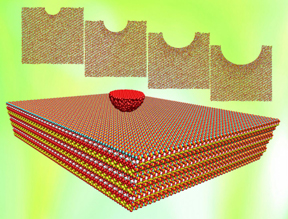 |
| Indented tobermorite, a natural analog to the calcium-silicate-hydrate mix in cement, responds differently than bulk tobermorite, depending on the size of the indentation and the force. Layers that bond through indentation remain that way after the force is removed, according to Rice University engineers. CREDIT Lei Ren/Rice University |
Abstract:
Rice University scientists have determined that no matter how large or small a piece of tobermorite is, it will respond to loading forces in precisely the same way. But poking it with a sharp point will change its strength.
Here's a tip: Indented cement shows unique properties: Rice University models reveal nanoindentation can benefit crystals in concrete
Houston, TX | Posted on July 20th, 2017Tobermorite is a naturally occurring crystalline analog to the calcium-silicate-hydrate (C-S-H) that makes up cement, which in turn binds concrete, the world's most-used material. A form of tobermorite used by ancient Romans is believed to be a key to the legendary strength of their undersea concrete structures.
The finely layered material will deform in different ways depending on how standard forces -- shear, compression and tension -- are applied, but the deformation will be consistent among sample sizes, according to Rice materials scientist Rouzbeh Shahsavari. He conducted the research, which appears in Nature's open-access Scientific Reports, with lead author and graduate student Lei Tao.
For their latest survey, Shahsavari and Tao built molecular dynamics models of the material. Their simulations revealed three key molecular mechanisms at work in tobermorite that are also likely responsible for the strength of C-S-H and other layered materials. One is a mechanism of displacement in which atoms under stress move collectively as they try to stay in equilibrium. Another is a diffusive mechanism in which atoms move more chaotically. They found that the material maintains its structural integrity best under shear, and less so under compressive and then tensile loading.
More interesting to the researchers was the third mechanism, by which bonds between the layers were formed when pressing a nanoindenter into the material. A nanoindenter is a device (simulated in this case) used to test the hardness of very small volumes of materials. The high stress at the point of indentation prompted local phase transformations in which the crystalline structure of the material deformed and created strong bonds between the layers, a phenomenon not observed under standard forces. The strength of the bond depended on both the amount of force and, unlike the macroscale stressors, the size of the tip.
"There is significant stress right below the small tip of the nanoindenter," Shahsavari said. "That connects the neighboring layers. Once you remove the tip, the structure does not go back to the original configuration. That's important: These transformations are irreversible.
"Besides providing fundamental understanding on key deformation mechanisms, this work uncovers the true mechanical response of the system under small localized (versus conventional) loads, such as nanoindentation," he said. "If changing the tip size (and thus the internal topology) is going to alter the mechanics -- for example, make the material stronger -- then one might use this feature to better design the system for particular localized loads."
Shahsavari is an assistant professor of civil and environmental engineering and of materials science and nanoengineering.
The National Science Foundation (NSF) supported the research. Computing resources were supplied by the National Institutes of Health and an IBM Shared University Research award in partnership with CISCO, Qlogic and Adaptive Computing and Rice's NSF-supported DAVinCI supercomputer administered by Rice's Center for Research Computing; the resources were procured in partnership with Rice's Ken Kennedy Institute for Information Technology.
####
About Rice University
Located on a 300-acre forested campus in Houston, Rice University is consistently ranked among the nation's top 20 universities by U.S. News & World Report. Rice has highly respected schools of Architecture, Business, Continuing Studies, Engineering, Humanities, Music, Natural Sciences and Social Sciences and is home to the Baker Institute for Public Policy. With 3,879 undergraduates and 2,861 graduate students, Rice's undergraduate student-to-faculty ratio is 6-to-1. Its residential college system builds close-knit communities and lifelong friendships, just one reason why Rice is ranked No. 1 for happiest students and for lots of race/class interaction by the Princeton Review. Rice is also rated as a best value among private universities by Kiplinger's Personal Finance. To read "What they're saying about Rice," go to http://tinyurl.com/RiceUniversityoverview.
Follow Rice News and Media Relations via Twitter @RiceUNews
For more information, please click here
Contacts:
David Ruth
713-348-6327
Mike Williams
713-348-6728
Copyright © Rice University
If you have a comment, please Contact us.Issuers of news releases, not 7th Wave, Inc. or Nanotechnology Now, are solely responsible for the accuracy of the content.
Bookmark:


| Related Links |
 Read the open-access paper at:
Rice probes ways to turn cement's weakness to strength:
Multiscale Materials Laboratory home page:
George R. Brown School of Engineering:
Rice Department of Civil and Environmental Engineering:
Rice Department of Materials Science and NanoEngineering:
| Related News Press |
Govt.-Legislation/Regulation/Funding/Policy
Quantum computer improves AI predictions April 17th, 2026
Metasurfaces smooth light to boost magnetic sensing precision January 30th, 2026
New imaging approach transforms study of bacterial biofilms August 8th, 2025
Possible Futures
A fundamentally new therapeutic approach to cystic fibrosis: Nanobody repairs cellular defect April 17th, 2026
UC Irvine physicists discover method to reverse ‘quantum scrambling’ : The work addresses the problem of information loss in quantum computing system April 17th, 2026
Discoveries
Quantum computer improves AI predictions April 17th, 2026
Flexible sensor gains sensitivity under pressure April 17th, 2026
A reusable chip for particulate matter sensing April 17th, 2026
Detecting vibrational quantum beating in the predissociation dynamics of SF6 using time-resolved photoelectron spectroscopy April 17th, 2026
Announcements
A fundamentally new therapeutic approach to cystic fibrosis: Nanobody repairs cellular defect April 17th, 2026
UC Irvine physicists discover method to reverse ‘quantum scrambling’ : The work addresses the problem of information loss in quantum computing system April 17th, 2026
Interviews/Book Reviews/Essays/Reports/Podcasts/Journals/White papers/Posters
A fundamentally new therapeutic approach to cystic fibrosis: Nanobody repairs cellular defect April 17th, 2026
UC Irvine physicists discover method to reverse ‘quantum scrambling’ : The work addresses the problem of information loss in quantum computing system April 17th, 2026
Grants/Sponsored Research/Awards/Scholarships/Gifts/Contests/Honors/Records
Quantum computer improves AI predictions April 17th, 2026
Detecting vibrational quantum beating in the predissociation dynamics of SF6 using time-resolved photoelectron spectroscopy April 17th, 2026
Metasurfaces smooth light to boost magnetic sensing precision January 30th, 2026
New-Contracts/Sales/Customers
Bruker Light-Sheet Microscopes at Major Comprehensive Cancer Center: New Advanced Imaging Center Powered by Two MuVi and LCS SPIM Microscopes March 25th, 2021
Arrowhead Pharmaceuticals Announces Closing of Agreement with Takeda November 27th, 2020
Veeco Announces Aledia Order of 300mm MOCVD Equipment for microLED Displays: Propel™ Platform First 300mm System with EFEM Designed for Advanced Display Applications October 20th, 2020
GREENWAVES TECHNOLOGIES Announces Next Generation GAP9 Hearables Platform Using GLOBALFOUNDRIES 22FDX Solution October 16th, 2020
Construction
Temperature-sensing building material changes color to save energy January 27th, 2023
Strain-sensing smart skin ready to deploy: Nanotube-embedded coating detects threats from wear and tear in large structures July 15th, 2022
A sunlight-driven “self-healing” anti-corrosion coating May 27th, 2022
Polymer fibers with graphene nanotubes make it possible to heat hard-to-reach, complex-shaped items February 11th, 2022
 |
||
 |
||
| The latest news from around the world, FREE | ||
 |
||
|
|
||
| Premium Products | ||
 |
||
|
Only the news you want to read!
Learn More |
||
 |
||
|
Full-service, expert consulting
Learn More |
||
|
|
||