Home > Press > Designing a pop-up future: Simple origami fold may hold the key to designing pop-up furniture, medical devices and scientific tools
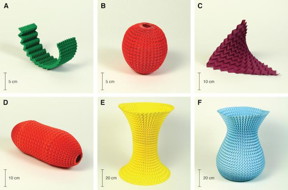 |
| This image shows various shapes made from Miura-ori pattern. CREDIT: Mahadevan Lab |
Abstract:
What if you could make any object out of a flat sheet of paper?
That future is on the horizon thanks to new research by L. Mahadevan, the Lola England de Valpine Professor of Applied Mathematics, Organismic and Evolutionary Biology, and Physics at the Harvard John A. Paulson School of Engineering and Applied Sciences (SEAS). He is also a core faculty member of the Wyss Institute for Biologically Inspired Engineering, and member of the Kavli Institute for Bionano Science and Technology, at Harvard University.
Designing a pop-up future: Simple origami fold may hold the key to designing pop-up furniture, medical devices and scientific tools
Cambridge, MA | Posted on January 27th, 2016Mahadevan and his team have characterized a fundamental origami fold, or tessellation, that could be used as a building block to create almost any three-dimensional shape, from nanostructures to buildings. The research is published in Nature Materials.
The folding pattern, known as the Miura-ori, is a periodic way to tile the plane using the simplest mountain-valley fold in origami. It was used as a decorative item in clothing at least as long ago as the 15th century. A folded Miura can be packed into a flat, compact shape and unfolded in one continuous motion, making it ideal for packing rigid structures like solar panels. It also occurs in nature in a variety of situations, such as in insect wings and certain leaves.
"Could this simple folding pattern serve as a template for more complicated shapes, such as saddles, spheres, cylinders, and helices?" asked Mahadevan.
"We found an incredible amount of flexibility hidden inside the geometry of the Miura-ori," said Levi Dudte, graduate student in the Mahadevan lab and first author of the paper. "As it turns out, this fold is capable of creating many more shapes than we imagined."
Think surgical stents that can be packed flat and pop-up into three-dimensional structures once inside the body or dining room tables that can lean flat against the wall until they are ready to be used.
"The collapsibility, transportability and deployability of Miura-ori folded objects makes it a potentially attractive design for everything from space-bound payloads to small-space living to laparoscopic surgery and soft robotics," said Dudte.
To explore the potential of the tessellation, the team developed an algorithm that can create certain shapes using the Miura-ori fold, repeated with small variations. Given the specifications of the target shape, the program lays out the folds needed to create the design, which can then be laser printed for folding.
The program takes into account several factors, including the stiffness of the folded material and the trade-off between the accuracy of the pattern and the effort associated with creating finer folds - an important characterization because, as of now, these shapes are all folded by hand.
"Essentially, we would like to be able to tailor any shape by using an appropriate folding pattern," said Mahadevan. "Starting with the basic mountain-valley fold, our algorithm determines how to vary it by gently tweaking it from one location to the other to make a vase, a hat, a saddle, or to stitch them together to make more and more complex structures."
"This is a step in the direction of being able to solve the inverse problem - given a functional shape, how can we design the folds on a sheet to achieve it," Dudte said.
"The really exciting thing about this fold is it is completely scalable," said Mahadevan. "You can do this with graphene, which is one atom thick, or you can do it on the architectural scale."
###
Co-authors on the study include Etienne Vouga, currently at the University of Texas at Austin, and Tomohiro Tachi from the University of Tokyo. The work was funded by the Wyss Institute for Bioinspired Engineering, the Kavli Institute for Bionano Science and Technology, and the Harvard MRSEC.
####
For more information, please click here
Contacts:
Leah Burrows
617-495-1351
Copyright © Harvard John A. Paulson School of Engineering and Applied Sc
If you have a comment, please Contact us.Issuers of news releases, not 7th Wave, Inc. or Nanotechnology Now, are solely responsible for the accuracy of the content.
Bookmark:


| Related News Press |
News and information
 Quantum computer improves AI predictions April 17th, 2026
Flexible sensor gains sensitivity under pressure April 17th, 2026
A reusable chip for particulate matter sensing April 17th, 2026
Detecting vibrational quantum beating in the predissociation dynamics of SF6 using time-resolved photoelectron spectroscopy April 17th, 2026
Graphene/ Graphite
Electrifying results shed light on graphene foam as a potential material for lab grown cartilage June 6th, 2025
Breakthrough in proton barrier films using pore-free graphene oxide: Kumamoto University researchers achieve new milestone in advanced coating technologies September 13th, 2024
Possible Futures
A fundamentally new therapeutic approach to cystic fibrosis: Nanobody repairs cellular defect April 17th, 2026
UC Irvine physicists discover method to reverse ‘quantum scrambling’ : The work addresses the problem of information loss in quantum computing system April 17th, 2026
Nanomedicine
A fundamentally new therapeutic approach to cystic fibrosis: Nanobody repairs cellular defect April 17th, 2026
New molecular technology targets tumors and simultaneously silences two ‘undruggable’ cancer genes August 8th, 2025
New imaging approach transforms study of bacterial biofilms August 8th, 2025
Electrifying results shed light on graphene foam as a potential material for lab grown cartilage June 6th, 2025
Discoveries
Quantum computer improves AI predictions April 17th, 2026
Flexible sensor gains sensitivity under pressure April 17th, 2026
A reusable chip for particulate matter sensing April 17th, 2026
Detecting vibrational quantum beating in the predissociation dynamics of SF6 using time-resolved photoelectron spectroscopy April 17th, 2026
Materials/Metamaterials/Magnetoresistance
First real-time observation of two-dimensional melting process: Researchers at Mainz University unveil new insights into magnetic vortex structures August 8th, 2025
Researchers unveil a groundbreaking clay-based solution to capture carbon dioxide and combat climate change June 6th, 2025
A 1960s idea inspires NBI researchers to study hitherto inaccessible quantum states June 6th, 2025
Institute for Nanoscience hosts annual proposal planning meeting May 16th, 2025
Announcements
A fundamentally new therapeutic approach to cystic fibrosis: Nanobody repairs cellular defect April 17th, 2026
UC Irvine physicists discover method to reverse ‘quantum scrambling’ : The work addresses the problem of information loss in quantum computing system April 17th, 2026
Interviews/Book Reviews/Essays/Reports/Podcasts/Journals/White papers/Posters
A fundamentally new therapeutic approach to cystic fibrosis: Nanobody repairs cellular defect April 17th, 2026
UC Irvine physicists discover method to reverse ‘quantum scrambling’ : The work addresses the problem of information loss in quantum computing system April 17th, 2026
Tools
Metasurfaces smooth light to boost magnetic sensing precision January 30th, 2026
From sensors to smart systems: the rise of AI-driven photonic noses January 30th, 2026
Japan launches fully domestically produced quantum computer: Expo visitors to experience quantum computing firsthand August 8th, 2025
Grants/Sponsored Research/Awards/Scholarships/Gifts/Contests/Honors/Records
Quantum computer improves AI predictions April 17th, 2026
Detecting vibrational quantum beating in the predissociation dynamics of SF6 using time-resolved photoelectron spectroscopy April 17th, 2026
Metasurfaces smooth light to boost magnetic sensing precision January 30th, 2026
Research partnerships
Lab to industry: InSe wafer-scale breakthrough for future electronics August 8th, 2025
HKU physicists uncover hidden order in the quantum world through deconfined quantum critical points April 25th, 2025
 |
||
 |
||
| The latest news from around the world, FREE | ||
 |
||
|
|
||
| Premium Products | ||
 |
||
|
Only the news you want to read!
Learn More |
||
 |
||
|
Full-service, expert consulting
Learn More |
||
|
|
||