Home > Press > Scientists Use Nanoscale Building Blocks and DNA 'Glue' to Shape 3D Superlattices: New approach to designing ordered composite materials for possible energy applications
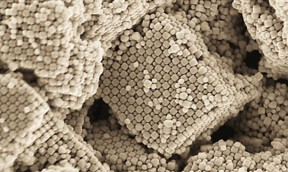 |
| Controlling the self-assembly of nanoparticles into superlattices is an important approach to build functional materials. The Brookhaven team used nanosized building blocks—cubes or octahedrons—decorated with DNA tethers to coordinate the assembly of spherical nanoparticles coated with complementary DNA strands. |
Abstract:
Taking child's play with building blocks to a whole new level-the nanometer scale-scientists at the U.S. Department of Energy's (DOE) Brookhaven National Laboratory have constructed 3D "superlattice" multicomponent nanoparticle arrays where the arrangement of particles is driven by the shape of the tiny building blocks. The method uses linker molecules made of complementary strands of DNA to overcome the blocks' tendency to pack together in a way that would separate differently shaped components. The results, published in Nature Communications, are an important step on the path toward designing predictable composite materials for applications in catalysis, other energy technologies, and medicine.
Scientists Use Nanoscale Building Blocks and DNA 'Glue' to Shape 3D Superlattices: New approach to designing ordered composite materials for possible energy applications
Upton, NY | Posted on April 23rd, 2015"If we want to take advantage of the promising properties of nanoparticles, we need to be able to reliably incorporate them into larger-scale composite materials for real-world applications," explained Brookhaven physicist Oleg Gang, who led the research at Brookhaven's Center for Functional Nanomaterials (CFN), a DOE Office of Science User Facility.
"Our work describes a new way to fabricate structured composite materials using directional bindings of shaped particles for predictable assembly," said Fang Lu, the lead author of the publication.
The research builds on the team's experience linking nanoparticles together using strands of synthetic DNA. Like the molecule that carries the genetic code of living things, these synthetic strands have complementary bases known by the genetic code letters G, C, T, and A, which bind to one another in only one way (G to C; T to A). Gang has previously used complementary DNA tethers attached to nanoparticles to guide the assembly of a range of arrays and structures. The new work explores particle shape as a means of controlling the directionality of these interactions to achieve long-range order in large-scale assemblies and clusters.
Spherical particles, Gang explained, normally pack together to minimize free volume. DNA linkers-using complementary strands to attract particles, or non-complementary strands to keep particles apart-can alter that packing to some degree to achieve different arrangements. For example, scientists have experimented with placing complementary linker strands in strategic locations on the spheres to get the particles to line up and bind in a particular way. But it's not so easy to make nanospheres with precisely placed linker strands.
"We explored an alternate idea: the introduction of shaped nanoscale 'blocks' decorated with DNA tethers on each facet to control the directional binding of spheres with complementary DNA tethers," Gang said.
When the scientists mixed nanocubes coated with DNA tethers on all six sides with nanospheres of approximately the same size, which had been coated with complementary tethers, these two differently shaped particles did not segregate as would have been expected based on their normal packing behavior. Instead, the DNA "glue" prevented the separation by providing an attractive force between the flat facets of the blocks and the tethers on the spheres, as well as a repulsive force between the non-pairing tethers on same-shaped objects.
"The DNA permits us to enforce rules: spheres attract cubes (mutually); spheres do not attract spheres; and cubes do not attract cubes," Gang said. "This breaks the conventional packing tendency and allows for the system to self-assemble into an alternating array of cubes and spheres, where each cube is surrounded by six spheres (one to a face) and each sphere is surrounded by six cubes." Using octahedral blocks instead of cubes achieved a different arrangement, with one sphere binding to each of the blocks' eight triangular facets.
The method required some thermal processing to achieve the most uniform long-range order. And experiments with different types of DNA tethers showed that having flexible DNA strands was essential to accommodate the pairing of differently shaped particles.
"The flexible DNA shells 'soften' the particles, which allows them to fit into arrangements where the shapes do not match geometrically," Lu said. But excessive softness results in unnecessary particle freedom, which can ruin a perfect lattice, she added. Finding the ideal flexibility for the tethers was an essential part of the work.
The scientists used transmission and scanning electron microscopy at the CFN and also conducted x-ray scattering experiments at the National Synchrotron Light Source, another DOE Office of Science User Facility at Brookhaven Lab, to reveal the structure and take images of assembled clusters and lattices at various length scales. They also explained the experimental results with models based on the estimation of nanoscale interactions between the tiny building blocks.
"Ultimately, this work shows that large-scale binary lattices can be formed in a predictable manner using this approach," Gang said. "Given that our approach does not depend on the particular particle's material and the large variety of particle shapes available-many more than in a child's building block play set-we have the potential to create many diverse types of new nanomaterials."
This research and operations at CFN and NSLS were funded by the DOE Office of Science.
####
About Brookhaven National Laboratory
Brookhaven National Laboratory is supported by the Office of Science of the U.S. Department of Energy. The Office of Science is the single largest supporter of basic research in the physical sciences in the United States, and is working to address some of the most pressing challenges of our time. For more information, please visit science.energy.gov.
One of ten national laboratories overseen and primarily funded by the Office of Science of the U.S. Department of Energy (DOE), Brookhaven National Laboratory conducts research in the physical, biomedical, and environmental sciences, as well as in energy technologies and national security. Brookhaven Lab also builds and operates major scientific facilities available to university, industry and government researchers. Brookhaven is operated and managed for DOE's Office of Science by Brookhaven Science Associates, a limited-liability company founded by the Research Foundation for the State University of New York on behalf of Stony Brook University, the largest academic user of Laboratory facilities, and Battelle, a nonprofit applied science and technology organization.
For more information, please click here
Contacts:
Karen McNulty Walsh
(631) 344-8350
or
Peter Genzer
(631) 344-3174
Copyright © Brookhaven National Laboratory
If you have a comment, please Contact us.Issuers of news releases, not 7th Wave, Inc. or Nanotechnology Now, are solely responsible for the accuracy of the content.
Bookmark:


| Related Links |
 Scientific paper: "Superlattices Assembled through Shape-Induced Directional Binding":
| Related News Press |
News and information
Quantum computer improves AI predictions April 17th, 2026
Flexible sensor gains sensitivity under pressure April 17th, 2026
A reusable chip for particulate matter sensing April 17th, 2026
Detecting vibrational quantum beating in the predissociation dynamics of SF6 using time-resolved photoelectron spectroscopy April 17th, 2026
Chemistry
Projecting light to dispense liquids: A new route to ultra-precise microdroplets January 30th, 2026
From sensors to smart systems: the rise of AI-driven photonic noses January 30th, 2026
"Nanoreactor" cage uses visible light for catalytic and ultra-selective cross-cycloadditions October 3rd, 2025
Cambridge chemists discover simple way to build bigger molecules – one carbon at a time June 6th, 2025
Single-atom catalysts change spin state when boosted by a magnetic field June 4th, 2025
Laboratories
Researchers develop molecular qubits that communicate at telecom frequencies October 3rd, 2025
Govt.-Legislation/Regulation/Funding/Policy
Quantum computer improves AI predictions April 17th, 2026
Metasurfaces smooth light to boost magnetic sensing precision January 30th, 2026
New imaging approach transforms study of bacterial biofilms August 8th, 2025
Self Assembly
Diamond glitter: A play of colors with artificial DNA crystals May 17th, 2024
Liquid crystal templated chiral nanomaterials October 14th, 2022
Nanoclusters self-organize into centimeter-scale hierarchical assemblies April 22nd, 2022
Atom by atom: building precise smaller nanoparticles with templates March 4th, 2022
Nanomedicine
A fundamentally new therapeutic approach to cystic fibrosis: Nanobody repairs cellular defect April 17th, 2026
New molecular technology targets tumors and simultaneously silences two ‘undruggable’ cancer genes August 8th, 2025
New imaging approach transforms study of bacterial biofilms August 8th, 2025
Electrifying results shed light on graphene foam as a potential material for lab grown cartilage June 6th, 2025
Discoveries
Quantum computer improves AI predictions April 17th, 2026
Flexible sensor gains sensitivity under pressure April 17th, 2026
A reusable chip for particulate matter sensing April 17th, 2026
Detecting vibrational quantum beating in the predissociation dynamics of SF6 using time-resolved photoelectron spectroscopy April 17th, 2026
Materials/Metamaterials/Magnetoresistance
First real-time observation of two-dimensional melting process: Researchers at Mainz University unveil new insights into magnetic vortex structures August 8th, 2025
Researchers unveil a groundbreaking clay-based solution to capture carbon dioxide and combat climate change June 6th, 2025
A 1960s idea inspires NBI researchers to study hitherto inaccessible quantum states June 6th, 2025
Institute for Nanoscience hosts annual proposal planning meeting May 16th, 2025
Announcements
A fundamentally new therapeutic approach to cystic fibrosis: Nanobody repairs cellular defect April 17th, 2026
UC Irvine physicists discover method to reverse ‘quantum scrambling’ : The work addresses the problem of information loss in quantum computing system April 17th, 2026
Interviews/Book Reviews/Essays/Reports/Podcasts/Journals/White papers/Posters
A fundamentally new therapeutic approach to cystic fibrosis: Nanobody repairs cellular defect April 17th, 2026
UC Irvine physicists discover method to reverse ‘quantum scrambling’ : The work addresses the problem of information loss in quantum computing system April 17th, 2026
Energy
Sensors innovations for smart lithium-based batteries: advancements, opportunities, and potential challenges August 8th, 2025
Simple algorithm paired with standard imaging tool could predict failure in lithium metal batteries August 8th, 2025
Nanobiotechnology
A fundamentally new therapeutic approach to cystic fibrosis: Nanobody repairs cellular defect April 17th, 2026
New molecular technology targets tumors and simultaneously silences two ‘undruggable’ cancer genes August 8th, 2025
New imaging approach transforms study of bacterial biofilms August 8th, 2025
Electrifying results shed light on graphene foam as a potential material for lab grown cartilage June 6th, 2025
 |
||
 |
||
| The latest news from around the world, FREE | ||
 |
||
|
|
||
| Premium Products | ||
 |
||
|
Only the news you want to read!
Learn More |
||
 |
||
|
Full-service, expert consulting
Learn More |
||
|
|
||