Home > Press > Nanowire clothing could keep people warm -- without heating everything else
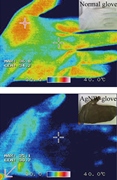 |
| Heat-based images show a conventional cloth glove (top) lets warmth escape while a nanowire glove traps it. Credit: American Chemical Society |
Abstract:
To stay warm when temperatures drop outside, we heat our indoor spaces -- even when no one is in them. But scientists have now developed a novel nanowire coating for clothes that can both generate heat and trap the heat from our bodies better than regular clothes. They report on their technology, which could help us reduce our reliance on conventional energy sources, in the ACS journal Nano Letters.
Nanowire clothing could keep people warm -- without heating everything else
Washington, DC | Posted on January 7th, 2015i Cui and colleagues note that nearly half of global energy consumption goes toward heating buildings and homes. But this comfort comes with a considerable environmental cost - it's responsible for up to a third of the world's total greenhouse gas emissions. Scientists and policymakers have tried to reduce the impact of indoor heating by improving insulation and construction materials to keep fuel-generated warmth inside. Cui's team wanted to take a different approach and focus on people rather than spaces.
The researchers developed lightweight, breathable mesh materials that are flexible enough to coat normal clothes. When compared to regular clothing material, the special nanowire cloth trapped body heat far more effectively. Because the coatings are made out of conductive materials, they can also be actively warmed with an electricity source to further crank up the heat. The researchers calculated that their thermal textiles could save about 1,000 kilowatt hours per person every year -- that's about how much electricity an average U.S. home consumes in one month.
####
About American Chemical Society
The American Chemical Society is a nonprofit organization chartered by the U.S. Congress. With more than 161,000 members, ACS is the world's largest scientific society and a global leader in providing access to chemistry-related research through its multiple databases, peer-reviewed journals and scientific conferences. Its main offices are in Washington, D.C., and Columbus, Ohio.
For more information, please click here
Contacts:
Michael Bernstein
202-872-6042
Yi Cui, Ph.D.
Department of Materials Science and Engineering
Stanford University
Stanford, CA 94305
and
Stanford Institute for Materials and Energy Sciences
SLAC National Accelerator Laboratory
Menlo Park, CA 94025
Copyright © American Chemical Society
If you have a comment, please Contact us.Issuers of news releases, not 7th Wave, Inc. or Nanotechnology Now, are solely responsible for the accuracy of the content.
Bookmark:


| Related Links |
 DOWNLOAD FULL-TEXT ARTICLE - "Personal Thermal Management by Metallic Nanowire-Coated Textile":
| Related News Press |
News and information
Quantum computer improves AI predictions April 17th, 2026
Flexible sensor gains sensitivity under pressure April 17th, 2026
A reusable chip for particulate matter sensing April 17th, 2026
Detecting vibrational quantum beating in the predissociation dynamics of SF6 using time-resolved photoelectron spectroscopy April 17th, 2026
Discoveries
Quantum computer improves AI predictions April 17th, 2026
Flexible sensor gains sensitivity under pressure April 17th, 2026
A reusable chip for particulate matter sensing April 17th, 2026
Detecting vibrational quantum beating in the predissociation dynamics of SF6 using time-resolved photoelectron spectroscopy April 17th, 2026
Announcements
A fundamentally new therapeutic approach to cystic fibrosis: Nanobody repairs cellular defect April 17th, 2026
UC Irvine physicists discover method to reverse ‘quantum scrambling’ : The work addresses the problem of information loss in quantum computing system April 17th, 2026
Interviews/Book Reviews/Essays/Reports/Podcasts/Journals/White papers/Posters
A fundamentally new therapeutic approach to cystic fibrosis: Nanobody repairs cellular defect April 17th, 2026
UC Irvine physicists discover method to reverse ‘quantum scrambling’ : The work addresses the problem of information loss in quantum computing system April 17th, 2026
Textiles/Clothing
Protective equipment with graphene nanotubes meets the strictest ESD safety standards March 25th, 2022
Polymer fibers with graphene nanotubes make it possible to heat hard-to-reach, complex-shaped items February 11th, 2022
Flexible material shows potential for use in fabrics to heat, cool July 3rd, 2020
Alliances/Trade associations/Partnerships/Distributorships
Chicago Quantum Exchange welcomes six new partners highlighting quantum technology solutions, from Chicago and beyond September 23rd, 2022
University of Illinois Chicago joins Brookhaven Lab's Quantum Center June 10th, 2022
 |
||
 |
||
| The latest news from around the world, FREE | ||
 |
||
|
|
||
| Premium Products | ||
 |
||
|
Only the news you want to read!
Learn More |
||
 |
||
|
Full-service, expert consulting
Learn More |
||
|
|
||