Home > Press > Sussex physicists find simple solution for quantum technology challenge
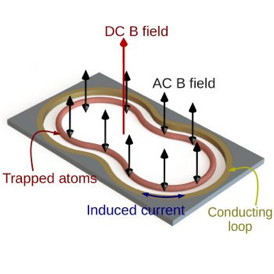 |
| Shaped atom-chip microtrap comprised of a conducting loop (gold) in which currents are induced in the same way as a transformer. |
Abstract:
A solution to one of the key challenges in the development of quantum technologies has been proposed by University of Sussex physicists.
Sussex physicists find simple solution for quantum technology challenge
Brighton, UK | Posted on October 28th, 2014In a paper published today (28 October) in Nature Communications, Professor Barry Garraway and colleagues show how to make a new type of flexibly designed microscopic trap for atoms.
Quantum technology devices, such as high-precision sensors and specialised superfast computers, often depend on harnessing the delicate interaction of atoms. However, the methods for trapping these tiny particles are hugely problematic because of the atoms' tendency to interact with their immediate environment.
The Sussex team, in collaboration with the University of Strathclyde, have now shown that a new technique involving electromagnetic induction could be the solution.
Professor Garraway says: "Our findings are significant because future quantum technologies will depend on confining and manipulating cold atoms. The design of those traps is normally extremely complex and involves stringent requirements for scale and smoothness. Our new approach is simple to implement using a chip-based technology, which is flexible and very robust.
"This is another step towards the development of new quantum technologies that will revolutionise many aspects of our lives. Already, our researchers in Atomic, Molecular and Optical Physics (AMO) are developing devices that could radically change how we measure time, navigate our world, sense our gravitational field and solve seemingly impossible mathematical problems."
####
For more information, please click here
Contacts:
Jacqui Bealing
Tel: 44 01273 678888
Copyright © University of Sussex
If you have a comment, please Contact us.Issuers of news releases, not 7th Wave, Inc. or Nanotechnology Now, are solely responsible for the accuracy of the content.
Bookmark:


| Related Links |
| Related News Press |
News and information
 Quantum computer improves AI predictions April 17th, 2026
Flexible sensor gains sensitivity under pressure April 17th, 2026
A reusable chip for particulate matter sensing April 17th, 2026
Detecting vibrational quantum beating in the predissociation dynamics of SF6 using time-resolved photoelectron spectroscopy April 17th, 2026
Physics
UC Irvine physicists discover method to reverse ‘quantum scrambling’ : The work addresses the problem of information loss in quantum computing system April 17th, 2026
Quantum computers simulate fundamental physics: shedding light on the building blocks of nature June 6th, 2025
Chip Technology
A reusable chip for particulate matter sensing April 17th, 2026
Metasurfaces smooth light to boost magnetic sensing precision January 30th, 2026
Quantum Computing
Quantum computer improves AI predictions April 17th, 2026
UC Irvine physicists discover method to reverse ‘quantum scrambling’ : The work addresses the problem of information loss in quantum computing system April 17th, 2026
Researchers develop molecular qubits that communicate at telecom frequencies October 3rd, 2025
Discoveries
Quantum computer improves AI predictions April 17th, 2026
Flexible sensor gains sensitivity under pressure April 17th, 2026
A reusable chip for particulate matter sensing April 17th, 2026
Detecting vibrational quantum beating in the predissociation dynamics of SF6 using time-resolved photoelectron spectroscopy April 17th, 2026
Announcements
A fundamentally new therapeutic approach to cystic fibrosis: Nanobody repairs cellular defect April 17th, 2026
UC Irvine physicists discover method to reverse ‘quantum scrambling’ : The work addresses the problem of information loss in quantum computing system April 17th, 2026
Interviews/Book Reviews/Essays/Reports/Podcasts/Journals/White papers/Posters
A fundamentally new therapeutic approach to cystic fibrosis: Nanobody repairs cellular defect April 17th, 2026
UC Irvine physicists discover method to reverse ‘quantum scrambling’ : The work addresses the problem of information loss in quantum computing system April 17th, 2026
Research partnerships
Lab to industry: InSe wafer-scale breakthrough for future electronics August 8th, 2025
HKU physicists uncover hidden order in the quantum world through deconfined quantum critical points April 25th, 2025
 |
||
 |
||
| The latest news from around the world, FREE | ||
 |
||
|
|
||
| Premium Products | ||
 |
||
|
Only the news you want to read!
Learn More |
||
 |
||
|
Full-service, expert consulting
Learn More |
||
|
|
||