Home > Press > Anasys' EPFL users publish their AFM-IR application of research into photosynthesis
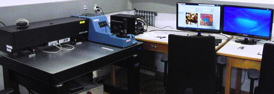 |
| The Anasys nanoIR system of Andrzej Kulik from Giovanni Dietler's group at EPFL |
Abstract:
Anasys Instruments reports on EPFL's publication in Plant Cell on the use of nanoIR to look into the process of photosynthesis to shed more light on how plants produce energy.
Anasys' EPFL users publish their AFM-IR application of research into photosynthesis
Santa Barbara, CA | Posted on October 22nd, 2013École Polytechnique Federale de Lausanne, better known as EPFL, has recently reported on how a group of its scientists have used powerful imaging techniques including nanoIR to support a study which sheds light on photosynthesis.
All plants use a form of photosynthesis to produce energy, though not all rely exclusively on it. In higher plants, capturing light takes place in specialized compartments called thylakoids. These are found in cell organelles called chloroplasts, which are the equivalent of a power station for the plant. Despite being well-defined from a biochemical perspective, photosynthesis is still a mystery when we consider what happens at the level of the cell. Collaborating in a study published in Plant Cell, EPFL scientists have used a range of microscopy and visualization techniques to understand how the largest photosynthetic pigment-protein antenna complex, known as light-harvesting complex II (LHCII) behave to capture light.
Andrzej Kulik from Giovanni Dietler's group at EPFL, collaborating with Wiesław Gruszecki at the Maria Curie-Sklodowska University and with researchers at the University of Warsaw compared LHCII-membrane complexes isolated from spinach leaves. The difference lay in the amount of light the complexes had received: One group came from leaves adapted to the dark and the other from leaves previously exposed to high-intensity light. Using X-ray diffraction, nanoscale infrared imaging microscopy*, confocal laser scanning microscopy, and transmission electron microscopy, the researchers found that the dark-adapted LHCII-membranes complexes assembled into rivet-like stacks of bilayers (like a typical chloroplast membranes), while the pre-illuminated complexes formed 3-D forms that were considerably less structured.
The authors conclude that the formation of bilayer, rivet-like structures is crucial in determining how the thylakoid membrane structures itself in response to light exposure. Depending on how much light they receive, the membranes can either stack up on each other or unstack in order to better utilize the energy captured.
* Dr Kulik describes nanoIR as "one of the most important breakthroughs in the AFM technique since it adds chemical composition information to nanoscale morphology. Its ease of use will ensure its wide adoption given the crucial importance of nanoscale chemical composition in most research applications.'
####
About Anasys Instruments
Anasys Instruments is dedicated to delivering innovative products that measure material properties for samples with spatially varying physical and chemical properties at the nanoscale. Anasys introduced the nano-TA in 2006 which pioneered the field of nanoscale thermal property measurement. In 2010, Anasys introduced the award-winning breakthrough nanoIR™ Platform which pioneered the field of nanoscale IR measurement. Most recently, Anasys is proud to introduce the breakthrough Lorentz Force Contact Resonance, which pioneers the field of wideband nanomechanical spectroscopy.
For more information, please click here
Contacts:
Anasys contact:
Roshan Shetty
Anasys Instruments Corporation
121 Gray Avenue, Suite 100
Santa Barbara
CA 93101 USA
Tel: +1 (805) 730-3310
http://www.anasysinstruments.com/
Media contact:
Jezz Leckenby
Talking Science Limited
39 de Bohun Court
Saffron Walden
Essex CB10 2BA, UK
Tel +44 (0) 1799 521881
Mob +44 (0) 7843 012997
http://www.talking-science.com/
Copyright © Anasys Instruments
If you have a comment, please Contact us.Issuers of news releases, not 7th Wave, Inc. or Nanotechnology Now, are solely responsible for the accuracy of the content.
Bookmark:


| Related News Press |
News and information
 Quantum computer improves AI predictions April 17th, 2026
Flexible sensor gains sensitivity under pressure April 17th, 2026
A reusable chip for particulate matter sensing April 17th, 2026
Detecting vibrational quantum beating in the predissociation dynamics of SF6 using time-resolved photoelectron spectroscopy April 17th, 2026
Imaging
Simple algorithm paired with standard imaging tool could predict failure in lithium metal batteries August 8th, 2025
Discoveries
Quantum computer improves AI predictions April 17th, 2026
Flexible sensor gains sensitivity under pressure April 17th, 2026
A reusable chip for particulate matter sensing April 17th, 2026
Detecting vibrational quantum beating in the predissociation dynamics of SF6 using time-resolved photoelectron spectroscopy April 17th, 2026
Announcements
A fundamentally new therapeutic approach to cystic fibrosis: Nanobody repairs cellular defect April 17th, 2026
UC Irvine physicists discover method to reverse ‘quantum scrambling’ : The work addresses the problem of information loss in quantum computing system April 17th, 2026
Tools
Metasurfaces smooth light to boost magnetic sensing precision January 30th, 2026
From sensors to smart systems: the rise of AI-driven photonic noses January 30th, 2026
Japan launches fully domestically produced quantum computer: Expo visitors to experience quantum computing firsthand August 8th, 2025
Energy
Sensors innovations for smart lithium-based batteries: advancements, opportunities, and potential challenges August 8th, 2025
Simple algorithm paired with standard imaging tool could predict failure in lithium metal batteries August 8th, 2025
Nanobiotechnology
A fundamentally new therapeutic approach to cystic fibrosis: Nanobody repairs cellular defect April 17th, 2026
New molecular technology targets tumors and simultaneously silences two ‘undruggable’ cancer genes August 8th, 2025
New imaging approach transforms study of bacterial biofilms August 8th, 2025
Electrifying results shed light on graphene foam as a potential material for lab grown cartilage June 6th, 2025
 |
||
 |
||
| The latest news from around the world, FREE | ||
 |
||
|
|
||
| Premium Products | ||
 |
||
|
Only the news you want to read!
Learn More |
||
 |
||
|
Full-service, expert consulting
Learn More |
||
|
|
||