Home > Press > Semi-nonlinear etchless lithium niobate waveguide with bound states in the continuum
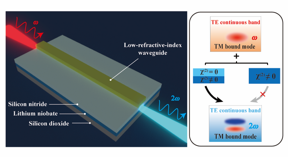 |
| Schematic of the BIC-based semi-nonlinear photonic waveguide and its nonlinear frequency conversion. CREDIT by Xueshi Li, Jiantao Ma, Shunfa Liu, Peinian Huang, Bo Chen, Dunzhao Wei, Jin Liu |
Abstract:
Lithium niobite (LN) with an ultra-wide optical transparent window has shown excellent nonlinear, electro-optic, acoustic-optic, piezoelectric, thermoelectric and photorefractive effects. It is an excellent platform for realizing χ(2) nonlinear photonic devices with low power consumption and high efficiency. However, phase matching condition among the nonlinear interacting optical fields and advanced nanofabrication techniques are required to realize high-performance LN nonlinear devices. On the one hand, an etchless LN waveguide structure, based on bound states in the continuum (BIC), has been proposed to simplify the nanofabrication process. On the other hand, most of the modal phase matching (MPM) processes suffer from the significant mode profile disparities between the fundamental frequency (FF) and the second harmonic (SH) waves, resulting in a small or even vanishing nonlinear modal overlap and consequently limiting the conversion efficiency. Alternatively, quasi-phase matching can be achieved by periodic poling of LN waveguides to maximize the nonlinear modal overlap, but the poling process is technologically nontrivial.
Semi-nonlinear etchless lithium niobate waveguide with bound states in the continuum
Changchun, China | Posted on November 4th, 2022Xueshi Li, Dunzhao Wei, Jin Liu et al. from Sun Yat-sen University have reported efficient SHG by harnessing the BIC in a highly engineerable semi-nonlinear waveguide constructed by electron-beam resist waveguide and thin-film silicon nitride (SiN) and LN, as shown in Fig.1. This device shows the following advantages: (a) Low propagation losses for FF and SH waves; (b) achievement of MPM; (c) Large nonlinear modal overlap for FF TM00 and SH TM01 mode.
Bound propagation modes of the device were guided by a patterned low-refractive-index (LRI) waveguide but confined in a high refractive SiN/LN thin films. Since TM-like modes are immersed in the high-loss continuous TE-like modes, it will encounter propagation loss due to its coupling with TE-like modes. However, by carefully designing octave-separating BICs for the nonlinear interacting TM modes in such a hybrid structure, one can largely decrease the propagation losses of both FF and SH waves. In addition, the efficient second-harmonic generation (SHG) not only requires phase matching between the FF and SH modes, but also depends on their nonlinear modal overlap integrals. In the nonlinear conversion between the FF TM00 mode at the telecom band and the SH TM01 mode at the visible band, the nonlinear overlapping integral is not zero any more due to the vanishing χ(2) of SiN, which could achieve a theoretical normalized conversion efficiency of 327% W-1cm-2.
Such devices can be fabricated by simple procedures. Firstly, a SiN layer of similar thickness is deposited on the LN thin film. Then a LRI waveguide structure is fabricated by electron-beam lithography on top of the SiN layer, as shown in Fig. 2a. the processes of etching and ferroelectric domain poling are not involved. A fiber-coupled optical system shown in Fig. 2b is used to characterize the SHG. Figure 2c shows the relationship between the SH intensity and the FF wavelength, which proves the existence of the MPM process. Fixing the FF wavelength at the phase matching point of 1570 nm, the power dependence of SH wave is measured, as shown in Fig. 2d. The on-chip normalized conversion efficiency of the device is calculated to be 4.05% W-1cm-2.
This work provides a versatile and fabrication-friendly platform to study on-chip nonlinear optical processes with high efficiency in the context of nanophotonics and quantum optics, and explore new nonlinear physical phenomena, such as non-Hermitian systems, nonlinear topologies, etc.
####
For more information, please click here
Contacts:
Media Contact
Yaobiao Li
Light Publishing Center, Changchun Institute of Optics, Fine Mechanics And Physics, CAS
Office: 86-431-861-76851
Expert Contact
Xueshi Li
Sun Yat-Sen University, China
Copyright © Light Publishing Center, Changchun Institute of Optics, Fine Mechanics And Physics, CAS
If you have a comment, please Contact us.Issuers of news releases, not 7th Wave, Inc. or Nanotechnology Now, are solely responsible for the accuracy of the content.
Bookmark:


| Related Links |
| Related News Press |
News and information
 Quantum computer improves AI predictions April 17th, 2026
Flexible sensor gains sensitivity under pressure April 17th, 2026
A reusable chip for particulate matter sensing April 17th, 2026
Detecting vibrational quantum beating in the predissociation dynamics of SF6 using time-resolved photoelectron spectroscopy April 17th, 2026
Nanofabrication
Self-propelled protein-based nanomotors for enhanced cancer therapy by inducing ferroptosis June 6th, 2025
Multiphoton polymerization: A promising technology for precision medicine February 28th, 2025
New chip opens door to AI computing at light speed February 16th, 2024
Govt.-Legislation/Regulation/Funding/Policy
Quantum computer improves AI predictions April 17th, 2026
Metasurfaces smooth light to boost magnetic sensing precision January 30th, 2026
New imaging approach transforms study of bacterial biofilms August 8th, 2025
Possible Futures
A fundamentally new therapeutic approach to cystic fibrosis: Nanobody repairs cellular defect April 17th, 2026
UC Irvine physicists discover method to reverse ‘quantum scrambling’ : The work addresses the problem of information loss in quantum computing system April 17th, 2026
Chip Technology
A reusable chip for particulate matter sensing April 17th, 2026
Metasurfaces smooth light to boost magnetic sensing precision January 30th, 2026
Optical computing/Photonic computing
ICFO researchers overcome long-standing bottleneck in single photon detection with twisted 2D materials August 8th, 2025
Programmable electron-induced color router array May 14th, 2025
Discoveries
Quantum computer improves AI predictions April 17th, 2026
Flexible sensor gains sensitivity under pressure April 17th, 2026
A reusable chip for particulate matter sensing April 17th, 2026
Detecting vibrational quantum beating in the predissociation dynamics of SF6 using time-resolved photoelectron spectroscopy April 17th, 2026
Materials/Metamaterials/Magnetoresistance
First real-time observation of two-dimensional melting process: Researchers at Mainz University unveil new insights into magnetic vortex structures August 8th, 2025
Researchers unveil a groundbreaking clay-based solution to capture carbon dioxide and combat climate change June 6th, 2025
A 1960s idea inspires NBI researchers to study hitherto inaccessible quantum states June 6th, 2025
Institute for Nanoscience hosts annual proposal planning meeting May 16th, 2025
Announcements
A fundamentally new therapeutic approach to cystic fibrosis: Nanobody repairs cellular defect April 17th, 2026
UC Irvine physicists discover method to reverse ‘quantum scrambling’ : The work addresses the problem of information loss in quantum computing system April 17th, 2026
Interviews/Book Reviews/Essays/Reports/Podcasts/Journals/White papers/Posters
A fundamentally new therapeutic approach to cystic fibrosis: Nanobody repairs cellular defect April 17th, 2026
UC Irvine physicists discover method to reverse ‘quantum scrambling’ : The work addresses the problem of information loss in quantum computing system April 17th, 2026
Battery Technology/Capacitors/Generators/Piezoelectrics/Thermoelectrics/Energy storage
Decoding hydrogen‑bond network of electrolyte for cryogenic durable aqueous zinc‑ion batteries January 30th, 2026
COF scaffold membrane with gate‑lane nanostructure for efficient Li+/Mg2+ separation January 30th, 2026
MXene nanomaterials enter a new dimension Multilayer nanomaterial: MXene flakes created at Drexel University show new promise as 1D scrolls January 30th, 2026
Grants/Sponsored Research/Awards/Scholarships/Gifts/Contests/Honors/Records
Quantum computer improves AI predictions April 17th, 2026
Detecting vibrational quantum beating in the predissociation dynamics of SF6 using time-resolved photoelectron spectroscopy April 17th, 2026
Metasurfaces smooth light to boost magnetic sensing precision January 30th, 2026
Photonics/Optics/Lasers
Metasurfaces smooth light to boost magnetic sensing precision January 30th, 2026
From sensors to smart systems: the rise of AI-driven photonic noses January 30th, 2026
 |
||
 |
||
| The latest news from around the world, FREE | ||
 |
||
|
|
||
| Premium Products | ||
 |
||
|
Only the news you want to read!
Learn More |
||
 |
||
|
Full-service, expert consulting
Learn More |
||
|
|
||