Home > Press > Penn researchers improve computer modeling for designing drug-delivery nanocarriers
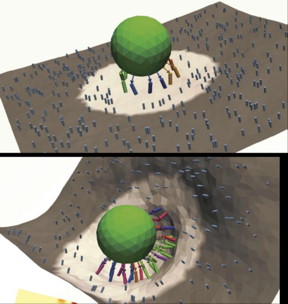 |
| Previous work by some of the researchers uncovered a counter-intuitive relationship that suggested that adding more targeting molecules on the nanocarrier's surface is not always better, as increases in stability may come with decreases in targeting specificity. Understanding the role the fluttering of the target cell's surface plays in this equation is necessary for better design of nanocarriers. CREDIT: University of Pennsylvania |
Abstract:
A team of University of Pennsylvania researchers has developed a computer model that will aid in the design of nanocarriers, microscopic structures used to guide drugs to their targets in the body. The model better accounts for how the surfaces of different types of cells undulate due to thermal fluctuations, informing features of the nanocarriers that will help them stick to cells long enough to deliver their payloads.
Penn researchers improve computer modeling for designing drug-delivery nanocarriers
Philadelphia, PA | Posted on August 8th, 2016The study was led by Ravi Radhakrishnan, a professor in the departments of bioengineering and chemical and biomolecular engineering in Penn's School of Engineering and Applied Science, and Ramakrishnan Natesan, a member of his lab.
Also contributing to the study were Richard Tourdot, a Radhakrishnan lab member; David Eckmann, the Horatio C. Wood Professor of Anesthesiology and Critical Care in Penn's Perelman School of Medicine; Portonovo Ayyaswamy, the Asa Whitney Professor of Mechanical Engineering and Applied Mechanics in Penn Engineering; and Vladimir Muzykantov, a professor of pharmacology in Penn Medicine.
It was published in the journal Royal Society Open Science.
Nanocarriers can be designed with molecules on their exteriors that only bind to biomarkers found on a certain type of cell. This type of targeting could reduce side effects, such as when chemotherapy drugs destroy healthy cells instead of cancerous ones, but the biomechanics of this binding process are complex.
Previous work by some of the researchers uncovered a counter-intuitive relationship that suggested that adding more targeting molecules on the nanocarrier's surface is not always better.
A nanocarrier with more of those targeting molecules might find and bind to many of the corresponding biomarkers at once. While such a configuration is stable, it can decrease the nanocarrier's ability to distinguish between healthy and diseased tissues. Having fewer targeting molecules makes the nanocarrier more selective, as it will have a harder time binding to healthy tissue where the corresponding biomarkers are not over-expressed.
The team's new study adds new dimensions to the model of the interplay between the cellular surface and the nanocarrier.
"The cell surface itself is like a caravan tent on a windy day on a desert," Radhakrishnan said. "The more excess in the cloth, the more the flutter of the tent. Similarly, the more excess cell membrane area on the 'tent poles,' the cytoskeleton of the cell, the more the flutter of the membrane due to thermal motion."
The Penn team found that different cell types have differing amounts of this excess membrane area and that this mechanical parameter governs how well nanocarriers can bind to the cell. Accounting for the fluttering of the membrane in their computer models, in addition to the quantity of targeting molecules on the nanocarrier and biomarkers on the cell surface, has highlighted the importance of these mechanical aspects in how efficiently nanocarriers can deliver their payloads.
"These design criteria," Radhakrishnan said, "can be utilized in custom designing nanocarriers for a given patient or patient-cohort, hence showing an important way forward for custom nanocarrier design in the era of personalized medicine."
###
The research was supported by the National Science Foundation through grants DMR-1120901, CBET-1236514 and MCB060006, and the National Institutes of Health through grants U01EB016027, 1R01EB006818-05, HL125462 and HL087936.
####
For more information, please click here
Contacts:
Evan Lerner
215-573-6604
Copyright © University of Pennsylvania
If you have a comment, please Contact us.Issuers of news releases, not 7th Wave, Inc. or Nanotechnology Now, are solely responsible for the accuracy of the content.
Bookmark:


| Related Links |
| Related News Press |
News and information
 Quantum computer improves AI predictions April 17th, 2026
Flexible sensor gains sensitivity under pressure April 17th, 2026
A reusable chip for particulate matter sensing April 17th, 2026
Detecting vibrational quantum beating in the predissociation dynamics of SF6 using time-resolved photoelectron spectroscopy April 17th, 2026
Cancer
New molecular technology targets tumors and simultaneously silences two ‘undruggable’ cancer genes August 8th, 2025
Ben-Gurion University of the Negev researchers several steps closer to harnessing patient's own T-cells to fight off cancer June 6th, 2025
Self-propelled protein-based nanomotors for enhanced cancer therapy by inducing ferroptosis June 6th, 2025
Govt.-Legislation/Regulation/Funding/Policy
Quantum computer improves AI predictions April 17th, 2026
Metasurfaces smooth light to boost magnetic sensing precision January 30th, 2026
New imaging approach transforms study of bacterial biofilms August 8th, 2025
Possible Futures
A fundamentally new therapeutic approach to cystic fibrosis: Nanobody repairs cellular defect April 17th, 2026
UC Irvine physicists discover method to reverse ‘quantum scrambling’ : The work addresses the problem of information loss in quantum computing system April 17th, 2026
Nanomedicine
A fundamentally new therapeutic approach to cystic fibrosis: Nanobody repairs cellular defect April 17th, 2026
New molecular technology targets tumors and simultaneously silences two ‘undruggable’ cancer genes August 8th, 2025
New imaging approach transforms study of bacterial biofilms August 8th, 2025
Electrifying results shed light on graphene foam as a potential material for lab grown cartilage June 6th, 2025
Discoveries
Quantum computer improves AI predictions April 17th, 2026
Flexible sensor gains sensitivity under pressure April 17th, 2026
A reusable chip for particulate matter sensing April 17th, 2026
Detecting vibrational quantum beating in the predissociation dynamics of SF6 using time-resolved photoelectron spectroscopy April 17th, 2026
Announcements
A fundamentally new therapeutic approach to cystic fibrosis: Nanobody repairs cellular defect April 17th, 2026
UC Irvine physicists discover method to reverse ‘quantum scrambling’ : The work addresses the problem of information loss in quantum computing system April 17th, 2026
Interviews/Book Reviews/Essays/Reports/Podcasts/Journals/White papers/Posters
A fundamentally new therapeutic approach to cystic fibrosis: Nanobody repairs cellular defect April 17th, 2026
UC Irvine physicists discover method to reverse ‘quantum scrambling’ : The work addresses the problem of information loss in quantum computing system April 17th, 2026
Nanobiotechnology
A fundamentally new therapeutic approach to cystic fibrosis: Nanobody repairs cellular defect April 17th, 2026
New molecular technology targets tumors and simultaneously silences two ‘undruggable’ cancer genes August 8th, 2025
New imaging approach transforms study of bacterial biofilms August 8th, 2025
Electrifying results shed light on graphene foam as a potential material for lab grown cartilage June 6th, 2025
 |
||
 |
||
| The latest news from around the world, FREE | ||
 |
||
|
|
||
| Premium Products | ||
 |
||
|
Only the news you want to read!
Learn More |
||
 |
||
|
Full-service, expert consulting
Learn More |
||
|
|
||