Home > Press > Atomic force microscope reveals molecular ghosts: Mapping molecules with atomic precision expands toolbox for designing new catalytic reactions
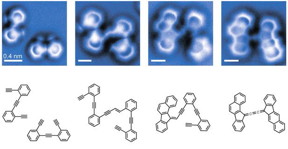 |
| An atomic force microscope was able to take a snapshot of the atoms before and after the reaction, but also found two supposedly short-lived intermediates (center) in this reaction of two enediyne molecules. CREDIT: UC Berkeley |
Abstract:
To the surprise of chemists, a new technique for taking snapshots of molecules with atomic precision is turning up chemicals they shouldn't be able to see.
Atomic force microscope reveals molecular ghosts: Mapping molecules with atomic precision expands toolbox for designing new catalytic reactions
Berkeley, CA | Posted on May 11th, 2016Chemical reactions take place so rapidly - often within picoseconds, or a trillionth of a second - that chemists expect intermediate steps in the reaction to be too brief to observe. Only lasers firing in femtosecond bursts - like a strobe flashing every thousandth of a picosecond - can capture the fleeting molecular structures that reacting chemicals form on their way to a final product.
Yet a team of chemists and physicists from the University of California, Berkeley, and Lawrence Berkeley National Laboratory has taken snapshots of two molecules reacting on the surface of a catalyst, and found intermediate structures lasting for the 20 minutes or so it takes to snap a photo.
"Intuitively, we did not expect to see these transient intermediates, because they are so short lived," said Felix Fischer, an assistant professor of chemistry at UC Berkeley. "Based on our traditional understanding, you would expect to see the starting materials and very shortly after, only the product. But we see these intermediates, so something else is going on."
The explanation for these ghostly molecules is now fleshing out details of catalytic reactions that chemists have only vaguely understood until now, and providing new rules for chemical reactions that chemists can exploit to make reactions go faster or more efficiently, or build molecules never before seen.
Fischer himself is just beginning to build a toolbox that will help design or improve catalytic reactions, which are the workhorse of the world's chemical industry, responsible for producing everything from fuel to the building blocks of plastics. These tools could also impact fields such as materials science, nanotechnology, biology and medicine.
"The way chemists think about heterogeneous catalysis appears to be an incomplete picture of what is actually happening on the surface," he said. "If we can understand how to take this tool box and use it in the design of new structures or the synthesis of new materials, that opens a whole new field of chemistry that so far has been dark to us, because we did not know how to actually visualize what is going on."
A paper describing their work appeared online this week in advance of publication in the journal Nature Chemistry.
Atomic force microscopy
Because chemical reactions occur so rapidly, chemists can only infer how chemicals change during the process, as bonds between atoms break and reform, branches rotate or join to form rings, and three-dimensional structures shift. Three years ago, Fischer and UC Berkeley's Michael Crommie, professor of physics, teamed up to apply the atom-scale precision of atomic force microscopy to take snapshots of molecules before and after a reaction, trying to confirm what chemists have always inferred.
Their non-contact atomic force microscope, or nc-AFM, hovers above a surface and detects individual atoms via a microscopic vibrating probe with a sensitive carbon monoxide molecule at its tip. Fischer, Crommie and their UC Berkeley colleagues place molecules on a gold or silver surface and heat them to make them react slowly, then use the nc-AFM to take snapshots over the course of the reaction.
During their first attempt to image a reaction between two molecules, they saw not only the starting chemicals and end product, but also two intermediate chemical structures that should not have been there. If you think of a reaction as a sequence of many intermediate chemical rearrangements, the easy structural changes should happen quickly while more complicated rearrangements would be slower, because there's a higher energy barrier to making those changes. But the intermediates he saw were ones that should have disappeared the fastest, based on current theories.
Organic chemists like Fischer tend to think of a chemical reaction as akin to falling downhill - once it starts, its own energy keeps it going until the final product appears. This concept didn't explain his results, however, so he borrowed an idea from chemical engineers who work with catalysts. To them, some intermediate states are bound more closely to the catalytic surface and lose energy to it, slowing the reaction. It's as if the reaction hit a rock on its downhill trajectory.
Fischer's colleague, Angel Rubio, director of the Max Planck Institute for the Structure and Dynamics of Matter in Hamburg and a professor at the University of the Basque Country in Spain, made extensive supercomputer calculations taking this surface binding into account, but still was not able to predict the intermediates actually observed.
Together they finally hit on the idea of taking into account the entropy changes at each step of the reaction, and matched observations exactly. Entropy - essentially the level of disorder or chaos in a system - hates to decrease, according to the third law of thermodynamics. So some transitions that seem energetically easy get stuck because they go from a flexible structure loosely bound to the catalyst - a high entropy situation - to a more rigid, tightly bound and lower-entropy situation.
"Taking entropy into account could help you understand the distribution of products you get from a heterogeneous catalysis reaction," he said. "It could help you predict which intermediates have a long lifetime on the surface, which ones could move around, adsorb or desorb from the surface, leading to a product distribution that might not be what you want. Then you could tune the reaction towards the product that you desire."
Fischer used his growing toolbox last year to make a molecule that was predicted more than half a century ago but unachievable using standard organic chemistry in solution. Instead, he built it on the surface of a catalyst from custom-made molecules that would normally not react in the right way, but which he guided to create an antiferromagnetic molecule called peripentacene.
"We used this toolbox of surface chemistry and the rules we have learned to make a molecule that no one had been able to make in 60 years," he said. "This is an example of why it is important to understand what is happening on these surfaces, and how you can use this understanding to access structures and reactivities that are not accessible with the standard tools we have right now."
###
Other co-authors of the Nature Chemistry paper are Alexander Riss, Sebastian Wickenburg, Hsin-Zon Tsai, Aaron Bradley, Miguel Ugeda, Han Sae Jung and Patrick Gorman of UC Berkeley, Alejandro Pérez Paz of the Universidad del País Vasco in Spain and Dimas G. De Oteyza of the Donostia International Physics Center in San Sebastián, Spain.
The work was funded by the Department of Energy, Office of Naval Research, European Research Council and Grupos Consolidados UPV/EHU del Gobierno Vasco.
####
For more information, please click here
Contacts:
Robert Sanders
510-643-6998
Copyright © University of California, Berkeley
If you have a comment, please Contact us.Issuers of news releases, not 7th Wave, Inc. or Nanotechnology Now, are solely responsible for the accuracy of the content.
Bookmark:


| Related News Press |
News and information
 Quantum computer improves AI predictions April 17th, 2026
Flexible sensor gains sensitivity under pressure April 17th, 2026
A reusable chip for particulate matter sensing April 17th, 2026
Detecting vibrational quantum beating in the predissociation dynamics of SF6 using time-resolved photoelectron spectroscopy April 17th, 2026
Imaging
Simple algorithm paired with standard imaging tool could predict failure in lithium metal batteries August 8th, 2025
First real-time observation of two-dimensional melting process: Researchers at Mainz University unveil new insights into magnetic vortex structures August 8th, 2025
Physics
UC Irvine physicists discover method to reverse ‘quantum scrambling’ : The work addresses the problem of information loss in quantum computing system April 17th, 2026
Chemistry
Projecting light to dispense liquids: A new route to ultra-precise microdroplets January 30th, 2026
From sensors to smart systems: the rise of AI-driven photonic noses January 30th, 2026
"Nanoreactor" cage uses visible light for catalytic and ultra-selective cross-cycloadditions October 3rd, 2025
Laboratories
Researchers develop molecular qubits that communicate at telecom frequencies October 3rd, 2025
Govt.-Legislation/Regulation/Funding/Policy
Quantum computer improves AI predictions April 17th, 2026
Metasurfaces smooth light to boost magnetic sensing precision January 30th, 2026
New imaging approach transforms study of bacterial biofilms August 8th, 2025
Possible Futures
A fundamentally new therapeutic approach to cystic fibrosis: Nanobody repairs cellular defect April 17th, 2026
UC Irvine physicists discover method to reverse ‘quantum scrambling’ : The work addresses the problem of information loss in quantum computing system April 17th, 2026
Discoveries
Quantum computer improves AI predictions April 17th, 2026
Flexible sensor gains sensitivity under pressure April 17th, 2026
A reusable chip for particulate matter sensing April 17th, 2026
Detecting vibrational quantum beating in the predissociation dynamics of SF6 using time-resolved photoelectron spectroscopy April 17th, 2026
Announcements
A fundamentally new therapeutic approach to cystic fibrosis: Nanobody repairs cellular defect April 17th, 2026
UC Irvine physicists discover method to reverse ‘quantum scrambling’ : The work addresses the problem of information loss in quantum computing system April 17th, 2026
Interviews/Book Reviews/Essays/Reports/Podcasts/Journals/White papers/Posters
A fundamentally new therapeutic approach to cystic fibrosis: Nanobody repairs cellular defect April 17th, 2026
UC Irvine physicists discover method to reverse ‘quantum scrambling’ : The work addresses the problem of information loss in quantum computing system April 17th, 2026
Tools
Metasurfaces smooth light to boost magnetic sensing precision January 30th, 2026
From sensors to smart systems: the rise of AI-driven photonic noses January 30th, 2026
Japan launches fully domestically produced quantum computer: Expo visitors to experience quantum computing firsthand August 8th, 2025
Military
Quantum engineers ‘squeeze’ laser frequency combs to make more sensitive gas sensors January 17th, 2025
Chainmail-like material could be the future of armor: First 2D mechanically interlocked polymer exhibits exceptional flexibility and strength January 17th, 2025
Single atoms show their true color July 5th, 2024
NRL charters Navy’s quantum inertial navigation path to reduce drift April 5th, 2024
Research partnerships
Lab to industry: InSe wafer-scale breakthrough for future electronics August 8th, 2025
HKU physicists uncover hidden order in the quantum world through deconfined quantum critical points April 25th, 2025
 |
||
 |
||
| The latest news from around the world, FREE | ||
 |
||
|
|
||
| Premium Products | ||
 |
||
|
Only the news you want to read!
Learn More |
||
 |
||
|
Full-service, expert consulting
Learn More |
||
|
|
||