Home > Press > Sweet 'quantum dots' light the way for new HIV and Ebola treatment
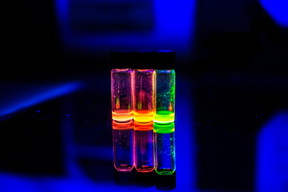 |
| Quantum dots are fluorescent crystals in which the color of the emitted light is dependent on the size of the crystal. CREDIT: Richard E. Cruise, University of Leeds |
Abstract:
A research team led by the University of Leeds has observed for the first time how HIV and Ebola viruses attach to cells to spread infection.
Sweet 'quantum dots' light the way for new HIV and Ebola treatment
Leeds, UK | Posted on March 15th, 2016The findings, published today in the journal Angewandte Chemie, offer a new way of treating such viruses: instead of destroying the pathogens, introduce a block on how they interact with cells.
Lead author Dr Yuan Guo, from the Astbury Centre for Structural Molecular Biology at the University of Leeds, said: "Until now, how these viruses attach to cells was a 'black box' to chemists. We knew that the viruses were interacting with healthy cells, but the way in which they bound together was still a mystery."
In the study, the researchers used nano-sized crystals (about a millionth of a millimetre in size) called 'quantum dots' that mimicked the shape of the viruses and acted as technological stand-ins in experiments to reveal how they bind to cells.
Quantum dots are fluorescent crystals in which the colour of the emitted light is dependent on the size of the crystal - one of several properties that has led to them becoming the most desirable component for the latest generation of televisions. They have also emerged as an advanced type of fluorescent probe for biomolecular and cellular imaging, making them useful for studying how viruses spread.
Using the fluorescence of the quantum dots, the research team behind the new study were able to illuminate the physical binds that attach them to the cells, also revealing how the viruses would bond.
In order to allow the quantum dots to bind to cells, they first had to be coated in sugar - a new technique that was developed at the University of Leeds for this study.
Study co-author Dr Bruce Turnbull, also from the Astbury Centre, and the University's School of Chemistry, said: "We often only hear about sugar in a negative light, about how consuming it is bad for our health. But there are many different types of sugars that play a vital role in human biology. In fact, all of our cells are coated in sugar and they interact with other cells by proteins binding with these sugars. Indeed, the reason why we have different blood types is because of the different types of sugar coating on our red blood cells.
"Viruses also attach to the surface of healthy cells through interactions between proteins and sugars. These interactions are weak individually, but can be reinforced by forming multiple contacts to offer the viruses a 'way in'. We want to understand what factors control this binding process and, eventually, develop a range of inhibitors designed to target specific viral bindings."
The study has already revealed the different ways in which two cell surface sugar binding proteins that were previously thought to be almost indistinguishable - called 'DC-SIGN' and 'DC-SIGNR' - bind to the HIV and Ebola virus surface sugars, thereby spreading the viruses.
Study co-lead author Dr Dejian Zhou, also from the Astbury Centre and the University's School of Chemistry, said: "These proteins are like twins with different personalities. Their physical make-up is almost identical, yet the efficiency with which they transmit different viruses, such as HIV and Ebola, varies dramatically and the reason behind this had been a mystery.
"Our study has revealed a way to differentiate between these proteins, as we have found that the way in which they bind to virus surface sugars is very different. They both attach via four binding sites to strengthen the bond, but the orientation of these binding pockets differs."
A pioneering tradition in structural biology
Further progress in this area will be boosted by the state-of-the-art facilities in the Astbury Centre, enabling researchers to better understand life in molecular detail.
The University of Leeds has played a key role in the birth of structural biology as a scientific discipline, with the development of X-ray crystallography by Nobel Laureates William and Lawrence Bragg in Leeds in 1912-13.
A recent £17 million investment in some of the best nuclear magnetic resonance and electron microscopy facilities in the world is now enabling scientists to remain at the forefront of research into complex proteins.
A new academic symposium, the Asbury Conversation, is being hosted at the University of Leeds from 11 - 12 April 2016, to bring together leading researchers from across the globe to discuss the most recent innovations, new techniques and technologies in the field of structural molecular biology.
A public exhibition and lecture on Tuesday 12 April follows the symposium, aimed at helping people understand the secret life of molecules, including an exhibit called "The complex life of sugars". Professor Michael Levitt, who was awarded the 2013 Nobel Prize in Chemistry for developing computer-based tools to better understand and predict chemical reactions, will be delivering the talk, "How modelling molecules builds our understanding of life."
The research was funded by the Wellcome Trust, with additional funding from the Biotechnology and Biological Sciences Research Council (BBSRC).
####
For more information, please click here
Contacts:
Sarah Reed
44-113-343-4196
Copyright © University of Leeds
If you have a comment, please Contact us.Issuers of news releases, not 7th Wave, Inc. or Nanotechnology Now, are solely responsible for the accuracy of the content.
Bookmark:


| Related Links |
 More information about the Astbury Conversation is available at:
| Related News Press |
News and information
Quantum computer improves AI predictions April 17th, 2026
Flexible sensor gains sensitivity under pressure April 17th, 2026
A reusable chip for particulate matter sensing April 17th, 2026
Detecting vibrational quantum beating in the predissociation dynamics of SF6 using time-resolved photoelectron spectroscopy April 17th, 2026
Govt.-Legislation/Regulation/Funding/Policy
Quantum computer improves AI predictions April 17th, 2026
Metasurfaces smooth light to boost magnetic sensing precision January 30th, 2026
New imaging approach transforms study of bacterial biofilms August 8th, 2025
Nanomedicine
A fundamentally new therapeutic approach to cystic fibrosis: Nanobody repairs cellular defect April 17th, 2026
New molecular technology targets tumors and simultaneously silences two ‘undruggable’ cancer genes August 8th, 2025
New imaging approach transforms study of bacterial biofilms August 8th, 2025
Electrifying results shed light on graphene foam as a potential material for lab grown cartilage June 6th, 2025
Discoveries
Quantum computer improves AI predictions April 17th, 2026
Flexible sensor gains sensitivity under pressure April 17th, 2026
A reusable chip for particulate matter sensing April 17th, 2026
Detecting vibrational quantum beating in the predissociation dynamics of SF6 using time-resolved photoelectron spectroscopy April 17th, 2026
Announcements
A fundamentally new therapeutic approach to cystic fibrosis: Nanobody repairs cellular defect April 17th, 2026
UC Irvine physicists discover method to reverse ‘quantum scrambling’ : The work addresses the problem of information loss in quantum computing system April 17th, 2026
Interviews/Book Reviews/Essays/Reports/Podcasts/Journals/White papers/Posters
A fundamentally new therapeutic approach to cystic fibrosis: Nanobody repairs cellular defect April 17th, 2026
UC Irvine physicists discover method to reverse ‘quantum scrambling’ : The work addresses the problem of information loss in quantum computing system April 17th, 2026
Events/Classes
Institute for Nanoscience hosts annual proposal planning meeting May 16th, 2025
A New Blue: Mysterious origin of the ribbontail ray’s electric blue spots revealed July 5th, 2024
Researchers demonstrate co-propagation of quantum and classical signals: Study shows that quantum encryption can be implemented in existing fiber networks January 20th, 2023
Grants/Sponsored Research/Awards/Scholarships/Gifts/Contests/Honors/Records
Quantum computer improves AI predictions April 17th, 2026
Detecting vibrational quantum beating in the predissociation dynamics of SF6 using time-resolved photoelectron spectroscopy April 17th, 2026
Metasurfaces smooth light to boost magnetic sensing precision January 30th, 2026
Quantum Dots/Rods
A new kind of magnetism November 17th, 2023
IOP Publishing celebrates World Quantum Day with the announcement of a special quantum collection and the winners of two prestigious quantum awards April 14th, 2023
Qubits on strong stimulants: Researchers find ways to improve the storage time of quantum information in a spin rich material January 27th, 2023
NIST’s grid of quantum islands could reveal secrets for powerful technologies November 18th, 2022
Nanobiotechnology
A fundamentally new therapeutic approach to cystic fibrosis: Nanobody repairs cellular defect April 17th, 2026
New molecular technology targets tumors and simultaneously silences two ‘undruggable’ cancer genes August 8th, 2025
New imaging approach transforms study of bacterial biofilms August 8th, 2025
Electrifying results shed light on graphene foam as a potential material for lab grown cartilage June 6th, 2025
 |
||
 |
||
| The latest news from around the world, FREE | ||
 |
||
|
|
||
| Premium Products | ||
 |
||
|
Only the news you want to read!
Learn More |
||
 |
||
|
Full-service, expert consulting
Learn More |
||
|
|
||