Home > Press > 'Swiss cheese' membrane with adjustable holes
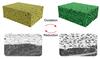 |
| Changing membrane pore size by oxidation and reduction |
Abstract:
The pore size of the smart membranes can be adjusted from the outside: this is very attractive in applications like biosensors or chemical analysis. The ‘Swiss cheese' structure is characteristic of many polymer membranes and is now modified by introducing iron within the polymer. Using an electric signal or a chemical reaction, the pore size can be adjusted. The key to this is controlled adding or extracting of electrons to and from iron.
'Swiss cheese' membrane with adjustable holes
Enschede, Netherlands | Posted on November 2nd, 2014Cheap biosensor
Thanks to this adjustable pore size, the permeability and selectivity of the membrane can be tuned, for separation purposes or controlled release. The UT scientists see possibilities in analysis and separation of proteins, for example. An extra advantage of the new membranes is the change in colour that takes place. The process of protein detection and analysis becomes visible in an easy way, which may lead to a cheap type of biosensor.
Silver nanoparticles
Another application of the smart membrane is in catalysis. Here, it is possible to kill two birds with one stone. Whilst the pore size and permeabiliteit can be altered using a chemical reaction with silver salt, nanosize particles of silver are deposited on the membrane at the same time. Silver is an important catalyst in many applications.
The membrane research is conducted by the Materials Science and Technology of Polymers group, led by Prof. Julius Vancso. This group is part of the MESA+ Institute for Nanotechnology of the University of Twente.
Full bibliographic information
Kaihuan Zhang, Xueling Feng, Dr. Xiaofeng Sui, Dr. Mark A. Hempenius and Prof. G. Julius Vancso, Breathing Pores on Command: Redox-Responsive Spongy Membranes from Poly(ferrocenylsilane)s, Angewandte Chemie International Edition, DOI: 10.1002/anie.201408010
####
For more information, please click here
Contacts:
Wiebe van der Veen
+31612185692
Copyright © AlphaGalileo
If you have a comment, please Contact us.Issuers of news releases, not 7th Wave, Inc. or Nanotechnology Now, are solely responsible for the accuracy of the content.
Bookmark:


| Related News Press |
News and information
 Quantum computer improves AI predictions April 17th, 2026
Flexible sensor gains sensitivity under pressure April 17th, 2026
A reusable chip for particulate matter sensing April 17th, 2026
Detecting vibrational quantum beating in the predissociation dynamics of SF6 using time-resolved photoelectron spectroscopy April 17th, 2026
Chemistry
Projecting light to dispense liquids: A new route to ultra-precise microdroplets January 30th, 2026
From sensors to smart systems: the rise of AI-driven photonic noses January 30th, 2026
"Nanoreactor" cage uses visible light for catalytic and ultra-selective cross-cycloadditions October 3rd, 2025
Cambridge chemists discover simple way to build bigger molecules – one carbon at a time June 6th, 2025
Nanomedicine
A fundamentally new therapeutic approach to cystic fibrosis: Nanobody repairs cellular defect April 17th, 2026
New molecular technology targets tumors and simultaneously silences two ‘undruggable’ cancer genes August 8th, 2025
New imaging approach transforms study of bacterial biofilms August 8th, 2025
Electrifying results shed light on graphene foam as a potential material for lab grown cartilage June 6th, 2025
Sensors
Flexible sensor gains sensitivity under pressure April 17th, 2026
Tiny nanosheets, big leap: A new sensor detects ethanol at ultra-low levels January 30th, 2026
From sensors to smart systems: the rise of AI-driven photonic noses January 30th, 2026
Sensors innovations for smart lithium-based batteries: advancements, opportunities, and potential challenges August 8th, 2025
Discoveries
Quantum computer improves AI predictions April 17th, 2026
Flexible sensor gains sensitivity under pressure April 17th, 2026
A reusable chip for particulate matter sensing April 17th, 2026
Detecting vibrational quantum beating in the predissociation dynamics of SF6 using time-resolved photoelectron spectroscopy April 17th, 2026
Announcements
A fundamentally new therapeutic approach to cystic fibrosis: Nanobody repairs cellular defect April 17th, 2026
UC Irvine physicists discover method to reverse ‘quantum scrambling’ : The work addresses the problem of information loss in quantum computing system April 17th, 2026
Interviews/Book Reviews/Essays/Reports/Podcasts/Journals/White papers/Posters
A fundamentally new therapeutic approach to cystic fibrosis: Nanobody repairs cellular defect April 17th, 2026
UC Irvine physicists discover method to reverse ‘quantum scrambling’ : The work addresses the problem of information loss in quantum computing system April 17th, 2026
Nanobiotechnology
A fundamentally new therapeutic approach to cystic fibrosis: Nanobody repairs cellular defect April 17th, 2026
New molecular technology targets tumors and simultaneously silences two ‘undruggable’ cancer genes August 8th, 2025
New imaging approach transforms study of bacterial biofilms August 8th, 2025
Electrifying results shed light on graphene foam as a potential material for lab grown cartilage June 6th, 2025
 |
||
 |
||
| The latest news from around the world, FREE | ||
 |
||
|
|
||
| Premium Products | ||
 |
||
|
Only the news you want to read!
Learn More |
||
 |
||
|
Full-service, expert consulting
Learn More |
||
|
|
||