Home > Press > 'Molecular Velcro' may lead to cost-effective alternatives to natural antibodies: Berkeley Lab researchers take cues from nature in designing a programmable nanomaterial for biosensing
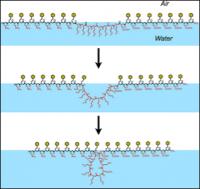 |
| Long organic molecules called peptoids self-assemble into a molecular film on the surface of a water solution. As this film gets folded into a nanosheet, segments of the peptoid get pushed out into loops, which eventually decorate the surface of the nanosheet.
Credit: Berkeley Lab |
Abstract:
Taking inspiration from the human immune system, researchers at the U.S. Department of Energy's Lawrence Berkeley National Laboratory (Berkeley Lab) have created a new material that can be programmed to identify an endless variety of molecules. The new material resembles tiny sheets of Velcro, each just one-hundred nanometers across. But instead of securing your sneakers, this molecular Velcro mimics the way natural antibodies recognize viruses and toxins, and could lead to a new class of biosensors.
'Molecular Velcro' may lead to cost-effective alternatives to natural antibodies: Berkeley Lab researchers take cues from nature in designing a programmable nanomaterial for biosensing
Berkeley, CA | Posted on October 30th, 2013"Antibodies have a really effective architectural design: a structural scaffold that pretty much stays the same, whether it's for snake venom or the common cold, and endlessly variable functional loops that bind foreign invaders," says Ron Zuckermann, a senior scientist at Berkeley Lab's Molecular Foundry. "We've mimicked that here, with a two-dimensional nanosheet scaffold covered with little functional loops like Velcro."
Zuckermann, Director of the Molecular Foundry's Biological Nanostructures Facility, is corresponding author on a paper reporting these results in ACS Nano, titled "Antibody-Mimetic Peptoid Nanosheets for Molecular Recognition." Coauthoring the paper are Gloria K. Olivier, Andrew Cho, Babak Sanii, Michael D. Connolly, and Helen Tran.
Zuckermann's nanosheet scaffolds are self-assembled from peptoids - synthetic, bio-inspired polymers capable of folding into protein-like architectures. Like beads on a string, each peptoid molecule is a long chain of small molecular units arranged in a specific pattern. In earlier work, Zuckermann showed how certain simple peptoids can fold themselves into nanosheets just a few nanometers thick but up to one-hundred micrometers across - dimensions equivalent to a one-millimeter-thick plastic sheet the size of a football field.
"The reason that nanosheets form is because there's a code for it programmed directly into the peptoids," says Zuckermann. "In this case it's admittedly a pretty rudimentary program, but it shows how if you bring in just a little bit of sequence information: Boom! You can make a nanosheet."
To create functional loops on the nanosheets, the researchers insert short molecular segments into nanosheet-forming peptoid polymers. As the peptoids knit themselves together into sheets, the inserted segments are excluded from the fold, pushed out instead into loops upon the nanosheet surface. The functional loops can be programmed to selectively bind certain enzymes or inorganic materials, which makes the new material promising for chemical sensing and catalysis.
"The advantage here is that we're able to make these materials in very high yield," says Gloria Olivier, a postdoctoral researcher and lead author on the paper. "We're borrowing this idea of stringing together a particular sequence of monomers, which Nature uses to build 3D protein structures, and applying it to the world of non-natural materials, to create a really useful material that can assemble itself."
The researchers demonstrated the flexibility of their method by creating nanosheets with loops of varying composition, length, and density; they made nanosheets that can pick specific enzymes out of a solution, causing chemical changes that can be detected with standard techniques, and others that bind selectively to gold metal, seeding the growth of gold nanoparticles and films.
"Peptoids can withstand much harsher conditions than peptides, their counterpart in nature," says Olivier. "So if you wanted to build a diagnostic device that can be taken outside of a laboratory, or a device that can screen for biomarkers in the presence of a mixture of proteins like proteases, peptoids are an excellent choice."
Looking beyond the exciting applications, Zuckermann points out that this work represents an important step toward extending the rules of protein folding to the world of synthetic materials.
Says Zuckermann, "That's kind of what my whole research program here is about: learning from the richness of chemical sequence information found in biology to create new types of advanced synthetic materials. We're really just starting to scratch the surface."
###
This research was funded by the DOE Office of Science and the Defense Threat Reduction Agency. The work was conducted at the Molecular Foundry with support from the Advanced Light Source, and at the Advanced Photon Source at Argonne National Laboratory.
####
About DOE/Lawrence Berkeley National Laboratory
Lawrence Berkeley National Laboratory addresses the world's most urgent scientific challenges by advancing sustainable energy, protecting human health, creating new materials, and revealing the origin and fate of the universe. Founded in 1931, Berkeley Lab's scientific expertise has been recognized with 13 Nobel prizes. The University of California manages Berkeley Lab for the U.S. Department of Energy's Office of Science. For more, visit www.lbl.gov.
The Molecular Foundry is one of five DOE Nanoscale Science Research Centers (NSRCs), national user facilities for interdisciplinary research at the nanoscale, supported by the DOE Office of Science. Together the NSRCs comprise a suite of complementary facilities that provide researchers with state-of-the-art capabilities to fabricate, process, characterize and model nanoscale materials, and constitute the largest infrastructure investment of the National Nanotechnology Initiative. The NSRCs are located at DOE's Argonne, Brookhaven, Lawrence Berkeley, Oak Ridge and Sandia and Los Alamos National Laboratories. For more information about the DOE NSRCs, please visit science.energy.gov
The DOE Office of Science is the single largest supporter of basic research in the physical sciences in the United States and is working to address some of the most pressing challenges of our time. For more information, please visit science.energy.gov.
For more information, please click here
Contacts:
Alison Hatt
510-486-7154
Copyright © DOE/Lawrence Berkeley National Laboratory
If you have a comment, please Contact us.Issuers of news releases, not 7th Wave, Inc. or Nanotechnology Now, are solely responsible for the accuracy of the content.
Bookmark:


| Related Links |
 For more about this research, listen to Episode 75 of the ACS Nano podcast:
For more about Ron Zuckermann's research and the Molecular Foundry, visit:
| Related News Press |
News and information
Quantum computer improves AI predictions April 17th, 2026
Flexible sensor gains sensitivity under pressure April 17th, 2026
A reusable chip for particulate matter sensing April 17th, 2026
Detecting vibrational quantum beating in the predissociation dynamics of SF6 using time-resolved photoelectron spectroscopy April 17th, 2026
Laboratories
Researchers develop molecular qubits that communicate at telecom frequencies October 3rd, 2025
A battery’s hopping ions remember where they’ve been: Seen in atomic detail, the seemingly smooth flow of ions through a battery’s electrolyte is surprisingly complicated February 16th, 2024
NRL discovers two-dimensional waveguides February 16th, 2024
Synthetic Biology
New micromaterial releases nanoparticles that selectively destroy cancer cells April 5th, 2024
Govt.-Legislation/Regulation/Funding/Policy
Quantum computer improves AI predictions April 17th, 2026
Metasurfaces smooth light to boost magnetic sensing precision January 30th, 2026
New imaging approach transforms study of bacterial biofilms August 8th, 2025
Sensors
Flexible sensor gains sensitivity under pressure April 17th, 2026
Tiny nanosheets, big leap: A new sensor detects ethanol at ultra-low levels January 30th, 2026
From sensors to smart systems: the rise of AI-driven photonic noses January 30th, 2026
Sensors innovations for smart lithium-based batteries: advancements, opportunities, and potential challenges August 8th, 2025
Discoveries
Quantum computer improves AI predictions April 17th, 2026
Flexible sensor gains sensitivity under pressure April 17th, 2026
A reusable chip for particulate matter sensing April 17th, 2026
Detecting vibrational quantum beating in the predissociation dynamics of SF6 using time-resolved photoelectron spectroscopy April 17th, 2026
Materials/Metamaterials/Magnetoresistance
First real-time observation of two-dimensional melting process: Researchers at Mainz University unveil new insights into magnetic vortex structures August 8th, 2025
Researchers unveil a groundbreaking clay-based solution to capture carbon dioxide and combat climate change June 6th, 2025
A 1960s idea inspires NBI researchers to study hitherto inaccessible quantum states June 6th, 2025
Institute for Nanoscience hosts annual proposal planning meeting May 16th, 2025
Announcements
A fundamentally new therapeutic approach to cystic fibrosis: Nanobody repairs cellular defect April 17th, 2026
UC Irvine physicists discover method to reverse ‘quantum scrambling’ : The work addresses the problem of information loss in quantum computing system April 17th, 2026
Interviews/Book Reviews/Essays/Reports/Podcasts/Journals/White papers/Posters
A fundamentally new therapeutic approach to cystic fibrosis: Nanobody repairs cellular defect April 17th, 2026
UC Irvine physicists discover method to reverse ‘quantum scrambling’ : The work addresses the problem of information loss in quantum computing system April 17th, 2026
Military
Quantum engineers ‘squeeze’ laser frequency combs to make more sensitive gas sensors January 17th, 2025
Chainmail-like material could be the future of armor: First 2D mechanically interlocked polymer exhibits exceptional flexibility and strength January 17th, 2025
Single atoms show their true color July 5th, 2024
NRL charters Navy’s quantum inertial navigation path to reduce drift April 5th, 2024
Nanobiotechnology
A fundamentally new therapeutic approach to cystic fibrosis: Nanobody repairs cellular defect April 17th, 2026
New molecular technology targets tumors and simultaneously silences two ‘undruggable’ cancer genes August 8th, 2025
New imaging approach transforms study of bacterial biofilms August 8th, 2025
Electrifying results shed light on graphene foam as a potential material for lab grown cartilage June 6th, 2025
 |
||
 |
||
| The latest news from around the world, FREE | ||
 |
||
|
|
||
| Premium Products | ||
 |
||
|
Only the news you want to read!
Learn More |
||
 |
||
|
Full-service, expert consulting
Learn More |
||
|
|
||