Home > Press > Designing Nanomaterials for Drug Delivery
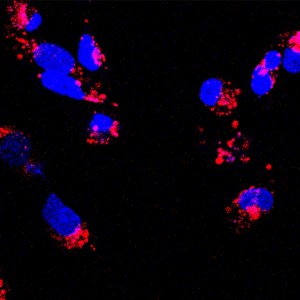 |
| Confocal laser scanning microscopy images of the protein-based nanoparticles incubated with breast cancer cells. |
Abstract:
Natural biological entities have been highly successful in fabricating nanoscale structures and functional systems, leading to scientific exploration of biologically inspired strategies for materials design. In particular, protein-based materials can combine natural properties, structural elements, and biologically reactive sites to obtain self-assembled nanoarchitectures with applications including tissue engineering, nanomaterials synthesis, and drug delivery. However, the functionality of these materials can be limited by the locations or absence of specific chemical conjugation sites.
Designing Nanomaterials for Drug Delivery
Germany | Posted on April 26th, 2012To circumvent this limitation, an investigation by Ren et al., at the University of California, Irvine, implemented a novel, non-covalent strategy to attach guest molecules into a protein-based nanocapsule. Their biomimetic inspiration was multi-drug efflux transporters, which bind a remarkably broad range of structurally-divergent molecules using phenylalanine, a hydrophobic amino acid. Through protein engineering, the team introduced targeted non-native phenylalanines into the hollow cavity of a caged protein scaffold.
The transformed nanoparticles enabled the antitumor drug doxorubicin to bind to the cavity at high loading capacities. These drug-protein complexes could subsequently be applied to induce death in breast cancer cells. Significantly, this work demonstrates a generalized strategy to engineer binding domains within protein-based materials that does not rely on conventional chemical coupling, thus extending the potential functionality of such materials.
Source: University of California, Irvine
####
For more information, please click here
Copyright © Wiley-VCH Materials Science Journals
If you have a comment, please Contact us.Issuers of news releases, not 7th Wave, Inc. or Nanotechnology Now, are solely responsible for the accuracy of the content.
Bookmark:


| Related News Press |
News and information
 Quantum computer improves AI predictions April 17th, 2026
Flexible sensor gains sensitivity under pressure April 17th, 2026
A reusable chip for particulate matter sensing April 17th, 2026
Detecting vibrational quantum beating in the predissociation dynamics of SF6 using time-resolved photoelectron spectroscopy April 17th, 2026
Nanomedicine
A fundamentally new therapeutic approach to cystic fibrosis: Nanobody repairs cellular defect April 17th, 2026
New molecular technology targets tumors and simultaneously silences two ‘undruggable’ cancer genes August 8th, 2025
New imaging approach transforms study of bacterial biofilms August 8th, 2025
Electrifying results shed light on graphene foam as a potential material for lab grown cartilage June 6th, 2025
Discoveries
Quantum computer improves AI predictions April 17th, 2026
Flexible sensor gains sensitivity under pressure April 17th, 2026
A reusable chip for particulate matter sensing April 17th, 2026
Detecting vibrational quantum beating in the predissociation dynamics of SF6 using time-resolved photoelectron spectroscopy April 17th, 2026
Announcements
A fundamentally new therapeutic approach to cystic fibrosis: Nanobody repairs cellular defect April 17th, 2026
UC Irvine physicists discover method to reverse ‘quantum scrambling’ : The work addresses the problem of information loss in quantum computing system April 17th, 2026
 |
||
 |
||
| The latest news from around the world, FREE | ||
 |
||
|
|
||
| Premium Products | ||
 |
||
|
Only the news you want to read!
Learn More |
||
 |
||
|
Full-service, expert consulting
Learn More |
||
|
|
||