Home > Press > Unique close-up of the dynamics of photosynthesis
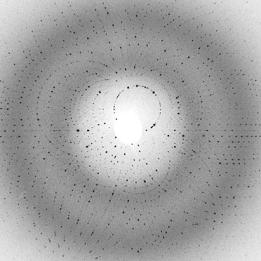 |
| Caption: Photograph of the photosynthetic reaction taken with an 80-microsecond X-ray pulse. Photographer: Gergely Katona/University of Gothenburg. |
Abstract:
Researchers at the University of Gothenburg have managed, with the help of an advanced X-ray flash, to photograph the movement of atoms during photosynthesis - an achievement that has been recognised by the journal Science.
By: Krister Svahn
Unique close-up of the dynamics of photosynthesis
Gothenburg, Sweden | Posted on May 11th, 2010The European Synchrotron Radiation Facility in Grenoble is home to one of the world's most advanced particle accelerators, whose pulsing X-ray beams are used by researchers to photograph and study life's tiniest components: atoms, molecules and proteins.
3D image
Using the special X-ray camera, researchers can depict the position of atoms in a molecule and obtain a three-dimensional image of something that is smaller than a billionth of a metre. Researchers at the Department of Chemistry at the University of Gothenburg and at Chalmers University of Technology have now used this advanced technology to photograph the dynamics of life's most fundamental system: photosynthesis.
On the nano scale
The focus of the study was a protein which is central to the conversion of light to chemical energy during photosynthesis, and which process the Gothenburg researchers have been the first to (successfully photograph) (capture?). The X-ray image shows how the protein temporarily stores the light energy immediately before a chemical bond forms - a movement that takes place on a scale of less than a nanometre.
Future solar panels
The photograph is not only a fascinating snapshot of the very core of life, but could also be used in the solar panels of the future, where researchers hope to be able to imitate the sophisticated energy conversion of photosynthesis.
The photography is highlighted in an article in the next issue of Science.
Link to article: www.sciencemag.org/cgi/content/full/328/5978/630
####
For more information, please click here
Contacts:
Gergely Katona, Department of Chemistry, University of Gothenburg
Tel: +46 707 167586
Annemarie Beate Wöhri, Chalmers University of Technology/AstraZeneca
Tel: +46 704 411988
Richard Neutze, Department of Chemistry, University of Gothenburg
Tel: +46 738 536622
Krister Svahn
+46 31 786 49 12
Copyright © University of Gothenburg
If you have a comment, please Contact us.Issuers of news releases, not 7th Wave, Inc. or Nanotechnology Now, are solely responsible for the accuracy of the content.
Bookmark:


| Related News Press |
News and information
 Quantum computer improves AI predictions April 17th, 2026
Flexible sensor gains sensitivity under pressure April 17th, 2026
A reusable chip for particulate matter sensing April 17th, 2026
Detecting vibrational quantum beating in the predissociation dynamics of SF6 using time-resolved photoelectron spectroscopy April 17th, 2026
Possible Futures
A fundamentally new therapeutic approach to cystic fibrosis: Nanobody repairs cellular defect April 17th, 2026
UC Irvine physicists discover method to reverse ‘quantum scrambling’ : The work addresses the problem of information loss in quantum computing system April 17th, 2026
Academic/Education
Rice University launches Rice Synthetic Biology Institute to improve lives January 12th, 2024
Multi-institution, $4.6 million NSF grant to fund nanotechnology training September 9th, 2022
Announcements
A fundamentally new therapeutic approach to cystic fibrosis: Nanobody repairs cellular defect April 17th, 2026
UC Irvine physicists discover method to reverse ‘quantum scrambling’ : The work addresses the problem of information loss in quantum computing system April 17th, 2026
Energy
Sensors innovations for smart lithium-based batteries: advancements, opportunities, and potential challenges August 8th, 2025
Simple algorithm paired with standard imaging tool could predict failure in lithium metal batteries August 8th, 2025
Solar/Photovoltaic
Spinel-type sulfide semiconductors to operate the next-generation LEDs and solar cells For solar-cell absorbers and green-LED source October 3rd, 2025
KAIST researchers introduce new and improved, next-generation perovskite solar cell November 8th, 2024
Groundbreaking precision in single-molecule optoelectronics August 16th, 2024
Development of zinc oxide nanopagoda array photoelectrode: photoelectrochemical water-splitting hydrogen production January 12th, 2024
 |
||
 |
||
| The latest news from around the world, FREE | ||
 |
||
|
|
||
| Premium Products | ||
 |
||
|
Only the news you want to read!
Learn More |
||
 |
||
|
Full-service, expert consulting
Learn More |
||
|
|
||