Home > Press > Safer, Denser Acetylene Storage in an Organic Framework
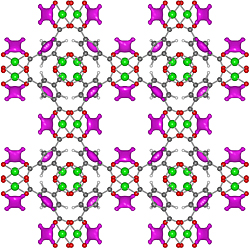 |
| This closeup image of the HKUST-1 metal-organic framework (MOF), recently obtained by NIST scientists, reveals that copper atoms (green) are exposed to the open air within the MOF’s lattice-like structure. The exposed copper allows the MOF to safely store acetylene (magenta) up to 100 times more densely than current methods. Credit: Liu, NIST |
Abstract:
The century-old challenge of transporting acetylene may have been solved in principle by a team of scientists working at the National Institute of Standards and Technology (NIST). A NIST research team has figured out* why a recently discovered material can safely store at low pressure up to 100 times as much of the volatile chemical as can be done with conventional methods.
Safer, Denser Acetylene Storage in an Organic Framework
Gaithersburg, MD | Posted on August 27th, 2009The team has probed the atomic-level workings of a metal-organic framework (MOF), a lattice-like structure made of copper oxide and benzene, that soaks up acetylene like a sponge. Using tools at the NIST Center for Neutron Research (NCNR), the scientists have shown that exposed copper atoms within the lattice give the MOF its talent at storing acetylene. The findings, according to NCNR physicist Yun Liu, could be of use to the chemical industry in the future.
"This discovery could provide substantial savings in acetylene transportation costs," says Liu, a member of the research team, which also included scientists from the University of Texas at San Antonio.
Acetylene, widely used in decades past for welding and illumination, is now also valuable as a starting point for synthesizing a range of chemicals used in plastics and explosives. In the United States alone, several hundred thousand tons of acetylene are produced every year, but its volatility renders it difficult to transport: It becomes dangerously explosive at about 30 psi (207 kilopascal), only about twice normal atmospheric pressure. To safely store acetylene, storage cylinders have to be filled with both porous material and liquid solvents such as acetone.
The research team used neutron powder diffraction and computer calculations at the NCNR to investigate an MOF called HKUST-1, which has a sponge-like interior in which copper atoms are exposed to the air. The analysis showed that the acetylene attaches to the exposed copper by virtue of weak electrical charges, allowing the MOF to store 201 cubic centimeters of acetylene per gram of lattice at ambient pressure—comparable to the amount of similar chemicals that can be contained within a high pressure storage cylinder.
Liu says the fundamental discovery could also help scientists better understand MOFs, which could be used to store other materials. "More than a thousand of these metal—organic frameworks have been created so far," he says. "We hope our technique will turn out to be a good way to check such materials' properties in advance."
* S. Xiang, W. Zhou, J.M. Gallegos, Y. Liu, and B. Chen. Exceptionally High Acetylene Uptake in a Microporous Metal - Organic Framework With Open Metal Sites. Journal of the American Chemical Society, Aug. 11, 2009, DOI 10.1021/ja904782h.
####
About NIST
From automated teller machines and atomic clocks to mammograms and semiconductors, innumerable products and services rely in some way on technology, measurement, and standards provided by the National Institute of Standards and Technology.
Founded in 1901, NIST is a non-regulatory federal agency within the U.S. Department of Commerce. NIST's mission is to promote U.S. innovation and industrial competitiveness by advancing measurement science, standards, and technology in ways that enhance economic security and improve our quality of life.
For more information, please click here
Contacts:
Media Contact
Chad Boutin
(301) 975-4261
Copyright © NIST
If you have a comment, please Contact us.Issuers of news releases, not 7th Wave, Inc. or Nanotechnology Now, are solely responsible for the accuracy of the content.
Bookmark:


| Related News Press |
News and information
 Quantum computer improves AI predictions April 17th, 2026
Flexible sensor gains sensitivity under pressure April 17th, 2026
A reusable chip for particulate matter sensing April 17th, 2026
Detecting vibrational quantum beating in the predissociation dynamics of SF6 using time-resolved photoelectron spectroscopy April 17th, 2026
Chemistry
Projecting light to dispense liquids: A new route to ultra-precise microdroplets January 30th, 2026
From sensors to smart systems: the rise of AI-driven photonic noses January 30th, 2026
"Nanoreactor" cage uses visible light for catalytic and ultra-selective cross-cycloadditions October 3rd, 2025
Cambridge chemists discover simple way to build bigger molecules – one carbon at a time June 6th, 2025
Possible Futures
A fundamentally new therapeutic approach to cystic fibrosis: Nanobody repairs cellular defect April 17th, 2026
UC Irvine physicists discover method to reverse ‘quantum scrambling’ : The work addresses the problem of information loss in quantum computing system April 17th, 2026
Discoveries
Quantum computer improves AI predictions April 17th, 2026
Flexible sensor gains sensitivity under pressure April 17th, 2026
A reusable chip for particulate matter sensing April 17th, 2026
Detecting vibrational quantum beating in the predissociation dynamics of SF6 using time-resolved photoelectron spectroscopy April 17th, 2026
Announcements
A fundamentally new therapeutic approach to cystic fibrosis: Nanobody repairs cellular defect April 17th, 2026
UC Irvine physicists discover method to reverse ‘quantum scrambling’ : The work addresses the problem of information loss in quantum computing system April 17th, 2026
Industrial
Tiny nanosheets, big leap: A new sensor detects ethanol at ultra-low levels January 30th, 2026
Quantum interference in molecule-surface collisions February 28th, 2025
Boron nitride nanotube fibers get real: Rice lab creates first heat-tolerant, stable fibers from wet-spinning process June 24th, 2022
 |
||
 |
||
| The latest news from around the world, FREE | ||
 |
||
|
|
||
| Premium Products | ||
 |
||
|
Only the news you want to read!
Learn More |
||
 |
||
|
Full-service, expert consulting
Learn More |
||
|
|
||