Home > Press > Toward next-generation integrated circuits made from carbon nanotubes
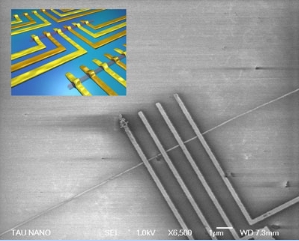 |
| Photo and illustration (inset) of carbon nanotube circuits. (Courtesy of Ze'ev Abrams and Yael Hanein, Tel-Aviv University, Israel) |
Abstract:
Scientists in Israel are reporting the first simple and inexpensive method for building the large-scale networks of single-walled carbon nanotubes (SWCNT) needed for using these microscopic wisps in a future generation of faster, smaller, and more powerful computers and portable electronic devices.
Toward next-generation integrated circuits made from carbon nanotubes
Tel-Aviv, Israel | Posted on September 12th, 2007In a study scheduled for the Sept. 12 issue of ACS' Nano Letters, a monthly journal, Yael Hanein and colleagues point out that no assembly method has solved all of the key problems involved in fabrication of large networks. Those problems range from aligning SWCNTs in a preset pattern to integrating carbon nanotube circuits into an integrated circuit environment similar to those at the heart of conventional microprocessors.
The study describes a method to manufacture and assemble large arrays of SWCNTs into an integrated circuit format. It can be used on a variety of surfaces and produced on an industrial scale. The process involves creating networks of nanotubes suspended between silicon pillars, which are then transferred onto other surfaces by direct stamping, the researchers say.
####
For more information, please click here
Contacts:
Yael Hanein, Ph. D.
Tel-Aviv University
Tel-Aviv 69978, Israel
Phone: 972-3-6407698
Fax: 972-3-6423508
Copyright © ACS
If you have a comment, please Contact us.Issuers of news releases, not 7th Wave, Inc. or Nanotechnology Now, are solely responsible for the accuracy of the content.
Bookmark:


| Related Links |
| Related News Press |
Chip Technology
 A reusable chip for particulate matter sensing April 17th, 2026
Metasurfaces smooth light to boost magnetic sensing precision January 30th, 2026
Nanotubes/Buckyballs/Fullerenes/Nanorods/Nanostrings/Nanosheets
Tiny nanosheets, big leap: A new sensor detects ethanol at ultra-low levels January 30th, 2026
Enhancing power factor of p- and n-type single-walled carbon nanotubes April 25th, 2025
Chainmail-like material could be the future of armor: First 2D mechanically interlocked polymer exhibits exceptional flexibility and strength January 17th, 2025
Innovative biomimetic superhydrophobic coating combines repair and buffering properties for superior anti-erosion December 13th, 2024
Discoveries
Quantum computer improves AI predictions April 17th, 2026
Flexible sensor gains sensitivity under pressure April 17th, 2026
A reusable chip for particulate matter sensing April 17th, 2026
Detecting vibrational quantum beating in the predissociation dynamics of SF6 using time-resolved photoelectron spectroscopy April 17th, 2026
Announcements
A fundamentally new therapeutic approach to cystic fibrosis: Nanobody repairs cellular defect April 17th, 2026
UC Irvine physicists discover method to reverse ‘quantum scrambling’ : The work addresses the problem of information loss in quantum computing system April 17th, 2026
 |
||
 |
||
| The latest news from around the world, FREE | ||
 |
||
|
|
||
| Premium Products | ||
 |
||
|
Only the news you want to read!
Learn More |
||
 |
||
|
Full-service, expert consulting
Learn More |
||
|
|
||