Home > Press > Shaping atomically thin materials in suspended structures
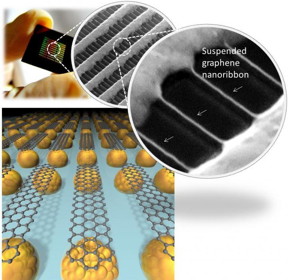 |
| Suspended graphene nanoribbons in wafer-scale. CREDIT: Toshiaki Kato |
Abstract:
Researchers at Tohoku University have realized wafer-scale and high yield synthesis of suspended graphene nanoribbons. The unique growth dynamic has been elucidated through comparing experiments, molecular dynamics simulations and theoretical calculations made with researchers from the University of Tokyo and Hokkaido University.
Shaping atomically thin materials in suspended structures
Sendai, Japan | Posted on June 14th, 2016dding a mechanical degree of freedom to the electrical and optical properties of atomically thin materials can provide an excellent platform to investigate various optoelectrical physics and devices with mechanical motion interaction. The large scale fabrication of such atomically thin materials with suspended structures, remains a challenge.
Led by Associate Prof. Toshiaki Kato, the team has used a bottom-up approach to demonstrate wafer-scale, high-yield synthesis of suspended graphene nanoribbon. This method has shed light on growth dynamics. It is possible to integrate over 1,000,000 suspended graphene nanoribbons in wafer-scale substrate with a high yield of over 90 %.
"Shaping atomically thin materials in suspended structures may provide a viable platform for nanoscale mechanical oscillators," says Kato.
Graphene nanoribbons are strips of graphene with quasi 1D structure (width ~ a few tens nm, length, ~ few μm). Different from 2D graphene, graphene nanoribbon includes band gap depending on its width and edge structures. It is expected to be utilized in next generation high performance optoelectrical semiconductor applications.
Kato adds, "The actualization of high yield and wafer-scale synthesis of suspended graphene nanoribbon will have an impact on the study of graphene nanoribbon, and be used in practical applications in a wide variety of fields."
####
For more information, please click here
Contacts:
Toshiaki Kato
Copyright © Tohoku University
If you have a comment, please Contact us.Issuers of news releases, not 7th Wave, Inc. or Nanotechnology Now, are solely responsible for the accuracy of the content.
Bookmark:


| Related Links |
| Related News Press |
News and information
 Quantum computer improves AI predictions April 17th, 2026
Flexible sensor gains sensitivity under pressure April 17th, 2026
A reusable chip for particulate matter sensing April 17th, 2026
Detecting vibrational quantum beating in the predissociation dynamics of SF6 using time-resolved photoelectron spectroscopy April 17th, 2026
Graphene/ Graphite
Electrifying results shed light on graphene foam as a potential material for lab grown cartilage June 6th, 2025
Breakthrough in proton barrier films using pore-free graphene oxide: Kumamoto University researchers achieve new milestone in advanced coating technologies September 13th, 2024
Possible Futures
A fundamentally new therapeutic approach to cystic fibrosis: Nanobody repairs cellular defect April 17th, 2026
UC Irvine physicists discover method to reverse ‘quantum scrambling’ : The work addresses the problem of information loss in quantum computing system April 17th, 2026
Optical computing/Photonic computing
ICFO researchers overcome long-standing bottleneck in single photon detection with twisted 2D materials August 8th, 2025
Programmable electron-induced color router array May 14th, 2025
Sensors
Flexible sensor gains sensitivity under pressure April 17th, 2026
Tiny nanosheets, big leap: A new sensor detects ethanol at ultra-low levels January 30th, 2026
From sensors to smart systems: the rise of AI-driven photonic noses January 30th, 2026
Sensors innovations for smart lithium-based batteries: advancements, opportunities, and potential challenges August 8th, 2025
Discoveries
Quantum computer improves AI predictions April 17th, 2026
Flexible sensor gains sensitivity under pressure April 17th, 2026
A reusable chip for particulate matter sensing April 17th, 2026
Detecting vibrational quantum beating in the predissociation dynamics of SF6 using time-resolved photoelectron spectroscopy April 17th, 2026
Materials/Metamaterials/Magnetoresistance
First real-time observation of two-dimensional melting process: Researchers at Mainz University unveil new insights into magnetic vortex structures August 8th, 2025
Researchers unveil a groundbreaking clay-based solution to capture carbon dioxide and combat climate change June 6th, 2025
A 1960s idea inspires NBI researchers to study hitherto inaccessible quantum states June 6th, 2025
Institute for Nanoscience hosts annual proposal planning meeting May 16th, 2025
Announcements
A fundamentally new therapeutic approach to cystic fibrosis: Nanobody repairs cellular defect April 17th, 2026
UC Irvine physicists discover method to reverse ‘quantum scrambling’ : The work addresses the problem of information loss in quantum computing system April 17th, 2026
Interviews/Book Reviews/Essays/Reports/Podcasts/Journals/White papers/Posters
A fundamentally new therapeutic approach to cystic fibrosis: Nanobody repairs cellular defect April 17th, 2026
UC Irvine physicists discover method to reverse ‘quantum scrambling’ : The work addresses the problem of information loss in quantum computing system April 17th, 2026
Photonics/Optics/Lasers
Metasurfaces smooth light to boost magnetic sensing precision January 30th, 2026
From sensors to smart systems: the rise of AI-driven photonic noses January 30th, 2026
 |
||
 |
||
| The latest news from around the world, FREE | ||
 |
||
|
|
||
| Premium Products | ||
 |
||
|
Only the news you want to read!
Learn More |
||
 |
||
|
Full-service, expert consulting
Learn More |
||
|
|
||