Home > Press > New nanoparticle reveals cancer treatment effectiveness in real time: 'Reporter nanoparticle' delivers therapeutic payload and glows green when cancer cells die
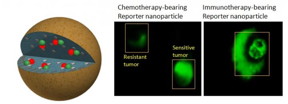 |
| Using reporter nanoparticles loaded with either a chemotherapy or immunotherapy, researchers could distinguish between drug-sensitive and drug-resistant tumors in a pre-clinical model of prostate cancer. CREDIT: Ashish Kulkarni, Brigham and Women's Hospital |
Abstract:
Being able to detect early on whether a cancer therapy is working for a patient can influence the course of treatment and improve outcomes and quality of life. However, conventional detection methods -- such as PET scans, CT and MRI -- usually cannot detect whether a tumor is shrinking until a patient has received multiple cycles of therapy. A new technique developed in pre-clinical models by investigators at Brigham and Women's Hospital (BWH) offers a new approach and a read out on the effectiveness of chemotherapy in as few as eight hours after treatment. The technology can also be used for monitoring the effectiveness of immunotherapy. Using a nanoparticle that delivers a drug and then fluoresces green when cancer cells begin dying, researchers were able to visualize whether a tumor is resistant or susceptible to a particular treatment much sooner than currently available clinical methods. The team's findings are published online this week in The Proceedings of the National Academy of Sciences.
New nanoparticle reveals cancer treatment effectiveness in real time: 'Reporter nanoparticle' delivers therapeutic payload and glows green when cancer cells die
Boston, MA | Posted on March 29th, 2016"Using this approach, the cells light up the moment a cancer drug starts working. We can determine if a cancer therapy is effective within hours of treatment," said co-corresponding author Shiladitya Sengupta, PhD, a principal investigator in BWH's Division of Bioengineering. "Our long-term goal is to find a way to monitor outcomes very early so that we don't give a chemotherapy drug to patients who are not responding to it."
The new technique takes advantage of the fact that when cells die, a particular enzyme known as caspase is activated. The researchers designed a 'reporter element' that, when in the presence of activated caspase, glows green. The team then tested whether they could use the reporter nanoparticles to distinguish between drug-sensitive and drug-resistant tumors. Using nanoparticles loaded with anti-cancer drugs, the team tested a common chemotherapeutic agent, paclitaxel, in a pre-clinical model of prostate cancer and, separately, an immunotherapy that targets PD-L 1 in a pre-clinical model of melanoma. In the tumors that were sensitive to paclitaxel, the team saw an approximately 400 percent increase in fluorescence compared to tumors that were not sensitive to the drug. The team also saw a significant increase in the fluorescent signal in tumors treated with the anti-PD-L1 nanoparticles after five days.
"We've demonstrated that this technique can help us directly visualize and measure the responsiveness of tumors to both types of drugs," said co-corresponding author Ashish Kulkarni, an instructor in the Division of Biomedical Engineering at BWH. "Current techniques, which rely on measurements of the size or metabolic state of the tumor, are sometimes unable to detect the effectiveness of an immunotherapeutic agent as the volume of the tumor may actually increase as immune cells begin to flood in to attack the tumor. Reporter nanoparticles, however, can give us an accurate read out of whether or not cancer cells are dying."
Researchers now plan to focus on the design of radiotracers that can be used in humans, and tests of both safety and efficacy will be necessary before the current technique can be translated into clinical applications. Sengupta, Kulkarni and their colleagues are actively working on these steps in order to further the lab's goal of improving the management and treatment of cancer using nanotechnology.
###
This work is supported by a Department of Defense (DoD) BCRP Collaborative Innovator Grant (W81XWH-09-1-0700), a NIH RO1 (1R01CA135242), a DoD Breakthrough Award (BC132168), an American Lung Association Innovation Award (LCD-259932-N), and an American Cancer Society Postdoctoral Fellowship (122854-PF-12-226-01-CDD).
####
For more information, please click here
Contacts:
Haley Bridger
617-525-6383
Copyright © Brigham and Women's Hospital
If you have a comment, please Contact us.Issuers of news releases, not 7th Wave, Inc. or Nanotechnology Now, are solely responsible for the accuracy of the content.
Bookmark:


| Related Links |
| Related News Press |
News and information
 Quantum computer improves AI predictions April 17th, 2026
Flexible sensor gains sensitivity under pressure April 17th, 2026
A reusable chip for particulate matter sensing April 17th, 2026
Detecting vibrational quantum beating in the predissociation dynamics of SF6 using time-resolved photoelectron spectroscopy April 17th, 2026
Cancer
New molecular technology targets tumors and simultaneously silences two ‘undruggable’ cancer genes August 8th, 2025
Ben-Gurion University of the Negev researchers several steps closer to harnessing patient's own T-cells to fight off cancer June 6th, 2025
Self-propelled protein-based nanomotors for enhanced cancer therapy by inducing ferroptosis June 6th, 2025
Govt.-Legislation/Regulation/Funding/Policy
Quantum computer improves AI predictions April 17th, 2026
Metasurfaces smooth light to boost magnetic sensing precision January 30th, 2026
New imaging approach transforms study of bacterial biofilms August 8th, 2025
Possible Futures
A fundamentally new therapeutic approach to cystic fibrosis: Nanobody repairs cellular defect April 17th, 2026
UC Irvine physicists discover method to reverse ‘quantum scrambling’ : The work addresses the problem of information loss in quantum computing system April 17th, 2026
Nanomedicine
A fundamentally new therapeutic approach to cystic fibrosis: Nanobody repairs cellular defect April 17th, 2026
New molecular technology targets tumors and simultaneously silences two ‘undruggable’ cancer genes August 8th, 2025
New imaging approach transforms study of bacterial biofilms August 8th, 2025
Electrifying results shed light on graphene foam as a potential material for lab grown cartilage June 6th, 2025
Discoveries
Quantum computer improves AI predictions April 17th, 2026
Flexible sensor gains sensitivity under pressure April 17th, 2026
A reusable chip for particulate matter sensing April 17th, 2026
Detecting vibrational quantum beating in the predissociation dynamics of SF6 using time-resolved photoelectron spectroscopy April 17th, 2026
Announcements
A fundamentally new therapeutic approach to cystic fibrosis: Nanobody repairs cellular defect April 17th, 2026
UC Irvine physicists discover method to reverse ‘quantum scrambling’ : The work addresses the problem of information loss in quantum computing system April 17th, 2026
Interviews/Book Reviews/Essays/Reports/Podcasts/Journals/White papers/Posters
A fundamentally new therapeutic approach to cystic fibrosis: Nanobody repairs cellular defect April 17th, 2026
UC Irvine physicists discover method to reverse ‘quantum scrambling’ : The work addresses the problem of information loss in quantum computing system April 17th, 2026
Grants/Sponsored Research/Awards/Scholarships/Gifts/Contests/Honors/Records
Quantum computer improves AI predictions April 17th, 2026
Detecting vibrational quantum beating in the predissociation dynamics of SF6 using time-resolved photoelectron spectroscopy April 17th, 2026
Metasurfaces smooth light to boost magnetic sensing precision January 30th, 2026
Nanobiotechnology
A fundamentally new therapeutic approach to cystic fibrosis: Nanobody repairs cellular defect April 17th, 2026
New molecular technology targets tumors and simultaneously silences two ‘undruggable’ cancer genes August 8th, 2025
New imaging approach transforms study of bacterial biofilms August 8th, 2025
Electrifying results shed light on graphene foam as a potential material for lab grown cartilage June 6th, 2025
 |
||
 |
||
| The latest news from around the world, FREE | ||
 |
||
|
|
||
| Premium Products | ||
 |
||
|
Only the news you want to read!
Learn More |
||
 |
||
|
Full-service, expert consulting
Learn More |
||
|
|
||