Home > Press > Polymer puts new medical solutions within reach
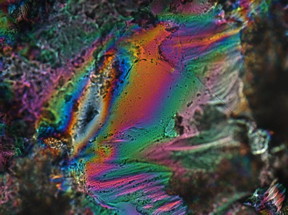 |
| The liquid crystalline hydrogel in a dry state. CREDIT: Patrick Mather |
Abstract:
Researchers, particularly those in the medical field, have been searching for a way to combine the properties of liquid crystallinity with those of hydrogels.
Polymer puts new medical solutions within reach
Syracuse, NY | Posted on January 12th, 2016Liquid crystals are characterized as having the fluidity of liquid but some of the order of a crystal so they can be oriented to have structure. They are not water-loving, in that they will dissolve in water, making them less than ideal candidates for use inside the body.
Hydrogels, however, are water-loving but they lack the order to orient them into specific shapes.
Combining the properties of liquid crystals and hydrogels in just the right proportions creates the potential for new materials that have the same mechanical properties as soft tissues in the body. A material that is water-loving and has structure opens up the door the possibility for artificial blood vessels that are mechanically stealth so they wouldn't be viewed as a foreign body.
Professor Pat Mather has developed a process that can create this type of a polymer.
The paper "A hydrogel-forming liquid crystalline elastomer exhibiting soft shape memory" authored by Mather and graduate student Amir Torbati G'14, now a post-doc at UC Denver, was featured on the cover the Journal of Polymer Science B: Polymer Physics.
"It is a balancing act of not having too many water-loving groups in the polymer and balancing that with other chemicals in the polymer that promote structure." said Mather.
Whatever the hydrogels do to make the liquid crystals water-loving destroys the order of crystallinity, so historically creating a material like this has been a challenge but Mather's process opens to the door to new medical applications that were previously out of reach.
####
For more information, please click here
Contacts:
Ariel Duchene
315-443-2546
Issuers of news releases, not 7th Wave, Inc. or Nanotechnology Now, are solely responsible for the accuracy of the content.
Bookmark:


| Related Links |
 To see the full article visit:
| Related News Press |
News and information
Quantum computer improves AI predictions April 17th, 2026
Flexible sensor gains sensitivity under pressure April 17th, 2026
A reusable chip for particulate matter sensing April 17th, 2026
Detecting vibrational quantum beating in the predissociation dynamics of SF6 using time-resolved photoelectron spectroscopy April 17th, 2026
Display technology/LEDs/SS Lighting/OLEDs
Spinel-type sulfide semiconductors to operate the next-generation LEDs and solar cells For solar-cell absorbers and green-LED source October 3rd, 2025
Efficient and stable hybrid perovskite-organic light-emitting diodes with external quantum efficiency exceeding 40 per cent July 5th, 2024
New organic molecule shatters phosphorescence efficiency records and paves way for rare metal-free applications July 5th, 2024
Hydrogels
Innovative biomimetic superhydrophobic coating combines repair and buffering properties for superior anti-erosion December 13th, 2024
Nanomedicine
A fundamentally new therapeutic approach to cystic fibrosis: Nanobody repairs cellular defect April 17th, 2026
New molecular technology targets tumors and simultaneously silences two ‘undruggable’ cancer genes August 8th, 2025
New imaging approach transforms study of bacterial biofilms August 8th, 2025
Electrifying results shed light on graphene foam as a potential material for lab grown cartilage June 6th, 2025
Discoveries
Quantum computer improves AI predictions April 17th, 2026
Flexible sensor gains sensitivity under pressure April 17th, 2026
A reusable chip for particulate matter sensing April 17th, 2026
Detecting vibrational quantum beating in the predissociation dynamics of SF6 using time-resolved photoelectron spectroscopy April 17th, 2026
Announcements
A fundamentally new therapeutic approach to cystic fibrosis: Nanobody repairs cellular defect April 17th, 2026
UC Irvine physicists discover method to reverse ‘quantum scrambling’ : The work addresses the problem of information loss in quantum computing system April 17th, 2026
Interviews/Book Reviews/Essays/Reports/Podcasts/Journals/White papers/Posters
A fundamentally new therapeutic approach to cystic fibrosis: Nanobody repairs cellular defect April 17th, 2026
UC Irvine physicists discover method to reverse ‘quantum scrambling’ : The work addresses the problem of information loss in quantum computing system April 17th, 2026
 |
||
 |
||
| The latest news from around the world, FREE | ||
 |
||
|
|
||
| Premium Products | ||
 |
||
|
Only the news you want to read!
Learn More |
||
 |
||
|
Full-service, expert consulting
Learn More |
||
|
|
||