Home > Press > Efficient and stable hybrid perovskite-organic light-emitting diodes with external quantum efficiency exceeding 40 per cent
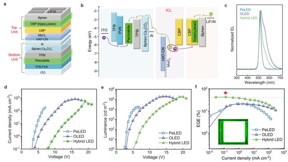 |
| a, Device structure and b, schematic energy band diagram of a hybrid LED. c, EL spectra, d, current density-voltage, e, luminance-voltage and f, EQE- current density characteristics of the PeLED, OLED and hybrid LED. The star marks the maximum EQE value. Inset in (f) is a photo of a hybrid LED operated under biased voltage of 7.5 V, with an active area of 30 mm × 30 mm. CREDIT by Lingmei Kong, Yun Luo, Qianqian Wu, Xiangtian Xiao, Yuanzhi Wang, Guo Chen, Jianhua Zhang, Kai Wang, Wallace C. H. Choy, Yong-Biao Zhao, Hongbo Li, Takayuki Chiba, Junji Kido, and Xuyong Yang |
Abstract:
Light-emitting diode (LED), one of core parts of display equipment, is required to fulfill the requirements of Rec. 2020 color gamut standard for next-generation display applications. Metal-halide perovskites have extremely narrowband emissions and easily tunable bandgaps, which are the only a few kinds of emitters that can fully satisfy the Rec.2020 so far. The fast advances in perovskite LEDs (PeLEDs) have been made in the past few years and the current external quantum efficiency (EQE) of PeLEDs have approached 30%, comparable to those of commercial organic LEDs (OLEDs). However, the intrinsic instability of perovskites still casts a shadow over their practical applications. Combining highly colour-purity perovskite emitters with other mature display technologies such as OLEDs to expand the display color gamut could be a shortcut towards commercialization for high-definition displays.
Efficient and stable hybrid perovskite-organic light-emitting diodes with external quantum efficiency exceeding 40 per cent
Changchun, China | Posted on July 5th, 2024In a new paper published in Light Science & Applications, a team of scientists, led by Professor Xuyong Yang from Key Laboratory of Advanced Display and System Applications of Ministry of Education, Shanghai University, China, and co-workers have developed a stable, efficient and high-color purity hybrid LED with a tandem structure by combining the perovskite LED and the commercial organic LED technologies to accelerate the practical application of perovskites. PeLED and OLED with close photoluminescence peaks are selected to maximize photon emission without photon reabsorption and to achieve the narrowed emission spectra. By designing an efficient interconnecting layer with p-type interface doping that provides good opto-electric coupling and reduces Joule heating, the resulting green emitting hybrid LED shows a narrow line width of around 30 nm, a peak luminance of over 176,000 cd m-2, a maximum external quantum efficiency of over 40%, and an operational half-lifetime of over 42,000 h.
####
For more information, please click here
Contacts:
Media Contact
WEI ZHAO
Changchun Institute of Optics, Fine Mechanics and Physics (CIOMP), Chinese Academy of Sciences
Office: 86-431-861-76852
Expert Contacts
Xuyong Yang
Key Laboratory of Advanced Display and System Applications of Ministry of Education, Shanghai University
Jianhua Zhang
Key Laboratory of Advanced Display and System Applications of Ministry of Education, Shanghai University
Kai Wang
Institute of Nanoscience and Applications, Department of Electrical and Electronic Engineering, Southern University of Science and Technology
Copyright © Light Publishing Center, Changchun Institute of Optics, Fine Mechanics And Physics, CAS
If you have a comment, please Contact us.Issuers of news releases, not 7th Wave, Inc. or Nanotechnology Now, are solely responsible for the accuracy of the content.
Bookmark:


| Related Links |
| Related News Press |
News and information
 Quantum computer improves AI predictions April 17th, 2026
Flexible sensor gains sensitivity under pressure April 17th, 2026
A reusable chip for particulate matter sensing April 17th, 2026
Detecting vibrational quantum beating in the predissociation dynamics of SF6 using time-resolved photoelectron spectroscopy April 17th, 2026
Organic Electronics
Unveiling the power of hot carriers in plasmonic nanostructures August 16th, 2024
Display technology/LEDs/SS Lighting/OLEDs
Spinel-type sulfide semiconductors to operate the next-generation LEDs and solar cells For solar-cell absorbers and green-LED source October 3rd, 2025
Perovskites
KAIST researchers introduce new and improved, next-generation perovskite solar cell November 8th, 2024
Possible Futures
A fundamentally new therapeutic approach to cystic fibrosis: Nanobody repairs cellular defect April 17th, 2026
UC Irvine physicists discover method to reverse ‘quantum scrambling’ : The work addresses the problem of information loss in quantum computing system April 17th, 2026
Discoveries
Quantum computer improves AI predictions April 17th, 2026
Flexible sensor gains sensitivity under pressure April 17th, 2026
A reusable chip for particulate matter sensing April 17th, 2026
Detecting vibrational quantum beating in the predissociation dynamics of SF6 using time-resolved photoelectron spectroscopy April 17th, 2026
Announcements
A fundamentally new therapeutic approach to cystic fibrosis: Nanobody repairs cellular defect April 17th, 2026
UC Irvine physicists discover method to reverse ‘quantum scrambling’ : The work addresses the problem of information loss in quantum computing system April 17th, 2026
Interviews/Book Reviews/Essays/Reports/Podcasts/Journals/White papers/Posters
A fundamentally new therapeutic approach to cystic fibrosis: Nanobody repairs cellular defect April 17th, 2026
UC Irvine physicists discover method to reverse ‘quantum scrambling’ : The work addresses the problem of information loss in quantum computing system April 17th, 2026
 |
||
 |
||
| The latest news from around the world, FREE | ||
 |
||
|
|
||
| Premium Products | ||
 |
||
|
Only the news you want to read!
Learn More |
||
 |
||
|
Full-service, expert consulting
Learn More |
||
|
|
||