Home > Press > Nanopositioning for Electron Microscopy Applications, new Brochure released by PI
 |
Abstract:
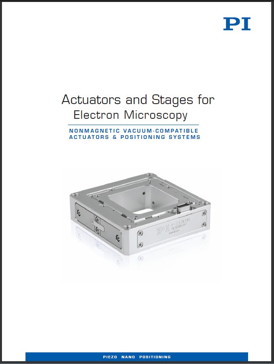
PI's new brochure covers a variety of novel actuators, stages and scanning systems, mostly based on the piezo effect. These ceramic drives are vacuum compatible and can also be manufactured in non-magnetic versions, important for electron microscopy environments.
Nanopositioning for Electron Microscopy Applications, new Brochure released by PI
Auburn, MA | Posted on April 1st, 2014Large Variety of Drive Systems
Piezo flexure stages for fast scanning applications, piezo stick-slip motor drives for economical, compact long-range motion and ultrasonic-ceramic motors for high-speed motion are available. Piezo motors offer excellent long term stability because of their self-clamping properties without the need for a holding current.
Motion systems from simple actuators and XY positioners to complex 6 degree of freedom positioning platforms are available, all operated by digital motion controllers of the latest generation for nanometer precise control and rapid step & settle.
####
About Physik Instrumente (PI)
PI is a leading manufacturer of precision motion control equipment, piezo systems, piezo motors and actuators for nano-technology, microscopy, semiconductor, medical engineering and photonics applications. PI has been developing and manufacturing standard & custom precision products with piezoceramic and electromagnetic drives for 4 decades. The company has been ISO 9001 certified since 1994 and provides innovative, high-quality solutions for OEM and research. PI is present worldwide with ten subsidiaries, R&D / engineering on 3 continents and total staff of 750+
For more information, please click here
Copyright © Physik Instrumente (PI)
If you have a comment, please Contact us.Issuers of news releases, not 7th Wave, Inc. or Nanotechnology Now, are solely responsible for the accuracy of the content.
Bookmark:


| Related Links |
 Download the at Products for Electron Microscopy Brochure:
| Related News Press |
News and information
Quantum computer improves AI predictions April 17th, 2026
Flexible sensor gains sensitivity under pressure April 17th, 2026
A reusable chip for particulate matter sensing April 17th, 2026
Detecting vibrational quantum beating in the predissociation dynamics of SF6 using time-resolved photoelectron spectroscopy April 17th, 2026
Announcements
A fundamentally new therapeutic approach to cystic fibrosis: Nanobody repairs cellular defect April 17th, 2026
UC Irvine physicists discover method to reverse ‘quantum scrambling’ : The work addresses the problem of information loss in quantum computing system April 17th, 2026
Tools
Metasurfaces smooth light to boost magnetic sensing precision January 30th, 2026
From sensors to smart systems: the rise of AI-driven photonic noses January 30th, 2026
Japan launches fully domestically produced quantum computer: Expo visitors to experience quantum computing firsthand August 8th, 2025
 |
||
 |
||
| The latest news from around the world, FREE | ||
 |
||
|
|
||
| Premium Products | ||
 |
||
|
Only the news you want to read!
Learn More |
||
 |
||
|
Full-service, expert consulting
Learn More |
||
|
|
||