Home > Press > Victor Grokhovsky, researcher from Ural Federal University, was awarded the title of the scientist of the year according to Nature journal
 |
Abstract:
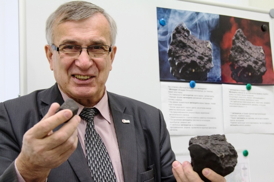
Associate Professor of the Institute of Physical Engineering, Ural Federal University, member of the Meteorites Committee of the Russian Academy of Sciences, Victor Grokhovsky is the only representative of Russian universities who has entered the list of scientists who mattered this year according to Nature journal.
Victor Grokhovsky, researcher from Ural Federal University, was awarded the title of the scientist of the year according to Nature journal
Ekaterinburg, Russia | Posted on December 19th, 2013UrFU researcher gained global recognition thanks to his studies of the substance of the bolide that flew above Chelyabinsk on February 15, its structural characteristics and physical and chemical properties. Victor Grokhovsky participated in the operation of uplifting the largest fragment of the meteorite from the Lake Chebarkul.
"Of course this appreciation is super pleasant; I don't even know why they've chosen me, - said Victor Grokhovsky to the reporter of "Gazeta.Ru". - The most important thing is that the comments we gave after 50 minutes turned out to be accurate, and during 9 months we have not made any mistakes. And it's absolutely fantastic that we managed to uplift the large fragment of the substance from Chebarkul, even from the Moon we brought less substance!"
It is to be recalled that the members of the meteorite expedition for more than 25 years led by Viktor Grokhovsky were the first to find the fragments of the fallen meteorite and deliver them to Yekaterinburg. Direct broadcast from the laboratory of the UrFU research center "Nanotech" attracted several thousand viewers from all over the world in the night of February 17-18; the university researchers demonstrated the meteorite debris for the first time and drew a conclusion about the type of the fallen space body (ordinary chondrite) and its composition.
Using the methods of optical and electronic microscopy in the UrFU research centre "Nanomaterials and nanotechnologies" an unusual diversity of plessite, sulfides and drift copper particles in the meteorite was observed. Besides, the researchers managed to discover the abnormally low strength of the substance that determined the specific character of the space body destruction.
Nature, one of the most reputable scientific journals in the world, has named ten researchers whose studies and achievements played an important role in the development of the global science in the expiring year. The list also includes biologists Shoukhrat Mitalipov and Feng Zhang, virologists Deborah Persaud and Hualan Chen, science adviser of the American Civil Liberties Union Tania Simoncelli, astronomer Michel Mayor, diplomat Naderev Sano, anthropologist Kathryn Clancy and physicist Henry Snaith.
####
For more information, please click here
Contacts:
Marina Sannikova
Phone: 73433745434
Fax: 73433745434
Copyright © Ural Federal University
If you have a comment, please Contact us.Issuers of news releases, not 7th Wave, Inc. or Nanotechnology Now, are solely responsible for the accuracy of the content.
Bookmark:


| Related News Press |
News and information
 Quantum computer improves AI predictions April 17th, 2026
Flexible sensor gains sensitivity under pressure April 17th, 2026
A reusable chip for particulate matter sensing April 17th, 2026
Detecting vibrational quantum beating in the predissociation dynamics of SF6 using time-resolved photoelectron spectroscopy April 17th, 2026
Imaging
Simple algorithm paired with standard imaging tool could predict failure in lithium metal batteries August 8th, 2025
Academic/Education
Rice University launches Rice Synthetic Biology Institute to improve lives January 12th, 2024
Multi-institution, $4.6 million NSF grant to fund nanotechnology training September 9th, 2022
Announcements
A fundamentally new therapeutic approach to cystic fibrosis: Nanobody repairs cellular defect April 17th, 2026
UC Irvine physicists discover method to reverse ‘quantum scrambling’ : The work addresses the problem of information loss in quantum computing system April 17th, 2026
Tools
Metasurfaces smooth light to boost magnetic sensing precision January 30th, 2026
From sensors to smart systems: the rise of AI-driven photonic noses January 30th, 2026
Japan launches fully domestically produced quantum computer: Expo visitors to experience quantum computing firsthand August 8th, 2025
Aerospace/Space
Decoding hydrogen‑bond network of electrolyte for cryogenic durable aqueous zinc‑ion batteries January 30th, 2026
ICFO researchers overcome long-standing bottleneck in single photon detection with twisted 2D materials August 8th, 2025
Onion-like nanoparticles found in aircraft exhaust May 14th, 2025
Grants/Sponsored Research/Awards/Scholarships/Gifts/Contests/Honors/Records
Quantum computer improves AI predictions April 17th, 2026
Detecting vibrational quantum beating in the predissociation dynamics of SF6 using time-resolved photoelectron spectroscopy April 17th, 2026
Metasurfaces smooth light to boost magnetic sensing precision January 30th, 2026
 |
||
 |
||
| The latest news from around the world, FREE | ||
 |
||
|
|
||
| Premium Products | ||
 |
||
|
Only the news you want to read!
Learn More |
||
 |
||
|
Full-service, expert consulting
Learn More |
||
|
|
||