Home > Press > Near-Field Enhancements along Ring-Shaped Nanostructures
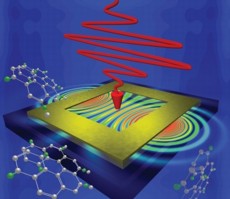 |
| The near-field enhancement on the surface of ring-shaped gold nanostructure becomes homogeneous through circularly polarized light. |
Abstract:
Molecules close to metal nanostuctures which are illuminated by light exhibit a complex electic field. They experience electric forces along the field lines, which become very crowded in sharp regions of the nanostructures, such as corners or tips, and in the regions of high electron density. These regions of crowded field lines are called hotspots which are generally localized to small spots. If it would be possible to expand the local field enhancements to the whole sample surface, heating which limits the field enhancement could be avoided and the interaction with molecules would be increased.
Near-Field Enhancements along Ring-Shaped Nanostructures
Germany | Posted on September 20th, 2012Ventsislav Valev (Katholieke Universiteit Leuven) and co-workers could now demonstrate that such near-field enhancements can be extended over an entire nanopatterned gold surface. The extension of the near-field is achieved by driving the electron density along ring-shaped nanostructures with circularly polarized light. They validated their concept by two sets of numerical simulations as well as by a clear experimental confirmation. The homogeneous field enhancement increases the interaction cross-section with molecules which will be useful for chemical and sensing applications.
The research was reported in Advanced Optical Materials, a new section in Advanced Materials dedicated to breakthrough discoveries and fundamental research in photonics, plasmonics, metamaterials, and more, covering all aspects of light-matter interactions.
####
For more information, please click here
Copyright © Wiley-VCH Materials Science Journals
If you have a comment, please Contact us.Issuers of news releases, not 7th Wave, Inc. or Nanotechnology Now, are solely responsible for the accuracy of the content.
Bookmark:


| Related Links |
 To get Advanced Optical Materials email alerts click here:
| Related News Press |
News and information
Quantum computer improves AI predictions April 17th, 2026
Flexible sensor gains sensitivity under pressure April 17th, 2026
A reusable chip for particulate matter sensing April 17th, 2026
Detecting vibrational quantum beating in the predissociation dynamics of SF6 using time-resolved photoelectron spectroscopy April 17th, 2026
Chemistry
Projecting light to dispense liquids: A new route to ultra-precise microdroplets January 30th, 2026
From sensors to smart systems: the rise of AI-driven photonic noses January 30th, 2026
"Nanoreactor" cage uses visible light for catalytic and ultra-selective cross-cycloadditions October 3rd, 2025
Cambridge chemists discover simple way to build bigger molecules – one carbon at a time June 6th, 2025
Sensors
Flexible sensor gains sensitivity under pressure April 17th, 2026
Tiny nanosheets, big leap: A new sensor detects ethanol at ultra-low levels January 30th, 2026
From sensors to smart systems: the rise of AI-driven photonic noses January 30th, 2026
Sensors innovations for smart lithium-based batteries: advancements, opportunities, and potential challenges August 8th, 2025
Discoveries
Quantum computer improves AI predictions April 17th, 2026
Flexible sensor gains sensitivity under pressure April 17th, 2026
A reusable chip for particulate matter sensing April 17th, 2026
Detecting vibrational quantum beating in the predissociation dynamics of SF6 using time-resolved photoelectron spectroscopy April 17th, 2026
Announcements
A fundamentally new therapeutic approach to cystic fibrosis: Nanobody repairs cellular defect April 17th, 2026
UC Irvine physicists discover method to reverse ‘quantum scrambling’ : The work addresses the problem of information loss in quantum computing system April 17th, 2026
 |
||
 |
||
| The latest news from around the world, FREE | ||
 |
||
|
|
||
| Premium Products | ||
 |
||
|
Only the news you want to read!
Learn More |
||
 |
||
|
Full-service, expert consulting
Learn More |
||
|
|
||