Home > Press > Environmental Concerns Set New Price Challenge For Desalination
 |
Abstract:
Technology will play an important role in the desalination industry's future growth, suggests Global Water Intelligence (GWI) in their new report, published this month.
Environmental Concerns Set New Price Challenge For Desalination
Posted on September 10th, 2010The cost of desalinated water has risen sharply, despite continued efficiency gains in the desalination process, the new report claims. Desalination Markets 2010: Global Forecast and Analysis suggests that savings related to the greater energy efficiency of new desalination plants have failed to compensate for the increased capital cost of new plants (see www.desalmarkets.com/?rnpress2).
Between 1965 when the reverse osmosis desalination process was invented, and 2005 when the Tuas desalination plant in Singapore was commissioned, the price of desalinated water fell to a low of $0.48/m3. However the average recorded cost of desalination plants contracted since then is in the region of $1.03/m3. This reflects the fact that newer plants have been much more expensive to build - primarily because of environmental concerns.
In Australia, in particular, the need for complex fish-friendly intakes and low impact brine disposal systems have pushed up the price of desalinated water. The price of water from some of the new generation of Australian plants (including amortised capital costs) is in excess of $2/m3.
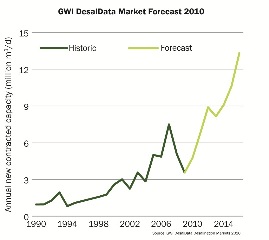
Despite the rising price of desalination demand is growing steeply. The report suggests that global contracted capacity will grow from 68 million m3/d this year to 130 million m3/d in 2016.
Christopher Gasson, editor of the report says: "Until recently no one worried too much about the environmental impact of desalination, but it has become a major consideration in places such as Australia, California and Spain. It has meant that some new desalination plants are very expensive to build. This won't have a long term impact on demand for desalination because it remains the only drought proof alternative for many communities. In the longer term the price of desalination will continue to fall: there has been an acceleration in the rate of investment in new technologies."
The report suggests that new nano-engineered and bio-mimetic membranes are the best hope for bringing down the price of desalinated water, although new technologies such as forward osmosis and membrane distillation are likely to play an important role. Further details of the report's findings, graphics and other material can be found at www.desalmarkets.com/?rnpress2.
Note to editors:
1. Press queries should be directed to Ruth Newcombe on who can arrange interviews with the report's editor, Christopher Gasson. You may also request a .pdf of the Executive Summary.
2. Desalination Markets 2010 is published in September by Global Water Intelligence. See www.globalwaterintel.com/?rnpress2 for details of their subscription publications and other water markets reports.
####
About Global Water Intelligence
Global Water Intelligence is the unchallenged leader in high-value business information for the water industry. The company publishes a monthly magazine, electronic desalination resources and major market reports by water type, country and world region each year.
For more information, please click here
Contacts:
Ruth Newcombe
Phone: +33 627 776 986
Copyright © Global Water Intelligence
If you have a comment, please Contact us.Issuers of news releases, not 7th Wave, Inc. or Nanotechnology Now, are solely responsible for the accuracy of the content.
Bookmark:


| Related News Press |
News and information
 Quantum computer improves AI predictions April 17th, 2026
Flexible sensor gains sensitivity under pressure April 17th, 2026
A reusable chip for particulate matter sensing April 17th, 2026
Detecting vibrational quantum beating in the predissociation dynamics of SF6 using time-resolved photoelectron spectroscopy April 17th, 2026
Announcements
A fundamentally new therapeutic approach to cystic fibrosis: Nanobody repairs cellular defect April 17th, 2026
UC Irvine physicists discover method to reverse ‘quantum scrambling’ : The work addresses the problem of information loss in quantum computing system April 17th, 2026
Interviews/Book Reviews/Essays/Reports/Podcasts/Journals/White papers/Posters
A fundamentally new therapeutic approach to cystic fibrosis: Nanobody repairs cellular defect April 17th, 2026
UC Irvine physicists discover method to reverse ‘quantum scrambling’ : The work addresses the problem of information loss in quantum computing system April 17th, 2026
Water
Taking salt out of the water equation October 7th, 2022
 |
||
 |
||
| The latest news from around the world, FREE | ||
 |
||
|
|
||
| Premium Products | ||
 |
||
|
Only the news you want to read!
Learn More |
||
 |
||
|
Full-service, expert consulting
Learn More |
||
|
|
||