Home > Press > Crystallisation drives controlled assembly of nanoparticles
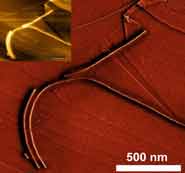 |
| Cylindrical nanostructures on a carbon surface |
Abstract:
A paper published in Nature Chemistry
Crystallisation drives controlled assembly of nanoparticles
Bristol, UK | Posted on May 31st, 2010Cylindrical structures such as fibres or filaments with nanoscale dimensions are rapidly attracting interest for use in a variety of potentially important applications - the controlled delivery of drugs to the body, for instance.
However, the ability to prepare samples where the dimensions are precisely controlled is very rare outside the biological domain. This represents a major drawback as there is a need to create cylindrical structures that vary in length.
A collaboration between researchers in two departments at the University of Bristol, England, and another group at the University of Toronto, Canada, has now led to the discovery of a new self-assembly method for controlling the dimensions of cylinders created from polymer precursors which contain two chemically different segments joined together, so the length of the cylinders can be precisely controlled.
The results are published online today in the prestigious journal Nature Chemistry.
Professor Ian Manners, a senior author on the paper, said: "The method relies on crystallisation as the driving force for the controlled assembly process. The work lays the conceptual groundwork for a broad variety of exciting developments - from the potential discovery of new phenomena to the creation of new nanoscopic devices, multifunctional catalysts, and controlled drug delivery vehicles."
The collaborative work was performed by postdoctoral research associates Dr. Joe Gilroy and Dr. Torben Gaedt, together with Dr. George Whittell and Dr Laurent Chabanne in the Ian Manners Group, and atomic force microscopy expert Dr John Mitchells, all in the School of Chemistry at Bristol, along with Professor Robert Richardson in the Department of Physics at Bristol, and collaborator Professor Mitchell Winnik in the Department of Chemistry at the University of Toronto.
####
For more information, please click here
Contacts:
Aliya Mughal
Copyright © University of Bristol
If you have a comment, please Contact us.Issuers of news releases, not 7th Wave, Inc. or Nanotechnology Now, are solely responsible for the accuracy of the content.
Bookmark:


| Related News Press |
News and information
 Quantum computer improves AI predictions April 17th, 2026
Flexible sensor gains sensitivity under pressure April 17th, 2026
A reusable chip for particulate matter sensing April 17th, 2026
Detecting vibrational quantum beating in the predissociation dynamics of SF6 using time-resolved photoelectron spectroscopy April 17th, 2026
Possible Futures
A fundamentally new therapeutic approach to cystic fibrosis: Nanobody repairs cellular defect April 17th, 2026
UC Irvine physicists discover method to reverse ‘quantum scrambling’ : The work addresses the problem of information loss in quantum computing system April 17th, 2026
Academic/Education
Rice University launches Rice Synthetic Biology Institute to improve lives January 12th, 2024
Multi-institution, $4.6 million NSF grant to fund nanotechnology training September 9th, 2022
Self Assembly
Diamond glitter: A play of colors with artificial DNA crystals May 17th, 2024
Liquid crystal templated chiral nanomaterials October 14th, 2022
Nanoclusters self-organize into centimeter-scale hierarchical assemblies April 22nd, 2022
Atom by atom: building precise smaller nanoparticles with templates March 4th, 2022
Nanomedicine
A fundamentally new therapeutic approach to cystic fibrosis: Nanobody repairs cellular defect April 17th, 2026
New molecular technology targets tumors and simultaneously silences two ‘undruggable’ cancer genes August 8th, 2025
New imaging approach transforms study of bacterial biofilms August 8th, 2025
Electrifying results shed light on graphene foam as a potential material for lab grown cartilage June 6th, 2025
Announcements
A fundamentally new therapeutic approach to cystic fibrosis: Nanobody repairs cellular defect April 17th, 2026
UC Irvine physicists discover method to reverse ‘quantum scrambling’ : The work addresses the problem of information loss in quantum computing system April 17th, 2026
 |
||
 |
||
| The latest news from around the world, FREE | ||
 |
||
|
|
||
| Premium Products | ||
 |
||
|
Only the news you want to read!
Learn More |
||
 |
||
|
Full-service, expert consulting
Learn More |
||
|
|
||