Home > Press > Shpyrko receives APS organization's Young Investigator Award
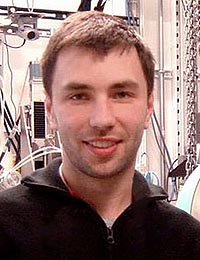 |
| Oleg G. Shpyrko has received the 2008 Rosalind Franklin Young Investigator Award from the Advanced Photon Source Users Organization. |
Abstract:
The Advanced Photon Source (APS) Users Organization has named Oleg G. Shpyrko as the recipient of the 2008 Rosalind Franklin Young Investigator Award. The award recognizes an important technical or scientific accomplishment by a young investigator that depended on, or is beneficial to, the APS. Shpyrko received the award during 2008 Users Week at the U.S. Department of Energy's (DOE) Argonne National Laboratory, where he will also present his work.
Shpyrko receives APS organization's Young Investigator Award
ARGONNE, IL | Posted on May 10th, 2008Shpyrko has been recognized for reaching a remarkably high level of achievement early in his career. He applied challenging surface and coherent X-ray scattering techniques to understanding the structure and dynamics of liquid metal surfaces and quantum states in condensed matter systems. He is also a dedicated and enthusiastic teacher.
He received his Ph.D. degree from Harvard University in 2004 under the direction of Peter Pershan; he then had postdoctoral fellowships at Harvard and the Center for Nanoscale Materials at Argonne National Laboratory before joining the faculty of the University of California, San Diego, Physics Department in 2007.
As a postdoctoral fellow at Argonne, Shpyrko studied domain wall fluctuations in antiferromagnets, technologically important materials used to tailor the properties of magnetic sensors in hard drive read heads. In antiferromagnets, magnetic properties form distinct regions called domains. Fluctuations in the domain boundaries or walls were expected to cause magnetic noise that could affect the material's performance, but characteristics of the domains rendered them invisible to conventional techniques.
Shpyrko applied a newly developed technique called X-ray photon correlation spectroscopy to observe fluctuations of these domain walls for the first time. He found that the magnetic noise cannot be eliminated.
The ability to observe domain wall fluctuation is important both for engineering tailored materials and for fundamental studies in condensed matter physics.
For his thesis work, Shpyrko resolved a long-standing controversy on whether atomic layering is unique to liquid metals. He used X-ray surface scattering techniques to compare the surface structure in high-surface-tension liquid metals with the surface structure in low-surface-tension alkali metals and nonmetallic liquids. The results showed layering in alkali metals but no layering in water. The observation indicates that layering is unique to metallic liquids and it arises from electronic properties rather than high surface tension.
Shpyrko has continued to study the surface properties of liquid metals, working in particular with gold silicide (AuSi), a solder used in nanoscale circuitry. In contrast to the previously observed behavior of other liquid alloys and pure liquid metals, a nondilute liquid eutectic gold-silicon alloy (Au82Si18) developed both a crystallized alloy "skin" and an ordered structure extending several atomic layers into the bulk. The "skin" remained an alloy, rather than segregating to a pure metal as in other liquid alloys. The results are important because properties at the nanoscale, including the effectiveness of AuSi as a nanoscale solder, are expected to depend heavily on surface effects.
Located at Argonne, the APS is a national synchrotron X-ray research facility funded by the U.S. Department of Energy, Office of Science, Office of Basic Energy Sciences. The APS provides the brightest X-ray beams in the Western Hemisphere to more than 5,000 scientists worldwide.
####
About Argonne National Laboratory
Argonne National Laboratory brings the world's brightest scientists and engineers together to find exciting and creative new solutions to pressing national problems in science and technology. The nation's first national laboratory, Argonne conducts leading-edge basic and applied scientific research in virtually every scientific discipline. Argonne researchers work closely with researchers from hundreds of companies, universities, and federal, state and municipal agencies to help them solve their specific problems, advance America's scientific leadership and prepare the nation for a better future. With employees from more than 60 nations, Argonne is managed by UChicago Argonne, LLC for the U.S. Department of Energy's Office of Science.
For more information, please click here
Contacts:
Brock Cooper
630/252-5565
Copyright © Argonne National Laboratory
If you have a comment, please Contact us.Issuers of news releases, not 7th Wave, Inc. or Nanotechnology Now, are solely responsible for the accuracy of the content.
Bookmark:


| Related News Press |
News and information
 Quantum computer improves AI predictions April 17th, 2026
Flexible sensor gains sensitivity under pressure April 17th, 2026
A reusable chip for particulate matter sensing April 17th, 2026
Detecting vibrational quantum beating in the predissociation dynamics of SF6 using time-resolved photoelectron spectroscopy April 17th, 2026
Laboratories
Researchers develop molecular qubits that communicate at telecom frequencies October 3rd, 2025
A battery’s hopping ions remember where they’ve been: Seen in atomic detail, the seemingly smooth flow of ions through a battery’s electrolyte is surprisingly complicated February 16th, 2024
Announcements
A fundamentally new therapeutic approach to cystic fibrosis: Nanobody repairs cellular defect April 17th, 2026
UC Irvine physicists discover method to reverse ‘quantum scrambling’ : The work addresses the problem of information loss in quantum computing system April 17th, 2026
Grants/Sponsored Research/Awards/Scholarships/Gifts/Contests/Honors/Records
Quantum computer improves AI predictions April 17th, 2026
Detecting vibrational quantum beating in the predissociation dynamics of SF6 using time-resolved photoelectron spectroscopy April 17th, 2026
Metasurfaces smooth light to boost magnetic sensing precision January 30th, 2026
 |
||
 |
||
| The latest news from around the world, FREE | ||
 |
||
|
|
||
| Premium Products | ||
 |
||
|
Only the news you want to read!
Learn More |
||
 |
||
|
Full-service, expert consulting
Learn More |
||
|
|
||