Home > Press > Nanosieves save energy in biofuel production
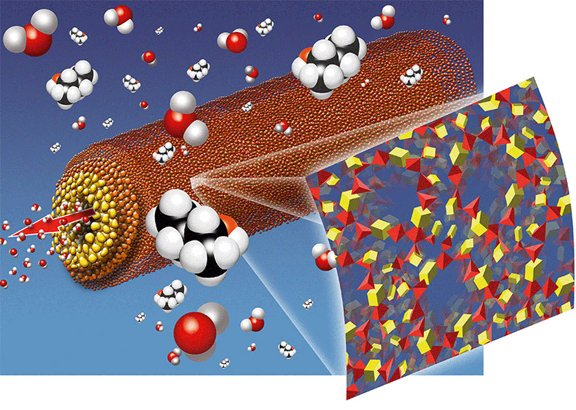 |
| The cylinder is the carrier of a hybrid membrane: a layer of about 100 nanometer thickness. The insert shows a close-up of the layer showing the organic links and pores. From the left of the tube, only water molecules leave the sieve. |
Abstract:
A new type of membrane, developed by scientists of the University of Twente in The Netherlands, can stand high temperatures for a long period of time. This ‘molecular sieve' is capable of removing water out of e.g. solvents and biofuels. It is a very energy efficient alternative to existing techniques like distillation. The scientists, who cooperated with colleagues from the Energy research Centre of the Netherlands (ECN) and the University of Amsterdam, present their invention in Chemical Communications of this week.
Nanosieves save energy in biofuel production
Netherlands | Posted on February 8th, 2008ven after testing during 18 months, the new membranes prove to be highly effective, while having continuously been exposed to a temperature of 150 ºC. Existing ceramic and polymer membranes will last considerably shorter periods of time, when exposed to the combination of water and high temperatures. The scientists managed to do this using a new ‘hybrid' type of material combining the best of both worlds of polymer and ceramic membranes. The result is a membrane with pores sufficiently small to let only the smallest molecules pass through.
Ceramic membranes, made of silica, degrade because they react with water and steam. In the new membrane, part of the ceramic links is therefore replaced by organic links. By doing this, water doesn't have the chance to ‘attack' the membranes. Manufacturing the new hybrid membranes is simpler than that of ceramic membranes, because the material is flexible and will not show cracks. What they have in common with ceramic membranes is the rapid flow: an advantage of this is that the membrane surface can be kept small.
The hybrid membranes are suitable for ‘drying' solvents and biofuels, an application for which there is a large potential market worldwide. The main advantage of membrane technology is that it consumes far less energy than common distillation techniques. The scientists also foresee opportunities in separating hydrogen gas from gas mixtures. This implies a broad range of applications in sustainable energy. Apart from that, the hybrid membranes are suitable for desalinating water. Using a hybrid membrane that is much smaller than the current polymer membranes, the same result can be achieved.
The results have been achieved in a close cooperation of scientists from the Inorganic Materials Science Group of the MESA+ Institute for Nanotechnology (UT), the Energy Efficiency in Industry department of ECN and the University of Amsterdam. The invention has been patented worldwide.
The article ‘Hybrid ceramic nanosieves: stabilizing nanopores with organic links' by Hessel Castricum, Ashima Sah, Robert Kreiter, Dave Blank, Jaap Vente and André ten Elshof has been published in Chemical Communications (ChemComm) of the Royal Society of Chemistry in de UK.
####
About University of Twente
The University of Twente is the site of a broad range of research projects in technological, scientific and social scientific disciplines. Research at the UT is mainly of a ‘fundamental-strategic’ nature: it focuses on issues which break fresh scientific ground and, at the same time, respond to needs in society. It is impossible to imagine research at the UT without this focus on practical usage. It underlies numerous new applications, appliances, systems and methods. In addition, the UT is a place for fundamental research, spurred on by the curiosity of its scientists.
For more information, please click here
Contacts:
University of Twente
Wiebe van der Veen
Phone +31 53 4894244
ECN
Florentine de Maar
Phone +31 224 564050
Copyright © University of Twente
If you have a comment, please Contact us.Issuers of news releases, not 7th Wave, Inc. or Nanotechnology Now, are solely responsible for the accuracy of the content.
Bookmark:


| Related Links |
 Hybrid ceramic nanosieves: stabilizing nanopores with organic links
| Related News Press |
News and information
Quantum computer improves AI predictions April 17th, 2026
Flexible sensor gains sensitivity under pressure April 17th, 2026
A reusable chip for particulate matter sensing April 17th, 2026
Detecting vibrational quantum beating in the predissociation dynamics of SF6 using time-resolved photoelectron spectroscopy April 17th, 2026
Discoveries
Quantum computer improves AI predictions April 17th, 2026
Flexible sensor gains sensitivity under pressure April 17th, 2026
A reusable chip for particulate matter sensing April 17th, 2026
Detecting vibrational quantum beating in the predissociation dynamics of SF6 using time-resolved photoelectron spectroscopy April 17th, 2026
Announcements
A fundamentally new therapeutic approach to cystic fibrosis: Nanobody repairs cellular defect April 17th, 2026
UC Irvine physicists discover method to reverse ‘quantum scrambling’ : The work addresses the problem of information loss in quantum computing system April 17th, 2026
 |
||
 |
||
| The latest news from around the world, FREE | ||
 |
||
|
|
||
| Premium Products | ||
 |
||
|
Only the news you want to read!
Learn More |
||
 |
||
|
Full-service, expert consulting
Learn More |
||
|
|
||