Home > Press > DHBW Heidenheim applies µCT scanning to study reinforced plastics under various environmental conditions using a Peltier Coolstage from Deben
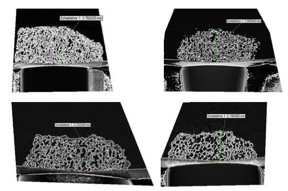 |
| 3D images of density and pore-size measurements of an organic specimen: upper left -14.5 °C; upper right 40.0 °C; lower left 100.0 °C; lower right 160.0 °C |
Abstract:
Deben, a leading provider of in-situ testing stages together with innovative accessories and components for electron microscopy, reports on the application of their CT-Cool stage at the Steinbeis Center for Non-destructive Testing and Measurement, located at the DHBW Heidenheim, Germany. It is being used to study the behaviour of various plastic materials under different temperature conditions.
DHBW Heidenheim applies µCT scanning to study reinforced plastics under various environmental conditions using a Peltier Coolstage from Deben
Woolpit, UK | Posted on May 10th, 2016Professor Nico Blessing is Engineering Programme Director at the Baden-Württemberg Cooperative State University (DHBW) at Heidenheim. Located in the Steinbeis Center for Non-destructive Testing and Measurement, the research goals of the group include the analysis of the behavior of plastic materials. In particular, glass- and carbon-fiber reinforced parts are studied under variable temperature conditions. The aim of the research is to simulate environmental conditions of real life parts.
In situ testing of modern materials and measurement of complex parts under real environmental conditions like temperature, compression or tension is getting more and more relevant for the development of many products. This is particularly relevant in the automotive and aerospace industries. Several pan-European and national projects have been conducted in the last five years. Small and medium sized companies are interested in the results of this research because innovative materials such as composites are no longer just applied in these industries but also in areas such as leisure and sports.
Describing the background to obtaining a Deben stage, Professor Blessing spoke about the work of his students. “Over the last three years, my students have worked to develop two different stages. The first offered tension and compression measurements with variable force control up to 5 kN. The second provided environmental control with adjustable temperature and humidity. We then selected the Deben stages because these gave us high accuracy in terms of load and temperature. Also, the stage is perfectly adapted for use in our CT system, a Zeiss METROTOM 800.”
The work of the group is illustrated by this montage of four 3D images which show changes in density and pore size of an organic specimen at temperatures from -14.5 °C up to 160 °C.
The Deben Peltier stage for µXCT tomography systems allows samples to be imaged in freezing conditions. A dual layer polystyrene (optional carbon) window prevents icing and allows samples to be rapidly cooled to ‐20 °C. A variable height specimen holder allows samples to be placed at the optimum height for X‐Ray imaging and mounting adaptors are available for a range of µXCT stages. The cooling system is self-contained and does not require an additional water chiller. The connecting pipework is flexible and easily allows 360° rotation. To obtain full details of the Deben applications and product portfolio, please visit www.deben.co.uk.
####
About Deben
Deben are a UK precision engineering company specialising in the field of in-situ tensile testing, motion control and specimen cooling for microscopy applications. Established in 1986 and named after a Suffolk river, Deben now operate from a large, modern business unit in Woolpit near Bury St. Edmunds in Suffolk. The product groups are motor control systems, in-situ micro-tensile stages, Peltier heating & cooling stages, detectors for SEMs and electro-static beam blankers. The company also makes custom and OEM versions of these products to specifically meet customer requirements.
Deben provide consultancy, design and prototype manufacturing services. In house facilities include SolidWorks and SolidEdge 3D CAD and COSMOS finite element analysis software, CNC machining, electronics design and manufacture and software design using Visual C++, Microsoft.net and DirectX. Utilising these resources and experience, Deben manufacture products for OEMs and end users in the UK and overseas.
Deben UK Ltd. is a subsidiary company of UK based Judges Scientific plc.
For more information, please click here
Contacts:
Deben UK Limited
Brickfields Business Park
Old Stowmarket Road
Woolpit, Bury St Edmunds
Suffolk IP30 9QS, UK
T +44 (0)1359 244870
F +44 (0)1359 244879
www.deben.co.uk
Talking Science Limited
39 de Bohun Court
Saffron Walden
Essex CB10 2BA
T +44(0)1799 521881
M +44(0)7843 012997
www.talking-science.com
Copyright © Deben
If you have a comment, please Contact us.Issuers of news releases, not 7th Wave, Inc. or Nanotechnology Now, are solely responsible for the accuracy of the content.
Bookmark:


| Related Links |
| Related News Press |
News and information
 Quantum computer improves AI predictions April 17th, 2026
Flexible sensor gains sensitivity under pressure April 17th, 2026
A reusable chip for particulate matter sensing April 17th, 2026
Detecting vibrational quantum beating in the predissociation dynamics of SF6 using time-resolved photoelectron spectroscopy April 17th, 2026
Imaging
Simple algorithm paired with standard imaging tool could predict failure in lithium metal batteries August 8th, 2025
Discoveries
Quantum computer improves AI predictions April 17th, 2026
Flexible sensor gains sensitivity under pressure April 17th, 2026
A reusable chip for particulate matter sensing April 17th, 2026
Detecting vibrational quantum beating in the predissociation dynamics of SF6 using time-resolved photoelectron spectroscopy April 17th, 2026
Materials/Metamaterials/Magnetoresistance
First real-time observation of two-dimensional melting process: Researchers at Mainz University unveil new insights into magnetic vortex structures August 8th, 2025
Researchers unveil a groundbreaking clay-based solution to capture carbon dioxide and combat climate change June 6th, 2025
A 1960s idea inspires NBI researchers to study hitherto inaccessible quantum states June 6th, 2025
Institute for Nanoscience hosts annual proposal planning meeting May 16th, 2025
Announcements
A fundamentally new therapeutic approach to cystic fibrosis: Nanobody repairs cellular defect April 17th, 2026
UC Irvine physicists discover method to reverse ‘quantum scrambling’ : The work addresses the problem of information loss in quantum computing system April 17th, 2026
Tools
Metasurfaces smooth light to boost magnetic sensing precision January 30th, 2026
From sensors to smart systems: the rise of AI-driven photonic noses January 30th, 2026
Japan launches fully domestically produced quantum computer: Expo visitors to experience quantum computing firsthand August 8th, 2025
 |
||
 |
||
| The latest news from around the world, FREE | ||
 |
||
|
|
||
| Premium Products | ||
 |
||
|
Only the news you want to read!
Learn More |
||
 |
||
|
Full-service, expert consulting
Learn More |
||
|
|
||