Home > Press > The Translational Research Center at the University Hospital of Erlangen in Germany uses the ZetaView from Particle Metrix to quantify extracellular vesicles such as exosomes
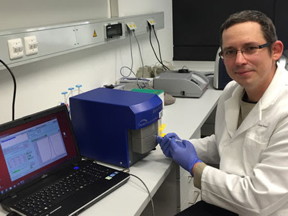 |
| Jochen Dindorf with his Zetaview particle characterization system from Particle Metrix |
Abstract:
Particle Metrix, developers of versatile particle characterization solutions for the life sciences, report on the work of the Baur Laboratory in the Department of Dermatology at the University Hospital of Erlangen. The Group, which is part of the Translational Research Center at the University, is working to quantify extracellular vesicles in plasma of patients.
The Translational Research Center at the University Hospital of Erlangen in Germany uses the ZetaView from Particle Metrix to quantify extracellular vesicles such as exosomes
Meersbusch, Germany | Posted on April 28th, 2016Andreas Baur leads a group in the Department of Dermatology at the University Hospital of Erlangen. Their research focuses on the quantification of extracellular vesicles (EV) in plasma of patients. The group has used several different approaches as recently demonstrated in their paper published in EBioMedicine1 (03/2016). This reported on the quantification of EV-derived microRNA, the measurement of protein concentration in sucrose fractions that contain EV and the measurement of particles in sucrose gradient fractions. This work has been performed using the ZetaView system from Particle Metrix. Used together, these parameters provide a rough estimate on the relative concentration of EV in plasma.
The Baur group chose the ZetaView system for microparticle characterization because it is the only way to get actual numbers of nanoparticles in a given solution. All other measuring methods are semi-quantitative at best. However, it is advisable to consider particle measurements not as absolute numbers unless serial dilutions have been made and measured and different patient samples have been compared and, these again have to be in a comparable range of particle numbers.
Prior to using ZetaView, they did not use any EV quantification tool/device, but rather measured the concentrations indirectly as outlined above. As principle user of the system, Jochen Dindorf, says, “ZetaView is the only way to get actual particle numbers, rather than a semi-quantitative assessment of EV in a given solution, e.g. by western blot or RNA quantification. I also find it an easy instrument to teach new users how to use. This is really useful for our lab.”
ZetaView allows the measurement of quantitative information on the number of particles in a particular preparation as well as basic physical information (i.e. size and zeta potential). To receive more details about Particle Metrix and their family of particle characterization solutions, please contact Particle Metrix on +49 (0)2150-705679-0, visit the web site: www.particle-metrix.de.
####
About Particle-Metrix GmbH
Particle-Metrix GmbH develops and manufactures instruments to characterize particles with a family of innovative analytical systems. Nanoparticle Tracking Analysis (Optical Particle Tracking), 180° dynamic light scattering and streaming potential charge mapping are employed to deliver answers on dispersion stability, zeta potential, charge density, particle size, molecular weight and concentration. Scattered and fluorescent light as well as electrical streaming potential signals are detected and analyzed to deliver rapid analyses for a broad range of materials.
The products are made in Germany and are distributed worldwide. These are backed with certification under DIN EN ISO 9001. A fast growing publications list from users in research and industry testify to the reliability and confidence of the product line and Particle-Metrix's competence to support them.
For more information, please click here
Contacts:
Particle-Metrix GmbH
Am Latumer See 11-13
40688 Meersbusch
Germany
T +49 (0)20150-705679-0
www.particle-metrix.de
Talking Science Limited
39 de Bohun Court
Saffron Walden
Essex CB10 2BA UK
T +44(0)1799 521881
M +44(0)7843 012997
www.talking-science.com
Copyright © Particle-Metrix GmbH
If you have a comment, please Contact us.Issuers of news releases, not 7th Wave, Inc. or Nanotechnology Now, are solely responsible for the accuracy of the content.
Bookmark:


| Related Links |
| Related News Press |
News and information
 Quantum computer improves AI predictions April 17th, 2026
Flexible sensor gains sensitivity under pressure April 17th, 2026
A reusable chip for particulate matter sensing April 17th, 2026
Detecting vibrational quantum beating in the predissociation dynamics of SF6 using time-resolved photoelectron spectroscopy April 17th, 2026
Imaging
Simple algorithm paired with standard imaging tool could predict failure in lithium metal batteries August 8th, 2025
Nanomedicine
A fundamentally new therapeutic approach to cystic fibrosis: Nanobody repairs cellular defect April 17th, 2026
New molecular technology targets tumors and simultaneously silences two ‘undruggable’ cancer genes August 8th, 2025
New imaging approach transforms study of bacterial biofilms August 8th, 2025
Electrifying results shed light on graphene foam as a potential material for lab grown cartilage June 6th, 2025
Discoveries
Quantum computer improves AI predictions April 17th, 2026
Flexible sensor gains sensitivity under pressure April 17th, 2026
A reusable chip for particulate matter sensing April 17th, 2026
Detecting vibrational quantum beating in the predissociation dynamics of SF6 using time-resolved photoelectron spectroscopy April 17th, 2026
Announcements
A fundamentally new therapeutic approach to cystic fibrosis: Nanobody repairs cellular defect April 17th, 2026
UC Irvine physicists discover method to reverse ‘quantum scrambling’ : The work addresses the problem of information loss in quantum computing system April 17th, 2026
Interviews/Book Reviews/Essays/Reports/Podcasts/Journals/White papers/Posters
A fundamentally new therapeutic approach to cystic fibrosis: Nanobody repairs cellular defect April 17th, 2026
UC Irvine physicists discover method to reverse ‘quantum scrambling’ : The work addresses the problem of information loss in quantum computing system April 17th, 2026
Nanobiotechnology
A fundamentally new therapeutic approach to cystic fibrosis: Nanobody repairs cellular defect April 17th, 2026
New molecular technology targets tumors and simultaneously silences two ‘undruggable’ cancer genes August 8th, 2025
New imaging approach transforms study of bacterial biofilms August 8th, 2025
Electrifying results shed light on graphene foam as a potential material for lab grown cartilage June 6th, 2025
 |
||
 |
||
| The latest news from around the world, FREE | ||
 |
||
|
|
||
| Premium Products | ||
 |
||
|
Only the news you want to read!
Learn More |
||
 |
||
|
Full-service, expert consulting
Learn More |
||
|
|
||