Home > Press > Patterning oxide nanopillars at the atomic scale by phase transformation
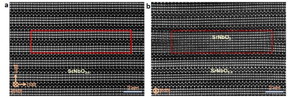 |
| Atomic zip in SrNbO3.4. (a) HAADF STEM image taken before irradiation. The irradiation area is marked by a red open rectangle. (b) HAADF STEM image taken after the electron irradiation for ~300 s showing changes in atomic structure in the irradiated region. The zigzag-like slab in the rectangle is transformed to a chain-like connected structure, resulting in atomic merging of the two neighboring chain-like slabs. The new phase has adopted the structure of SrNbO3. The phase transformation can be well controlled with atomic precision. CREDIT: Nano Letters |
Abstract:
Researchers at Tohoku University's Advanced Institute for Materials Research (AIMR) have carried out a collaborative study aimed at precisely controlling phase transformations with high spatial precision, which represents a significant step forward in realizing new functionalities in confined dimensions.
Patterning oxide nanopillars at the atomic scale by phase transformation
Sendai, Japan | Posted on October 15th, 2015The team, led by Prof. Yuichi Ikuhara, applied the focused electron beam of a scanning transmission electron microscope (STEM) to irradiate SrNbO3.4 crystals, and demonstrated a precise control of a phase transformation from layered SrNbO3.4 to perovskite SrNbO3 at the atomic scale.
Such a precise control of phase transformations opens up new avenues for materials design and processing, as well as advanced nanodevice fabrication. Full results of the study have been published in Nano Letters.
Background
Phase transformations in crystalline materials are of primary fundamental interest and practical significance in a wide range of fields, including materials science, information storage and geological science. To date, it remains highly desirable to precisely tailor the phase transformations in a material due to their potential impact on macroscopic properties and thus many advanced applications.
Despite decades of efforts, precisely controlling phase transformations at the atomic scale still poses a significant challenge due to the intricacies of governing thermodynamic conditions with atomic precision. Recent technical advances in aberration-corrected STEM offer fertile new ground for probing samples by a focused sub-Angström electron beam, opening an avenue for precisely triggering phase transformations.
Breakthrough
This work has demonstrated a successful control of a phase transformation from the layered SrNbO3.4 to the perovskite SrNbO3 with atomic precision by manipulating a focused sub-Angström electron beam to any selectable region.
Such a concept - of a precise control of phase transformations with an atomic spatial precision - should be, in principle, applicable not only to SrNbO3.4/SrNbO3 but also to other materials, finding applications in material processing and nanodevice fabrication.
Key points :
Precisely controlling phase transformation with high spatial precision
Patterning oxide nanopillars at the atomic scale by phase transformation
####
For more information, please click here
Contacts:
For information about the research:
Prof. Yuichi Ikuhara
Advanced Institute for Materials Research, Tohoku University
Institute of Engineering Innovation, The University of Tokyo
Tel: +81 3 5841-7688
Assist. Prof. Chunlin Chen and Assoc. Prof. Zhongchang Wang
Advanced Institute for Materials Research, Tohoku University
Email: chen.chunlinwpi-aimr.tohoku.ac.jp
Tel: +81 22 217-5933
For general enquiries:
Advanced Institute for Materials Research (AIMR), PR & Outreach Office
Tohoku University
Tel: +81 22 217-6146
Copyright © Tohoku University
If you have a comment, please Contact us.Issuers of news releases, not 7th Wave, Inc. or Nanotechnology Now, are solely responsible for the accuracy of the content.
Bookmark:


| Related Links |
| Related News Press |
News and information
 Quantum computer improves AI predictions April 17th, 2026
Flexible sensor gains sensitivity under pressure April 17th, 2026
A reusable chip for particulate matter sensing April 17th, 2026
Detecting vibrational quantum beating in the predissociation dynamics of SF6 using time-resolved photoelectron spectroscopy April 17th, 2026
Physics
UC Irvine physicists discover method to reverse ‘quantum scrambling’ : The work addresses the problem of information loss in quantum computing system April 17th, 2026
Chemistry
Projecting light to dispense liquids: A new route to ultra-precise microdroplets January 30th, 2026
From sensors to smart systems: the rise of AI-driven photonic noses January 30th, 2026
"Nanoreactor" cage uses visible light for catalytic and ultra-selective cross-cycloadditions October 3rd, 2025
Cambridge chemists discover simple way to build bigger molecules – one carbon at a time June 6th, 2025
Molecular Nanotechnology
Quantum pumping in molecular junctions August 16th, 2024
Scientists push the boundaries of manipulating light at the submicroscopic level March 3rd, 2023
First electric nanomotor made from DNA material: Synthetic rotary motors at the nanoscale perform mechanical work July 22nd, 2022
Discoveries
Quantum computer improves AI predictions April 17th, 2026
Flexible sensor gains sensitivity under pressure April 17th, 2026
A reusable chip for particulate matter sensing April 17th, 2026
Detecting vibrational quantum beating in the predissociation dynamics of SF6 using time-resolved photoelectron spectroscopy April 17th, 2026
Materials/Metamaterials/Magnetoresistance
First real-time observation of two-dimensional melting process: Researchers at Mainz University unveil new insights into magnetic vortex structures August 8th, 2025
Researchers unveil a groundbreaking clay-based solution to capture carbon dioxide and combat climate change June 6th, 2025
A 1960s idea inspires NBI researchers to study hitherto inaccessible quantum states June 6th, 2025
Institute for Nanoscience hosts annual proposal planning meeting May 16th, 2025
Announcements
A fundamentally new therapeutic approach to cystic fibrosis: Nanobody repairs cellular defect April 17th, 2026
UC Irvine physicists discover method to reverse ‘quantum scrambling’ : The work addresses the problem of information loss in quantum computing system April 17th, 2026
Interviews/Book Reviews/Essays/Reports/Podcasts/Journals/White papers/Posters
A fundamentally new therapeutic approach to cystic fibrosis: Nanobody repairs cellular defect April 17th, 2026
UC Irvine physicists discover method to reverse ‘quantum scrambling’ : The work addresses the problem of information loss in quantum computing system April 17th, 2026
 |
||
 |
||
| The latest news from around the world, FREE | ||
 |
||
|
|
||
| Premium Products | ||
 |
||
|
Only the news you want to read!
Learn More |
||
 |
||
|
Full-service, expert consulting
Learn More |
||
|
|
||