Home > Press > Leica SR GSD 3D Super-Resolution Microscope Voted Among Top 10 Innovations 2013 for Laboratories and Research: The Scientist Magazine Chooses Super-Resolution Microscope from Leica Microsystems as one of the Year's Best Innovations for the Second Time
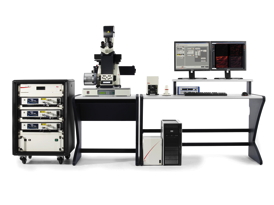 |
| The Leica SR GSD 3D super-resolution system for 3D localization microscopy attains a resolution of 20 nanometers in x and y and up to 50 nanometers in z direction. |
Abstract:
The Leica SR GSD 3D super-resolution microscope has been voted third among the Top 10 Innovations 2013 by the prestigious magazine The Scientist. The panel of judges, consisting of representatives from science, business, and the non-profit sector, selected the super-resolution system for 3D localization microscopy from more than 80 entries as one of the most innovative products with the potential to revolutionize life sciences.
Leica SR GSD 3D Super-Resolution Microscope Voted Among Top 10 Innovations 2013 for Laboratories and Research: The Scientist Magazine Chooses Super-Resolution Microscope from Leica Microsystems as one of the Year's Best Innovations for the Second Time
Wetzlar, Germany | Posted on December 9th, 2013The Leica SR GSD 3D enables scientists to visualize and study cellular structures and processes down to the molecular level. It is based on the GSDIM method (Ground State Depletion Microscopy followed by Individual Molecule Return), also known as dSTORM (direct Stochastic Optical Reconstruction Microscopy). Scientists can now study sub-cellular structures and protein-protein interactions, for example the nuclear pore complex, in both 2D and 3D - at highest resolution achievable to date in commercial widefield fluorescence microscopy. The Leica SR GSD 3D can achieve a resolution of 20 nanometers in the xy plane and 50 nanometers in the z axis. This capability provides new insights into biological systems and their functions, aiding in our understanding of disease processes and contributing to the development of new therapies.
At market launch in September 2013, the Leica SR GSD 3D scored excellent marks with scientists who tested the system and compared it to other imaging instruments. They certified the systems' outstanding precision in localizing single molecules, its system stability, optical performance, and ease of use. These qualities are essential for researchers to obtain reproducible results in the shortest time possible.
"This award highlights the impressive quality and performance of our high-resolution system and its importance for biomedical research - and it is a great reward for the whole team," comments Sebastian Tille, Director of Widefield Imaging, Life Science Division at Leica Microsystems. "We are all the more delighted with this award as the predecessor system had already won several awards for its innovation."
Launched in 2011, the predecessor Leica SR GSD was voted a Top 10 Innovation that year by The Scientist as well as the 2012 R&D100 Award and selected one of three 2012 R&D100 Editor's Choice Awards from R&D magazine. It was also awarded a 2012 Innovations Award by Microscopy Today, the magazine of the Microscopy Society of America.
With many years of experience developing STED (STimulated Emission Depletion) super-resolution technologies based on single point scanning confocal microscopy, Leica Microsystems has again raised the bar in nanoscopy with the Leica SR GSD 3D. The company continues its series of innovations with the new Leica TCS SP8 STED 3X, a confocal platform for 3D super-resolution that was recently presented - together with the Leica SR GSD 3D - at the Annual Meeting of the Society for Neuroscience in San Diego, CA, USA. Both will be shown as well from December 14 to 18 at the Annual Meeting of the American Society for Cell Biology in New Orleans, LA, USA.
####
For more information, please click here
Contacts:
Anja Schué
Claudia Müller
Ernst Leitz Strasse 17-37
35578 Wetzlar (Germany)
Tel. +49 6441 29-2201 / -2630
Fax +49 6441 29-2211
___________________________________________
Leica Microsystems GmbH
GmbH mit Sitz in Wetzlar
Amtsgericht Wetzlar HRB 5187
Geschäftsführer:
Andries Peter Jan van den Broek
Colin Davis
Cornelis Johannes Maria van Ophem
www.leica-microsystems.com
Copyright © Leica Microsystems GmbH
If you have a comment, please Contact us.Issuers of news releases, not 7th Wave, Inc. or Nanotechnology Now, are solely responsible for the accuracy of the content.
Bookmark:


| Related Links |
 Find out more about the Leica SR GSD 3D on the Leica Microsystems website:
Details of the Top 10 Innovations of 2013 can be found on the website of The Scientist at:
| Related News Press |
News and information
Quantum computer improves AI predictions April 17th, 2026
Flexible sensor gains sensitivity under pressure April 17th, 2026
A reusable chip for particulate matter sensing April 17th, 2026
Detecting vibrational quantum beating in the predissociation dynamics of SF6 using time-resolved photoelectron spectroscopy April 17th, 2026
Imaging
Simple algorithm paired with standard imaging tool could predict failure in lithium metal batteries August 8th, 2025
First real-time observation of two-dimensional melting process: Researchers at Mainz University unveil new insights into magnetic vortex structures August 8th, 2025
New imaging approach transforms study of bacterial biofilms August 8th, 2025
Videos/Movies
ICFO researchers overcome long-standing bottleneck in single photon detection with twisted 2D materials August 8th, 2025
Announcements
A fundamentally new therapeutic approach to cystic fibrosis: Nanobody repairs cellular defect April 17th, 2026
UC Irvine physicists discover method to reverse ‘quantum scrambling’ : The work addresses the problem of information loss in quantum computing system April 17th, 2026
Tools
Metasurfaces smooth light to boost magnetic sensing precision January 30th, 2026
From sensors to smart systems: the rise of AI-driven photonic noses January 30th, 2026
Japan launches fully domestically produced quantum computer: Expo visitors to experience quantum computing firsthand August 8th, 2025
 |
||
 |
||
| The latest news from around the world, FREE | ||
 |
||
|
|
||
| Premium Products | ||
 |
||
|
Only the news you want to read!
Learn More |
||
 |
||
|
Full-service, expert consulting
Learn More |
||
|
|
||