Home > Press > JPK reports on the use of the NanoTracker optical tweezers system at the Mechanobiology Institute at the National University of Singapore
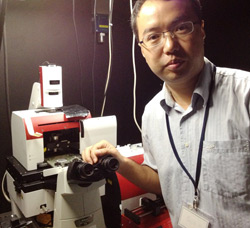 |
| Dr Hu Chen of the National University of Singapore with his JPK NanoTracker optical tweezers system |
Abstract:
JPK Instruments, a world-leading manufacturer of nanoanalytic instrumentation for research in life sciences and soft matter, reports on the Yan Jie single molecule biophysics research group at the Mechanobiology Institute of NUS and their use of optical tweezers.
JPK reports on the use of the NanoTracker optical tweezers system at the Mechanobiology Institute at the National University of Singapore
Berlin, Germany | Posted on June 4th, 2013The Mechanobiology Institute (MBI) of the National University of Singapore (NUS) was created through joint funding by the National Research Foundation and the Ministry of Education with the goal of creating a new research center in mechanobiology to benefit both the discipline and Singapore. Its' primary focus is to identify, measure and describe how the forces for motility and morphogenesis are expressed at the molecular, cellular and tissue level.
Dr Jie Yan is an associate professor in the Department of Physics of NUS and is a Principal Investigator of the MBI. His research is based on highly sensitive single-molecule manipulation and imaging techniques. It also requires understanding mechanics of biopolymers. One of his team, Dr Hu Chen, is a post-doctoral research fellow and he describes his topics of research. "We are doing single molecular biophysics studies. The projects cover DNA mechanics, protein-DNA interaction, chromatin dynamics, and cytoskeleton dynamics and force-sensing mechanism. We chose to use the JPK Instruments commercial NanoTracker® system to study the polymerization process of cytoskeletal fibers such as actin and microtubules by combining fluorescence and manipulation methods."
He continued: "Before purchasing the NanoTracker, our main tools were magnetic tweezers and AFM. Now with optical tweezers, we have a complimentary powerful system that combines manipulation of molecules, measurement of their force responses, as well as seeing them by fluorescence tagging. Such capability makes some difficult projects doable, and we already have some progress to see the polymerization process of actin fibers."
For single molecule manipulation, the group is using magnetic tweezers. For fluorescence imaging, they use TIRF microscope. AFM is also used to image DNA or protein/DNA complexes deposited on flat mica surfaces. As Dr Chen says, "Now with the JPK NanoTracker, we have a convenient means to combine both molecular manipulation with fluorescent imaging."
For more details about JPK's specialist products and applications for the bio and nano sciences, please contact JPK on +49 30533112070, visit the web site: www.jpk.com or see more on Facebook: www.jpk.com/facebook and on You Tube: www.youtube.com/jpkinstruments.
####
About JPK Instruments (JPK)
JPK Instruments AG is a world-leading manufacturer of nanoanalytic instruments – particularly atomic force microscope (AFM) systems and optical tweezers - for a broad range of applications reaching from soft matter physics to nano-optics, from surface chemistry to cell and molecular biology. From its earliest days applying atomic force microscope (AFM) technology, JPK has recognized the opportunities provided by nanotechnology for transforming life sciences and soft matter research. This focus has driven JPK's success in uniting the worlds of nanotechnology tools and life science applications by offering cutting-edge technology and unique applications expertise. Headquartered in Berlin and with direct operations in Dresden, Cambridge (UK), Singapore, Tokyo and Paris (France), JPK maintains a global network of distributors and support centers and provides on the spot applications and service support to an ever-growing community of researchers.
For more information, please click here
Contacts:
JPK Instruments AG
Bouchéstrasse 12
Haus 2, Aufgang C
Berlin 12435
Germany
T +49 30533112070
F +49 30 5331 22555
www.jpk.com
Bouchéstrasse 12
Haus 2, Aufgang C
Berlin 12435
Germany
T +49 30533112070
F +49 30 5331 22555
www.jpk.com
Talking Science Limited
39 de Bohun Court
Saffron Walden
Essex CB10 2BA
United Kingdom
T +44(0)1799 521881
M +44(0)7843 012997
www.talking-science.com
Copyright © JPK Instruments (JPK)
If you have a comment, please Contact us.Issuers of news releases, not 7th Wave, Inc. or Nanotechnology Now, are solely responsible for the accuracy of the content.
Bookmark:


| Related News Press |
News and information
 Quantum computer improves AI predictions April 17th, 2026
Flexible sensor gains sensitivity under pressure April 17th, 2026
A reusable chip for particulate matter sensing April 17th, 2026
Detecting vibrational quantum beating in the predissociation dynamics of SF6 using time-resolved photoelectron spectroscopy April 17th, 2026
Nanomedicine
A fundamentally new therapeutic approach to cystic fibrosis: Nanobody repairs cellular defect April 17th, 2026
New molecular technology targets tumors and simultaneously silences two ‘undruggable’ cancer genes August 8th, 2025
New imaging approach transforms study of bacterial biofilms August 8th, 2025
Electrifying results shed light on graphene foam as a potential material for lab grown cartilage June 6th, 2025
Announcements
A fundamentally new therapeutic approach to cystic fibrosis: Nanobody repairs cellular defect April 17th, 2026
UC Irvine physicists discover method to reverse ‘quantum scrambling’ : The work addresses the problem of information loss in quantum computing system April 17th, 2026
Tools
Metasurfaces smooth light to boost magnetic sensing precision January 30th, 2026
From sensors to smart systems: the rise of AI-driven photonic noses January 30th, 2026
Japan launches fully domestically produced quantum computer: Expo visitors to experience quantum computing firsthand August 8th, 2025
Nanobiotechnology
A fundamentally new therapeutic approach to cystic fibrosis: Nanobody repairs cellular defect April 17th, 2026
New molecular technology targets tumors and simultaneously silences two ‘undruggable’ cancer genes August 8th, 2025
New imaging approach transforms study of bacterial biofilms August 8th, 2025
Electrifying results shed light on graphene foam as a potential material for lab grown cartilage June 6th, 2025
 |
||
 |
||
| The latest news from around the world, FREE | ||
 |
||
|
|
||
| Premium Products | ||
 |
||
|
Only the news you want to read!
Learn More |
||
 |
||
|
Full-service, expert consulting
Learn More |
||
|
|
||