Home > Press > Advanced Raman Microspectroscopy Offered with Blue, Green, Red and Infrared Lasers
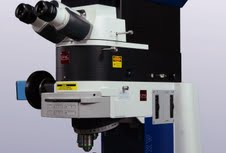 |
| CRAIC Apollo on 2020 Closeup |
Abstract:
CRAIC Technologies is a leading innovator in the field of optical microanalysis. CRAIC Technologies is proud to announce the addition of even more laser wavelengths to its state-of-the-art CRAIC Apollo™ Raman microspectrometer. Designed to be added to many different types of light microscopes, the CRAIC Apollo™ enables scientists and engineers to measure the Raman spectra from microscopic samples or microscope sampling areas of large samples. The CRAIC Apollo™ can even be added to a CRAIC Technologies microspectrophotometer adding Raman microspectroscopy to UV-visible-NIR absorbance, reflectance and fluorescence microspectroscopy and imaging. And because the CRAIC Apollo™ is now offered with lasers with peak wavelengths ranging from 405 nm through the 830 nm, a whole host of capabilities are now available to researchers and engineers including resonance Raman spectroscopy and more. Additionally, mulitple lasers can be combined on a single microscope for maximum experimental flexibility. By offering these new lasers for the CRAIC Apollo™ Raman spectrometer, CRAIC Technologies is able to supply you an even more powerful tool for sample micro-analysis.
Advanced Raman Microspectroscopy Offered with Blue, Green, Red and Infrared Lasers
San Dimas, CA | Posted on November 2nd, 2012 "CRAIC Technologies has been an innovator in the field of UV-visible-NIR microanalysis since its founding. We have helped to advance the field of microscale analysis with innovative instrumentation, software, research and teaching. We have seen the need for Raman microspectroscopy in addition to our current capabilities of UV-visible-NIR and luminescence microspectroscopy. Therefore, we created the CRAIC Apollo™ Raman microspectrometer based around a large number of different lasers." states Dr. Paul Martin, President of CRAIC Technologies. "And by combining the power of Raman spectroscopy with our UV-visible microspectrophotometers, the customer no longer has purchase a separate instrument, nor move the sample between instruments and acquire the data separately. You can analyze the same microscopic area of the sample under the same conditions without additional sample preparation or instrument alignment. Improved results and sample analysis throughput can be dramatically increased."
The CRAIC Apollo™ Raman microspectrometer is a self contained unit that features Raman grade lasers as the light source, an advanced optical interface to the microscope, a Raman spectrometer and sophisticated software for instrument control and data analysis. Lasers are now offered throughout the visible and near infrared region and include 405, 473, 488, 546, 638, 660, 785 and 830 nm. Each module can be used either individually or the modules may be combined so that mulitple laser wavelengths can be used to probe a single sample. The idea is to provide a highly flexible Raman microspectrometer with the optimum laser wavelengths to enhance your spectroscopic results. These rugged, self-contained units are also designed to be used either with an optical microscope or with a CRAIC Technologies microspectrophotometer. With high sensitivity, durable design, ease-of-use, multiple imaging and spectroscopic techniques and the support of CRAIC Technologies, the CRAIC Apollo™ is more than just a Raman microspectrometer...it is a key component to your analytical solution.
####
About CRAIC Technologies, Inc.
CRAIC Technologies, Inc. is a global technology leader focused on innovations for microscopy and microspectroscopy in the ultraviolet, visible and near-infrared regions. CRAIC Technologies creates cutting-edge solutions, with the very best in customer support, by listening to our customers and implementing solutions that integrate operational excellence and technology expertise. CRAIC Technologies provides answers for customers in forensic sciences, biotechnology, semiconductor, geology, nanotechnology and materials science markets who demand quality, accuracy, precision, speed and the best in customer support.
For more information, please click here
Contacts:
CRAIC Technologies, Inc.
+1-310-573-8180
Copyright © CRAIC Technologies, Inc.
If you have a comment, please Contact us.Issuers of news releases, not 7th Wave, Inc. or Nanotechnology Now, are solely responsible for the accuracy of the content.
Bookmark:


| Related News Press |
News and information
 Quantum computer improves AI predictions April 17th, 2026
Flexible sensor gains sensitivity under pressure April 17th, 2026
A reusable chip for particulate matter sensing April 17th, 2026
Detecting vibrational quantum beating in the predissociation dynamics of SF6 using time-resolved photoelectron spectroscopy April 17th, 2026
Imaging
Simple algorithm paired with standard imaging tool could predict failure in lithium metal batteries August 8th, 2025
Announcements
A fundamentally new therapeutic approach to cystic fibrosis: Nanobody repairs cellular defect April 17th, 2026
UC Irvine physicists discover method to reverse ‘quantum scrambling’ : The work addresses the problem of information loss in quantum computing system April 17th, 2026
Tools
Metasurfaces smooth light to boost magnetic sensing precision January 30th, 2026
From sensors to smart systems: the rise of AI-driven photonic noses January 30th, 2026
Japan launches fully domestically produced quantum computer: Expo visitors to experience quantum computing firsthand August 8th, 2025
Photonics/Optics/Lasers
Metasurfaces smooth light to boost magnetic sensing precision January 30th, 2026
From sensors to smart systems: the rise of AI-driven photonic noses January 30th, 2026
 |
||
 |
||
| The latest news from around the world, FREE | ||
 |
||
|
|
||
| Premium Products | ||
 |
||
|
Only the news you want to read!
Learn More |
||
 |
||
|
Full-service, expert consulting
Learn More |
||
|
|
||