Home > Press > White House Announces 2007 National Medal of Science Laureates
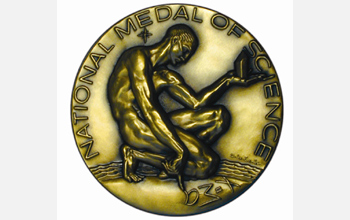 |
| President George W. Bush has named the recipients of the 2007 National Medal of Science, the nation's highest honor for science and engineering.
Credit: NSF |
Abstract:
President George W. Bush has named the recipients of the 2007 National Medal of Science, the nation's highest honor for science and engineering. Honorees will receive the medals at a White House ceremony on Sept. 29, 2008.
White House Announces 2007 National Medal of Science Laureates
Arlington, VA | Posted on September 5th, 2008"The 2007 National Medal of Science laureates have contributed to American science with their superb research," said Arden L. Bement, Jr., director of the National Science Foundation (NSF). "Their legacies have impacted our lives in numerous ways, from developing new therapies for diseases such as cancer to contributing to the development of the Internet and wireless communications. Their accomplishments reflect the high significance of this award."
The National Medal of Science honors individuals in a variety of fields for pioneering scientific research that has led to a better understanding of the world around us as well as to innovations and technologies that give the United States its global economic edge.
The award was established by Congress in 1959 and is administered by NSF. For more information about the National Medal of Science visit http://www.nsf.gov/od/nms/medal.jsp
The 2007 Laureates are:
Biological Sciences
* Robert J. Lefkowitz, Duke University, for his research into understanding the largest, most important and most therapeutically accessible receptor system that controls the body's response to drugs and hormones.
* Bert W. O'Malley, Baylor College of Medicine in Houston, Texas, for his work on the molecular mechanisms of steroid hormone action and hormone receptors and coactivators which has had a profound impact on our knowledge of steroid hormones in normal development and in diseases.
Chemistry
* Mostafa El-Sayed, Georgia Institute of Technology, for his contributions to our understanding of the electronic and catalytic properties of nanostructures and nanomaterials.
Engineering
* Leonard Kleinrock, University of California, Los Angeles, for fundamental contributions to the mathematical theory of modern data networks, including the functional specification of packet switching which is the foundation of the Internet Technology.
* Andrew J. Viterbi, University of Southern California, for the development of the maximum-likelihood algorighm for convolution coding, and for fundamental contributions to wireless technology.
Physical Sciences
* Fay Ajzenberg-Selove, University of Pennsylvania, for her contributions in nuclear physics that have advanced research into applications including energy generation from fusion, dating of artifacts, and nuclear medicine.
* Charles Slichter, University of Illinois, Urbana-Champaign, for establishing nuclear magnetic resonance as a powerful tool to reveal the fundamental properties of molecules, liquids and solids, enabling the development of numerous modern technologies.
* David Wineland, National Institute of Standards and Technology in Boulder, Colo., for his outstanding leadership in the science of laser cooling and manipulation of ions, that have had multiple applications in modern physics.
The 2007 National Medal of Technology and Innovation Laureates will also be honored in September. For more information on that award, please visit
www.uspto.gov/web/offices/com/speeches/08-19-2008ir.htm
####
About National Science Foundation
The National Science Foundation (NSF) is an independent federal agency that supports fundamental research and education across all fields of science and engineering, with an annual budget of $6.06 billion. NSF funds reach all 50 states through grants to over 1,900 universities and institutions. Each year, NSF receives about 45,000 competitive requests for funding, and makes over 11,500 new funding awards. NSF also awards over $400 million in professional and service contracts yearly.
For more information, please click here
Contacts:
Media Contacts
Dana Topousis
National Science Foundation
(703) 292-7750
Program Contacts
Mayra Montrose
National Science Foundation
(703) 292-4757
Copyright © National Science Foundation
If you have a comment, please Contact us.Issuers of news releases, not 7th Wave, Inc. or Nanotechnology Now, are solely responsible for the accuracy of the content.
Bookmark:


| Related News Press |
News and information
 Quantum computer improves AI predictions April 17th, 2026
Flexible sensor gains sensitivity under pressure April 17th, 2026
A reusable chip for particulate matter sensing April 17th, 2026
Detecting vibrational quantum beating in the predissociation dynamics of SF6 using time-resolved photoelectron spectroscopy April 17th, 2026
Govt.-Legislation/Regulation/Funding/Policy
Quantum computer improves AI predictions April 17th, 2026
Metasurfaces smooth light to boost magnetic sensing precision January 30th, 2026
New imaging approach transforms study of bacterial biofilms August 8th, 2025
Announcements
A fundamentally new therapeutic approach to cystic fibrosis: Nanobody repairs cellular defect April 17th, 2026
UC Irvine physicists discover method to reverse ‘quantum scrambling’ : The work addresses the problem of information loss in quantum computing system April 17th, 2026
Grants/Sponsored Research/Awards/Scholarships/Gifts/Contests/Honors/Records
Quantum computer improves AI predictions April 17th, 2026
Detecting vibrational quantum beating in the predissociation dynamics of SF6 using time-resolved photoelectron spectroscopy April 17th, 2026
Metasurfaces smooth light to boost magnetic sensing precision January 30th, 2026
 |
||
 |
||
| The latest news from around the world, FREE | ||
 |
||
|
|
||
| Premium Products | ||
 |
||
|
Only the news you want to read!
Learn More |
||
 |
||
|
Full-service, expert consulting
Learn More |
||
|
|
||