Home > Press > Vintage wine bottles authenticated by high energy ion beam
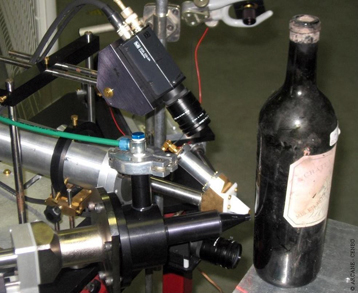 |
| © ARCANE-CENBG Authentication of the glass in a wine bottle by ion beam |
Abstract:
Arcane(1), the technological transfer unit at the Centre d'études nucléaires in Bordeaux Gradignan (CNRS-IN2P3(2)/University of Bordeaux 1) has signed an exclusive cooperation agreement with The Antique Wine Company(3), which specializes in the international vintage wine trade, to authenticate the glass in the bottles by ion beam analysis.
Vintage wine bottles authenticated by high energy ion beam
France | Posted on September 4th, 2008Just like works of art, wine is now being subjected to advanced testing to establish its authenticity: after measuring caesium 137 radioactivity levels to test the age of the wine, the glass in vintage wine bottles is now being tested by particle acceleration. The London-based company, which specializes in the international fine wine trade, has asked Arcane to find a way of assessing the age of some of the 10,000 bottles that the company buys or sells annually on behalf of its clients. It wants to offer its customer base a new authentication service for vintage wine. Arcane analyses the X-rays emitted when bottles are placed under an ion beam produced by the particle accelerator at the AIFIRA(4) platform. This enables researchers to verify the age and provenance of the bottles and thus to authenticate the vintage, rather like checking a painter's signature on a masterpiece, without opening the bottle or damaging the contents in any way.
The results obtained for the glass are then compared with the certified database set up by Arcane using data from the analysis of the glass from 80 bottles of red Bordeaux wine ranging from the 19th century to today, for the most part fine wines from St Émilion and the Médoc region. Authentication is possible because of both the complexity of the glass manufacturing process, which have evolved over time, and the diversity of glass-making production centers, which give each object a characteristic signature. Analysis by ion beam provides information about the age of the wine by dating its container, thereby overcoming some of the limitations of the caesium 137 radioactivity technique, which cannot be used to date wine produced before 1950.
The cooperation agreement(5) will initially cover the analysis of approximately 160 bottles from top châteaux and from the wine cellars of The Antique Wine Company, with most of the results being integrated into the Arcane database. A second phase will begin in November 2008, with the creation of an independent French-based company called «Vincert S.A.R.L»(6) offering commercial expertise services.
Notes:
1) Regional workshop for characterization by nuclear element analysis. Arcane is managed by ADERA (Association for the development of education and research in Aquitaine), which has signed a cooperation agreement with CNRS/University of Bordeaux 1.
2) IN2P3: CNRS's National institute of nuclear and particle physics
3) The London-based Antique Wine Company was set up 25 years ago by Stephen Williams. It manages a portfolio of some of the most prestigious wine cellars in the world for its 17,000 clients in 67 countries: www.antique-wine.com
4) Platform for cross-disciplinary ion beam applications in the Aquitaine region. To find out more: View web site
www.in2p3.fr/presse/communiques/archives/2005/14_inauguration_aifira.htm
5) The ten-year agreement was signed on 2 March 2008.
6) To find out more about Vincert SARL : View web site www.vincert.com/register.php
####
About CNRS
The Centre National de la Recherche Scientifique (National Center for Scientific Research) is a government-funded research organization, under the administrative authority of France's Ministry of Research.
For more information, please click here
Contacts:
Researcher
Hervé Guégan
[33] (0)5 57 12 08 88
Public Information Officer
CNRS
Laetitia Louis
[33] (0)1 44 96 51 37
The Antique Wine Company
Julie Turner
[44] (0)207 359 1109
Copyright © CNRS
If you have a comment, please Contact us.Issuers of news releases, not 7th Wave, Inc. or Nanotechnology Now, are solely responsible for the accuracy of the content.
Bookmark:


| Related News Press |
News and information
 Quantum computer improves AI predictions April 17th, 2026
Flexible sensor gains sensitivity under pressure April 17th, 2026
A reusable chip for particulate matter sensing April 17th, 2026
Detecting vibrational quantum beating in the predissociation dynamics of SF6 using time-resolved photoelectron spectroscopy April 17th, 2026
Announcements
A fundamentally new therapeutic approach to cystic fibrosis: Nanobody repairs cellular defect April 17th, 2026
UC Irvine physicists discover method to reverse ‘quantum scrambling’ : The work addresses the problem of information loss in quantum computing system April 17th, 2026
Food/Agriculture/Supplements
New imaging approach transforms study of bacterial biofilms August 8th, 2025
SMART researchers pioneer first-of-its-kind nanosensor for real-time iron detection in plants February 28th, 2025
 |
||
 |
||
| The latest news from around the world, FREE | ||
 |
||
|
|
||
| Premium Products | ||
 |
||
|
Only the news you want to read!
Learn More |
||
 |
||
|
Full-service, expert consulting
Learn More |
||
|
|
||